




SUMITA GHOSE
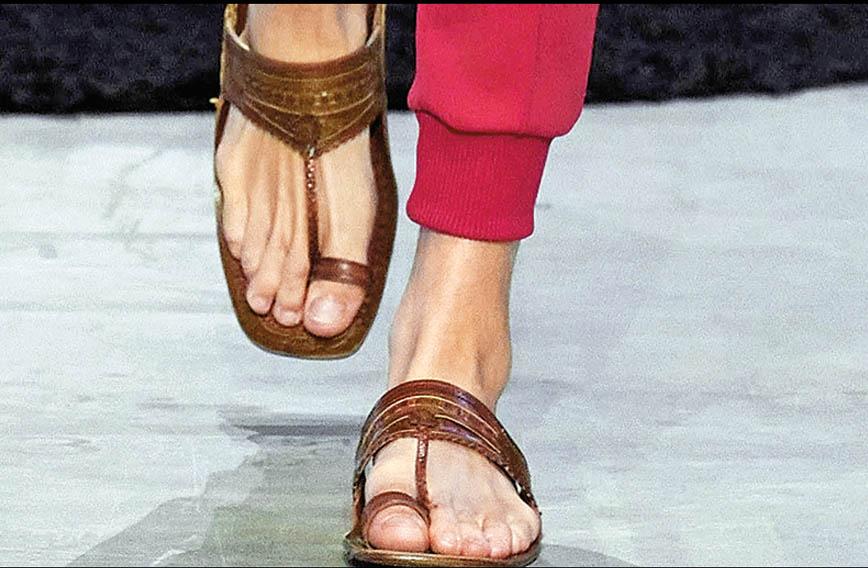
Prada, the renowned Italian luxury fashion house, recently created a controversy over its Spring/Summer 2026 menswear collection at Milan Fashion Week, which featured leather sandals that closely resembled India’s traditional Kolhapuri chappals.
What was the hullabaloo about? More important, what will be the fallout of this? Will the noise die down and will Prada just abandon their experiment with the chappals? Leaving the makers of Kolhapuri chappals in India with their meagre earnings? Or will we as Indians wake up, and become aware of the talent and traditional knowledge that has been passed down from generation to generation with very little support from the powers that be?
I wore Kolhapuri chappals frequently during my college days in Bombay. They were available at roadside stalls in Colaba Causeway, a stone’s throw from college. They looked delicate yet elegant, and were easy to wear and walk around in on the streets of Mumbai. They were, and still are, easy on the pocket. They could always be fixed by the mochi working on the pavement, if a strap or some stitches came off. Of course, innovations, maybe like a rubber sole, would have probably helped make the chappals more comfortable, especially during the rainy season, but that would require investment in appropriate technology in the villages where the artisans practise their craft.

So, what was the controversy about? First, Prada featured the footwear on the runway but did not acknowledge the Kolhapuri craft nor the craftspersons. Second, the price of the Kolhapuri chappals was estimated at around `1.2 lakh, whereas locally they are available anywhere between `300 and `1,800.
The reactions
The Maharashtra Chamber of Commerce, Industry and Agriculture officially alerted Prada that its runway sandals closely resembled GI (Geographical Indication)-protected Kolhapuri chappals, emphasizing both the cultural importance and legal standing of the product.
Some in the design and craft fraternity are indignant about design appropriation and Intellectual Property Rights (IPR). The reality is that most crafts in our country are practised by communities due to the entrenched caste system that still operates in large parts of the country. And most craftspeople do not want their children to practise crafts, due to the low recognition everyday handcrafted products receive in India.
While many craftspeople and handloom weavers do continue practising their craft, a large number do so because of very few livelihood options in their villages. Craft collectives have survived because of efforts made by community-based organizations (non-government, or non-profits) in mobilization, training, and in product development to suit contemporary market demand, and in marketing and organization building. With support from government programmes, from independent foundations, both local and global, and often led by social entrepreneurs, some have managed to not only survive but thrive.
As Indians we can do so much more. Handicrafts and handlooms are the second largest provider of employment after agriculture for rural Indians. India has an amazing textile and craft heritage, second to no other country. Yes, colonization, industrialization and ruthless unhealthy competition have driven away many craftspeople to other occupations.
It has sadly forced many to take up jobs as faceless and sometimes voiceless workers in factories, or on road and building construction sites, but handmade craft has survived — even if to decorate one’s home or make a gift for a child, friend or family member. It is our responsibility as customers, as buyers in the biggest market in the world to show more respect, and appreciation for handcrafted products by choosing them.

Shivraj Soudagar who runs the Athani Kolhapuri Chappal Cluster, a micro industry that produces footwear in Belagavi, said to The Hindu:
“Everyone is blaming Prada for basing its designs on the Kolhapuri chappal. But I think they have done us a favour by taking our brand and making it global….Leaders and government officers are talking about taking Prada to court. But we would like them to help us improve our designs and sell them. I want Prada to realise that an average chappal maker in Athani, Nippani or surrounding villages like Madabhavi earns between `250 to `400 per pair. The middlemen who transport those goods sell them for `1,500 to `2,000 per pair in Pune and Mumbai. The retailer sells them for up to `4,000 a pair.
“We would like a system where our goods are exported and the profits shared with us. If the Italian company is selling them for over one lakh rupees, we would be happy even if we get 10 percent of that amount.”
Sumita Ghose is founder-director of Rangsutra Crafts
Comments
Currently there are no Comments. Be first to write a comment!