



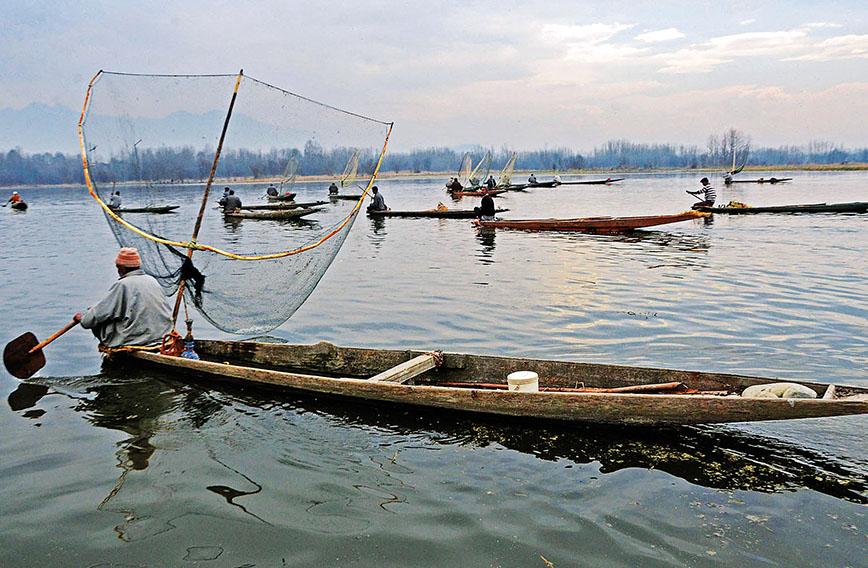
Snowtrout is no longer abundant in the Wullar lake due to pollution, sand mining and habitat loss | Photo: Civil Society/Bilal Bahadur
Wullar Lake loses fish species in pollution onslaught
Jehangir Rashid
Srinagar
From 70 species of fish to just four. That’s the state of Wullar lake, say worried fisherfolk. Fifteen species exist, says the Department of Fisheries. Fisherfolk say no, they can spot just four. How many species of fish populate the lake is, it seems, a matter of conjecture. But what is indisputable is the terminal decline of the picturesque Wullar lake, one of India’s largest freshwater lakes, in North Kashmir’s Bandipora district.
Sullied by pollution, throttled by encroachments, and scuffed by sand mining, the lake’s ecosystem is being further ruined by a mafia that kills fish with electric shocks instead of using nets to catch fish, say fisherfolk. The local fisherfolk’s union and the Nature Conservancy Alliance (NCA) have expressed alarm over the state of the lake and of the Jhelum river which feeds it freshwater.
In October, the sight of a large number of dead snowtrout (Schizothorax) floating in several stretches of the Jhelum caused widespread alarm. “This cold-water fish species, once abundant, has been declining rapidly due to water pollution, habitat loss and unregulated sand extraction. The Department of Fisheries has failed to conduct or make public a scientific investigation into the cause of this worrying incident,” points out Ghulam Hassan Bhat, president of the Mahigeer and Singhara Association.

“When fish die in silence, it is not only an ecological warning — it is the slow death of our culture and livelihood,” says Bhat, who fears the entire aquatic system of the lake and river might collapse. Inaction by the fisheries department has eroded trust in it as well as hope that the systemic degradation of the lake will be halted. Bhat demands a transparent inquiry into the causes of lake degradation and seeks restoration of fish habitats before the decline becomes irreversible.
Naseer Ahmad Dar, a fisherman, said residents of 33 villages living around Wullar are dependent on the lake for their livelihood. In 2012, a survey by the Wullar Conservation Management Authority (WCMA) estimated that around 100,000 people depended on the lake for their livelihood. That number has climbed to 200,000 people comprising 33,000 families.
Bhat flagged the rampant use of electric shock fishing. It has emerged as one of the gravest threats to aquatic biodiversity in the region, he said.
“The use of electric equipment to kill fish en masse destroys breeding populations, wipes out juvenile fish and leads to long-term ecological imbalance. It is not the first time that electric shocks have been used to kill fish. It’s been going on for many years. The concerned authorities are turning a blind eye to this practice for reasons best known to them,” says Bhat.
There are around 5,000 to 6,000 registered fishermen who fish in Wullar lake. Bhat says that two pieces of equipment used by the electric shock mafia were seized by the Department of Fisheries but no FIR was registered. He says that according to the concerned authorities there is no legislation under which the electric shock mafia can be booked.
“Electric shock fishing is ecological terrorism. It is a crime not just against nature, but against the communities who live by these waters. The state must act decisively. It should seize illegal equipment, prosecute violators and protect the remaining biodiversity of Wullar lake and the Jhelum,” says Dr Shaikh Ghulam Rasool, a well-known climate
justice activist and conservationist with
the NCA. He alleges that the deputy commissioner of Bandipora was requested to act against such violators but no action has been taken so far.
However, Ghulam Mohi-ud-din, joint director, Department of Fisheries, dismissed such charges. He said incidents of electric shock being used to kill fish were not many. The department is currently facing a shortage of manpower and at times it gets difficult to catch the culprits, he explained.
“There are some mischievous elements in fishing activity. But they are a negligible number. The situation cannot be generalized. As and when we catch hold of such violators we take action against them and present a charge sheet in court,” said Mohi-ud-din.
The lake was once well known for its fish, water chestnuts and lotus stems (locally known as nadru). “It has now lost its glory due to untreated garbage, sewage, unregulated sand mining, as well as using electric shock to kill fish,” says Dar. He points out that due to lower production of fish, 70 to 80 percent of the fish in the local market has to be imported from other places to meet local demand.

Dar also attributes the death of fish species to shrinking oxygen levels in the lake. The water body has shrunk by around 50 percent, mostly due to encroachment, according to studies. Also, sand mining has been spreading from the Wullar and the Jhelum to other water bodies across the Kashmir Valley. The lake used to be a favourite habitat for migratory birds from different parts of the world but depletion of the water table has resulted in fewer bird species arriving at this wetland, says Dar.
The problem, he says, is that the government has been working in isolation to preserve the lake. Fisherfolk and their families need to be roped in and involved in its conservation. Cosmetic changes carried out to make Wullar a tourist attraction won’t help. It is a freshwater lake which needs scientific revival.
The other problem is encroachment. “Large-scale encroachments in the lake have severely altered its hydrology. These illegal structures restrict fish movement, intensify siltation and degrade the lake’s natural resilience. The result is a shrinking wetland, rising pollution and collapsing fish productivity,” says Bhat.
“The restoration of traditional fishing zones and migration corridors, removal of all encroachments obstructing Wullar lake’s natural flow and representation of fisherfolk in all decision-making and monitoring committees related to fisheries, wetlands and aquatic resource management needs to be taken up at the earliest,” Bhat emphasizes.
Comments
Currently there are no Comments. Be first to write a comment!