



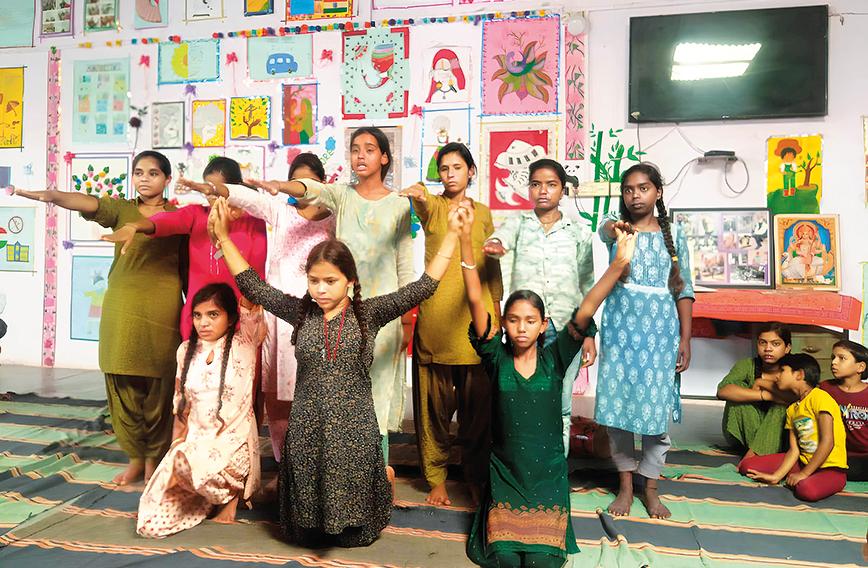
Working with adolescent girls has an impact
India’s gentle battle to end child marriage
Bharat Dogra, Barmer
A few years ago, a team from Action Aid, an NGO based in New Delhi, was journeying to several rural schools in Barmer district of Rajasthan to combat the pernicious practice of child marriage. One aspect of their campaign was to administer a pledge to male as well as female students that they would not agree to marry so young.
Halfway through the pledge the team realized that several students were feeling very uneasy. They stopped and enquired if anything was wrong. There was silence for a while. Then one boy spoke up: “How can we take this pledge of not marrying when we are already married?”
Caught on the wrong foot, the head of the team asked all those students who were married to raise their hands. Quite a few hands went up.
Many campaigners against child marriage face such awkward situations from time to time, reflecting the reality that despite decades of campaigns against child marriages this practice remains a significant reality in India as well as several other countries.
According to the National Family Health Survey (NFHS) data, child marriage declined in India from 47 percent in 2005-06 to 23 percent around 2020, inching closer to the world average of around 19 percent. India does not figure in the top 10 countries in terms of the rate of child marriages. Most of the countries listed are in Sub-Saharan Africa. However, due to India’s large size, plus neighbouring countries, South Asia has the highest number of women who were married before the age of 18 — 285 million, compared to 650 million for the rest of the world.

According to UNICEF, 25 million child marriages were prevented worldwide during the past decade, of which seven million were owed to declining trends and nearly 18 million to special efforts. UNICEF has also stated that the rate at which this reduction is taking place needs to be hiked significantly if the SDG (Sustainable Development Goal) target of eliminating child marriage is to be achieved by 2030.
India has achieved success but needs to do more. In November 2024, the Union Ministry for Women and Child Development started the Bal Vivah Mukt Bharat campaign (Campaign for Child Marriage Free India). This campaign involves nearly 160 voluntary organizations campaigning in over 300 districts which have a higher incidence of child marriage.
The target is to reduce the percentage of child marriages from about 23 percent in 2021 to 5 percent in 2030. One sign of hope is the growing number of voluntary organizations which are working, directly or indirectly, in various programmes for adolescent girls, especially for improving their education and health.
Prayas is one such organization known for its health, education and justice-based work among weaker sections, including Dalit and tribal communities in South Rajasthan. Its founder, Dr Narendra Gupta, says, “The best way of eliminating child marriage is to put much more effort and resources into extending the educational level of girls. Education should be accessible and attractive for the girls as well as their families.”
Prayas’ former director, reputed activist Khemraj Chaudhary, had started a residential educational centre for girls who faced obstacles in going to school in Chittorgarh district. Girls from remote villages are admitted to the school and efforts are made by teachers to ensure they catch up and soon join the appropriate class for their age. In fact, some girls are now going to college. The school has been made an attractive proposition with sports and extra-curricular activities.
A girl studying there said she was married off when she was eight years old. She didn’t know the boy or realize what was happening. Some months after the marriage, the boy died. Subsequently, rituals were performed to undo the earlier rituals, which too the girl did not understand. But the entire experience had a very distressing impact on her. Fortunately, she is now studying and has friends in whose company she can leave behind those memories and look forward to a new life.
Mahila Sangathan in Barmer district of West Rajasthan has been prioritizing curbing the incidence of child marriage in its work. Anita Soni, coordinator, says that the issue of child marriage involves sensitivities and so it is important to win the trust and goodwill of the communities.
Mahila Sangathan first won the trust of the women by being engaged with several issues beneficial to them. That helped them broach the subject of child marriage. Most of their meetings are with women, but in addition they have reached out to men who too have come out to support the campaign against child marriage.
Thanks to efforts like these, child marriages have come down significantly especially in Rajasthan which was once infamous for having the highest rate of child marriage in India. The government singled it out for special attention.
In the latest NFHS round, the child marriage rate in the state was found to be only marginally higher (25 percent) than the national average of around 23 percent. Moreover, the rate of reduction in Rajasthan during 2005-2021 was much faster than in the entire country.
While this achievement of Rajasthan is commendable, there are still instances of child marriage — coinciding with the Akshay Tritiya festival, or with certain ritualistic ceremonial occasions of several communities and castes.

The year 2005-06 was a landmark year as a national law to ban child marriage was passed. Under this law, marriage of girls below 18 years and boys under 21 years was prohibited. Subsequently, various states framed their own rules to implement the law. In the case of priority states like Rajasthan, directives were issued by the courts to bolster implementation of the law and fix responsibility for this clearly.
However, legislation can be effective only when it is supported by grassroots campaigns with people’s participation. Hence, the contribution of voluntary organizations and social movements which can win over the trust and support of people is critical. Even they have to be careful not to offend local sensitivities on socio-cultural issues.
Gopal Bhai, founder of ABSSS (Akhil Bharatiya Samaj Sena Sansthan), an organization working at the grassroots in Chitrakoot district of Uttar Pradesh, explains how a combination of overall positive trends, laws, policy decisions and efforts by voluntary organizations has worked to bring down the rate of child marriage.
Gopal Bhai and ABSSS have been working mainly among Kol tribal communities and Dalits of Manikpur block for over four decades. He says that at the start of their campaign, child marriages were quite widespread but are rare now. While laws have contributed, he says, so has the spread of education. One factor specific to this plateau and forested area called Patha is that earlier it was overrun by dacoit gangs who made the lives of villagers miserable, especially at night. Parents were therefore in a hurry to marry off their daughters at an early age. Once a crackdown on the dacoits began, security improved and the pressure to marry off girls young also eased.
“Since we were organizing regular meetings on social issues, there were conversations on what the law says about the age of marriage and the importance of girls’ education. Educated girls and women also visited the villages as a part of various programmes,” says Gopal Bhai.
“Earlier we concentrated more on ensuring elementary education for all by starting our own informal schools as there were very few government schools. Girls in particular did not go to schools if they were located at a distance. At a later stage, we placed more emphasis on girls completing secondary education. Girls who were educated, like Booti and Shyama, started teaching other girls and those like Sanjo won panchayat elections.”
He said the situation has improved to such an extent that about 18 girls in hamlets of Dalits and Kol tribals are now going to college. “We also try to facilitate their progress. Some girls are renting rooms in Manikpur on their own in order to be able to study further. This was unheard of earlier, not socially acceptable and not economically viable either. These girls in turn are inspiring other younger girls in their villages with their achievements and aspirations.”
This progress of girls’ education in remote villages helps create conditions in which child marriage has declining acceptability. “Parents are much less inclined to go in for child marriage. But what’s equally empowering is that chances of the girls themselves resisting this firmly are much higher.” ν
Comments
-

Porus Dadabhoy - Nov. 13, 2025, 6:27 p.m.
There was a recent article in the NY Times on this subject . Hare Krishna sect home schooled a girl 10 years old and got her married. A 13 year old muslim girl was married of to her cousin 26 year old. In the USA different states have different laws. It is banned in more than 20 states . I discussed this with League of Women Voters in Illinois and they were not aware that in our home state one could get married as young as 16 with both parental permission. India has 1.4 million cases wheras we have around 30,000. However teenage pregancy continues to be an issue and often results in abortion. Thank you coving this issue in India. Our high schools have sessions educating our girls not to indulge in premarital sex by the local and national health care departments that have good results with educational role playing. This should also be handled by India as a public health issue.