



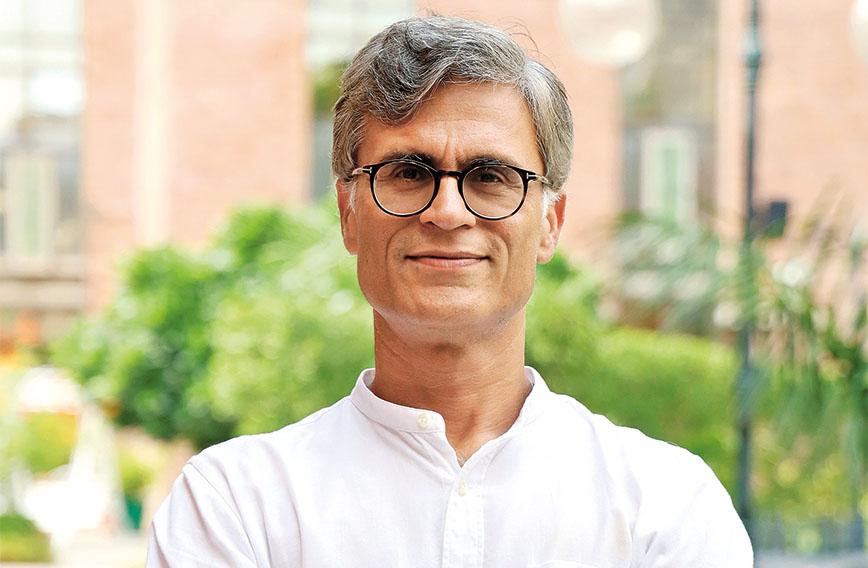
Sandeep Sachdeva: ‘We are solutions centric’
‘Workers losing fingers daily was shocking’
Civil Society News, Gurugram
IF you are feeling pleased about the car you drive, spare a thought for the workers who put it together for you. Some of them might have lost their fingers in the process.
Every year, a report titled Crushed, brought out by Safe In India, a non-profit, uncovers a large number of accidents taking place on shopfloors in the Indian automobile sector. The dangerous power press, used to shape metal parts, is mostly the cause of the injuries.
Workers, many of them young, end up maimed for life. They are inadequately compensated and invariably left to fend for themselves. Labyrinthine paperwork and official procedures are unleashed on them.
This is where Safe In India has been stepping in for the past 10 years or so. It began by opening a Worker Assistance Centre in Manesar, but is now addressing the needs of workers in many more parts of the country. Interestingly, the story is the same all over and Gurugram is no exception.
Safe In India also engages closely with automobile company managements in the hope of crafting solutions that extend deep into supply chains. It has taken time to motivate the companies, but improvements are visible.

To find out more, Civil Society spoke to Sandeep Sachdeva, CEO of Safe In India. A former banker, he set up the non-profit together with likeminded collegemates who, in midlife, were motivated to do something socially relevant.
Q: What made you take up the lack of safety in the Indian industrial sector and that too specifically in the automobile sector in Gurugram?
I was travelling to India quite often after I started my social sector life in 2013. I came across a news item which said that 20 workers a day in the auto sector lose their fingers in Gurugram alone. Initially I thought it was just noise. But it turned out to be true. I got together with three of my batchmates. We thought these accidents should not happen and we could help improve safety standards. But it was tough. None of us is from the working class. Labour is a challenging, overlooked and ignored sector.
We decided to help injured workers access healthcare and get compensation from the ESIC (Employees State Insurance Corporation) scheme and learn from the process.
We opened our first Worker Assistance Centre (WAC) in December 2016 in Manesar. And we started finding injured workers left, right and centre. For a couple of years, we just talked to them, helped them through the process, understood their lives and so on. And there were some insights that emerged.
We were very analytical about it. We started capturing that qualitative and quantitative data into an IT system. And what we found as we reached 1,000 workers whom we had assisted in 2018-19, was that 80 percent of them were getting crush injuries on their hands majorly from the auto sector supply chain. That’s what led us into the auto sector supply chain. What we had was an organic insight-driven, evidence-driven decision.
We started going into those supply chains and opened a second WAC in Faridabad where the problem was worse. Then we went to Pune. The same problem repeated itself. We opened a fourth centre in Gurugram and our fifth in Pune.
We are expanding into auto sector hubs. We just recruited somebody in Chennai to open our next centre there because Tamil Nadu has a large auto sector hub. After that we will go to Karnataka, then Gujarat. This covers 80 to 90 percent of the sector.
Q: Are you saying this situation prevails uniformly across the country in each auto hub?
We don’t just do surveys. We actually help these workers. We know them. We know their lives. Our surveys are not just data driven. We have gone to Rudrapur in Uttarakhand, to Gujarat, Chennai and Karnataka. There are similar stories everywhere. And the reason is the auto sector uses a lot of metal forming machines because they need those components. They are made in a machine called the power press. It is the power press which causes 65 percent of crush injuries. So, there is an engineering reason why these injuries are happening in the auto sector.
Q: Does this happen globally?
Metal forming in most countries and in developing, emerging markets leads to similar issues, but there is no data available to compare. Everywhere data is under-reported. In India, to give you an idea of under-reporting, Haryana has been reporting 50 accidents a year for the past 20 to 30 years. We, with just our six outreach executives, junior guys, go out into the community, and report more than 1,000 accidents a year. That’s the scale of under-reporting that only our data shows. God knows what the reality is out there.
Q: You are helping injured workers access ESIC compensation. Is there no recognition in the official system of the number of people that you were able to help?
No. People know that things are worse than what the data suggests. I think one of our big wins is the fact that we are robustly reporting this data, not based just on surveys but on real workers who get into the ESIC system to get their injuries and sicknesses treated. Our data shows that consistently, year after year, for the past seven years thousands of workers have been getting injured. It’s a well-established trend now.
Q: Isn’t it possible to prevent such injuries from taking place?
Once we started helping workers and got these insights, we started building our advocacy on workplace safety. Our advocacy also includes improving the ESIC quality of services, empowerment and communication. We have a Facebook page and YouTube channel in Hindi. For workplace safety we went to the top 10 brands in the country and told them, you have a problem and it’s your responsibility to fix this. You have profits, power, influence over the government and implementation of policies on the ground through corrupt and non-corrupt means, right? And you have the technical expertise as well as the moral and ethical responsibility as per global trends, ESG norms, and India’s national guidelines on responsible business conduct.
It’s taken us three years but now those 10 brands have been gradually engaging with us. Our report, Crushed, is bottom-up evidence of the data of accidents, their nature, the kind of migrant workers injured: 90 percent are young, 60 percent below 30 years, 70 percent on contract. And by brand: how many accidents by Maruti, Hero, Honda, Eicher, Ashok Leyland…
Two years after we started Crushed in 2019 and 2021, we launched another report called SafetyNiti because we realized that their policies were not good enough for supply chains. We began tracking, rating and ranking those policies.
We are solutions centric. Our first value is worker centricity, and second value is solutions centricity. We will come to you with the solutions. You make recommendations to your supply chain based on these recommendations. These top brands have started improving their policy framework.
For example, a supplier code of conduct is a critical document to improve safety in the supply chain. Two companies had that when we started. Now nine have it. They all have it in the public domain. So, they’re accountable to it.
We have implementation recommendations of Tier 2 audits. Maruti started reporting on Tier 2 audits, Bajaj started reporting on Tier 2 audits. We’ve created a platform for industrial safety and health. Maruti, Hero, Honda and Safe In India have done 30 audits and 80 percent failed. Some lessons came out of that.
As a result, in Haryana, where we started, accidents began declining in 2022 in four quarters and in 2023 in four quarters — that’s eight quarters in a row.
In 2024, accidents went up again a little but according to the industry it was because of growth. We haven’t published the 2025 data as yet. It has declined again. We had told the brands that until we see three years of consistent reduction, we will not believe it is being sustained.
Q: Is the rate of accidents lower in the south? Levels of industrialization, education, empowerment, etc are higher. But when it comes to worker accidents, has it made a difference?
We don’t know because our centres are in Maharashtra and Haryana right now. We are just setting up in Chennai so we will know in two years. We were surprised that Maharashtra was as bad as Haryana. In some places things were better, in others worse. We measure many things. For example, how many fingers on average are lost in these accidents? Broadly, average loss of fingers in the power press is two.
We measure ESIC compliance because we found a correlation with accidents. Companies that are unprofessional about assessing compliance are also unprofessional about safety standards. So, they are worse off. ESIC compliance in some areas is worse in Maharashtra. We are in Mohan Nagar and Chakan right now. We had thought Maharashtra will do better in everything because they’re more compliant about reporting accidents than Haryana. So, it’s a mixed bag.
Q: The car is not just a car, it’s also a brand which comes with so much more. When you approach a company with this kind of data, what is the response? What level of access are you given? Who do you talk to?
There’s a whole mix of people. When we started, R.C. Bhargava wrote back to us on our first report, promising action, and they did some great work for three years. At the other end of the spectrum — I won’t mention the brands — they made us meet their industrial relations people instead of the head of supply chain, or a director who’s in charge of Environmental, Social and Governance (ESG) compliance. But what I would say is that almost every brand has done something or the other in line with these requirements. There’s a spectrum in safety. We rate and rank them accordingly.
The number one trend, for example, is that Japanese companies, on average, have a better response than non-Japanese companies, sadly. That is a fact. The more Indian ownership a company has, the worse it is, despite being a global brand. That’s sadly true. The third is in terms of access. You see, SEBI (Securities and Exchange Board of India) now requires them to do a business responsibility and sustainability report (BRSR). That requires ESG reporting, including supply chain. But the supply chain doesn’t get reported as well.
We are doing a project for the Ministry of Corporate Affairs where the BRSR reports of the 50 listed top auto sector companies are being analysed by us. The report will come out later this year. The auto sector is now engaged with the ministry and there is access to the sector.
Santosh Gangwal, who was the first labour minister when we came in, had actually called industry, along with government bodies, to work on our report and come up with solutions. There’s engagement that happened at that level. But such engagement comes and goes, depending on how conscientious the person in charge is.
Q: In the equation between the regulator, in this case the government, and the management, it would appear that the management has the upper hand because the regulator, despite knowing all this is happening, is not able to take any action.
That’s a great point. I come from an industry background. What I’ve seen of politics in the past 20 years, worldwide, is that business has the upper hand. Whether it’s tech or the auto sector, business is ahead of government. Government is always trying to catch up. That’s what’s happening everywhere.
Even when the government makes regulations in India, the law is there but not the order. Who decides who will implement that order? Unless business wants to work with some conscientiousness, governments, especially in our country, are really not that powerful. On the other hand, they are also making their laws and regulations more business-friendly as opposed to being labour-friendly.

For example, in the labour codes, which are still not law and are still not implemented, there are some labour-friendly provisions. There should be annual medical tests of all workers. Nobody’s doing it. But the inspector in the government department is already operating like an inspector-cum-facilitator. He doesn’t have teeth anymore to do audits. There are no surprise audits. They are, in effect, consultants.
In the labour codes, the daily working hours are 12 hours. Previously it was eight hours with a cap of 48 hours. Right now, the 12-hour work day has become the norm and acceptable. Nobody can challenge that because for the labour courts that’s fine. Nobody’s monitoring the cap. Overtime should be twice the amount paid but nobody’s monitoring that either.
Q: The managements of these companies consist of people who get high salaries. Most of them come from the best institutions in the country. How come they can’t see this? How come they don’t act? How come a management guy with a one-crore salary doesn’t know what his supply chain is doing?
Yeah, they don’t have a philosophical issue here, right?
Q: So I’m asking you an even more blunt question. Do these people have blood on their hands?
Of course they do. Frankly, all of us do.
Q: No, that’s not answering the question. They run those companies, they run those managements, they access those supply chains.
The way I look at this issue is they are definitely responsible. Unfortunately, people like these professionals are slaves to their job description, and those job descriptions have only one major line — which is profit. Everything else is missing in terms of human or environmental impact.
The audits that happen on the supply chain are focused around quality, delivery and cost. It does not include safety of working conditions. Are they responsible for it? Absolutely. They are ignoring it. As a result, they are responsible for what’s happening.
Second, the supply chains are huge and powerful, and often corrupt. And it’s not just one sector. Supplier procurement departments are corrupt in lots of places all over the world. How do you expect a corrupt department to do things like workplace safety! I mean, philosophically, how does it go together? It doesn’t. They can’t say they don’t understand the problem. We have been telling them for eight years now. They’ve accepted the reports. So are they responsible for not solving it? Of course they are. ν
Comments
Currently there are no Comments. Be first to write a comment!