



At Saahas people get the skills they need
Rakesh Agrawal, Dehradun
The town of Saharanpur in Uttar Pradesh is well known for its fine woodcraft. In this male dominated ecosystem, a new unit sprang up sometime in 2017 — employing 15 people, including women and one experienced unemployed craftsman. Those who joined were given daily wages. Anyone needing work could get a job here. It was financed as a start-up, unusual for a tiny manufacturing unit.
“A friend of mine invested in the first woodcraft unit I set up. We simplified local designs and started making a range of products. But, yes, we do struggle to sell,” says Shahab Naqvi, who studied computer science and started Saahas Foundation Inclusive Resource Centre in 2017 to create employment for everyone: very low-income people, women, the marginalized and people with disabilities. Those who join are, of course, trained.
In eight years Naqvi has set up 12 units dotted across Uttarakhand’s hilly terrain and UP’s flatter terrain. Apart from woodcraft, there are units making paper craft with recycled paper, bamboo craft, carpentry and handloom products. Saahas has also forayed into tourism and built gharats or water mills which have boosted millet farming.

Prior to starting Saahas, Naqvi was steadily climbing the corporate ladder. With a master’s degree in computer science applications, he’d worked for a line-up of blue chip companies: HCL Technologies, Mphasis, Lenovo and then IL&FS Education and Technology Services where his nerdy career graph took a dramatic turn.
In June 2013 the Kedarnath flood disaster took place and he was called on by his company to assist in relief services. It was while helping people by providing education, skills training and implementing public schemes that he decided it was development at the grassroots that he wanted to be involved in. As an employee he didn’t have much say in how money for relief should be spent. He also came from a socially conscious family. “My father was a schoolteacher with Kendriya Vidyalaya who was deeply involved in the literacy mission,” he recalls.
 |
|
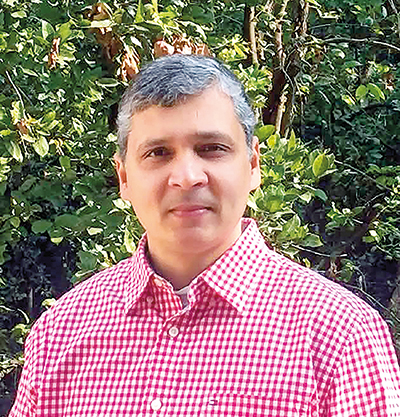
Shahab Naqvi |
It was also at this time that he met people with disability and their families. Naqvi’s ideas differ from what most disability rights activists expound. “Most people with disability are employable. In rural areas they are not abandoned or mistreated. On the contrary, disabled people are integrated into tightly knit family and community networks,” he observes. “The environment itself, lack of access to clean drinking water, sanitation or living conditions, produces disabling conditions.” Saahas’ approach is to unbox this distinction between ‘abled’ and ‘disabled’ and treat all the same.
Saahas now has a significant presence in the lower and mid-Garhwal Hills of Uttarakhand and adjacent districts in Uttar Pradesh. Their work combines insights from the community, skills education, environmentalism, entrepreneurship, and research.
“We have established a community-led, fully-equipped woodcrafts unit for training, demonstration, incubation, and employment,” says Captain Vippan Chhibbar (Retd), co-founder of Saahas. Other skills are also taught like carpentry, handmade paper, handloom and bamboo products. Also, skills like marketing, regulation, compliances, communications and so on are integrated into the hands-on course.
Agriculture is also a key focus area. Saahas markets and sells Himalayan grains, pulses and millets. It has revived five gharats or water turbine powered flour mills in the hills. Three are in Bunglow ki Kandi village near Mussoorie and two in Sahaspur village in Dehradun district.
The mills are a boon for women since they don’t have to travel miles in search of chakkis. The gharats easily grind mandua or ragi which Saahas packets and sells. A ready market has encouraged farmers to grow more millets. Saahas is working with 20 families in the lower and mid-Garhwal Hills to improve farming practices.
The other employment generating strategies include Saahas Nirman, an eco-tourism project which sets up homestays and identifies trekking routes. Sewa Atithi is a collective of women-run homestays, offering immersive village experiences. Two community-led rural homestays, employing seven to ten locals, have been set up in Bunglow ki Kandi.
The Saharanpur wood unit makes utility boxes in three sizes from hardwood which is naturally seasoned. Also racks, seats, boxes, customized frames, benches, study tables, bird houses, and designer woodcraft pieces blended with wrought and cast iron. “Our wood products are treated with natural oils and paints in such a way that they last for years. We understand wood behaviour,” says Tushar Thapa, a mentally challenged person. His mother died when he was three and his father abandoned him.
One handloom unit, in collaboration with Godambari Enterprises, a women-led handicraft association, has been set up in Johri village in Dehradun district. “Saahas Foundation trained me and four local artisans. We make cotton handloom fabrics which are bought by tourists. We also supply modern clothes to showrooms in Mussoorie. We earn a good income,” says 36-year-old Sunita Rana.

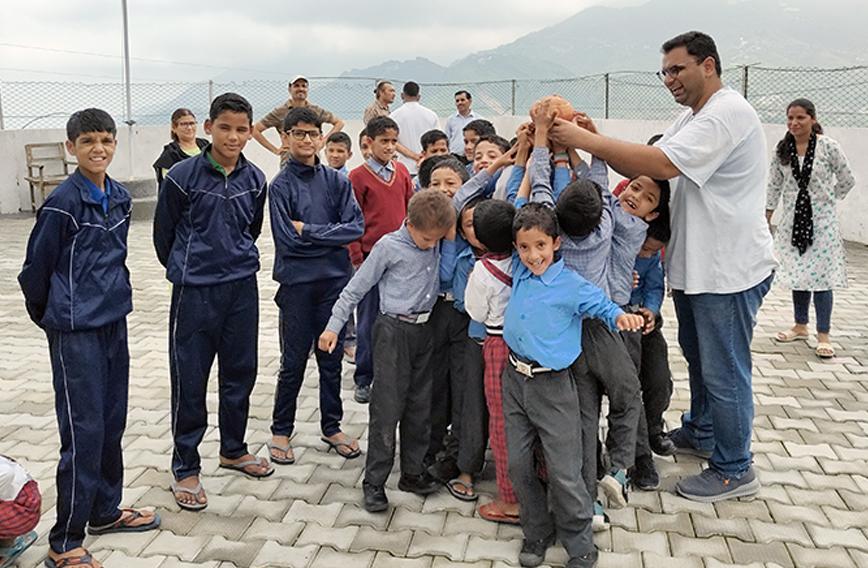
Saahas teaches skills in five government schools with around 500 schoolchildren. It engages them in art, craft, and life skills like carpentry, plumbing, and electrical works. It also supports residential schools for orphans, children with disabilities, and those from remote areas, providing medical camps and disability assessments, and setting up libraries and computer labs.
Saahas follows a hyper local model. Their guiding principle is decentrallization of all operations. Each unit is located deep in the village and its community. It also has financial autonomy, access to public schemes and resources and a close connect with panchayats.
“This model ensures that interventions are modest, locally evolved, and based on empathy, making them a valuable tool for addressing social issues. It leads to lower project costs and benefits a broader citizenry,” says Rana Khan, adviser to Saahas.
In order to scale up, Saahas is focusing on bringing together all collectives like Self-Help Groups and producer groups and connecting with the National Rural Livelihoods Mission (NRLM). “Scale will help us all to sell better. We also need to integrate with public schemes. Both UP and Uttarakhand are difficult markets,” says Naqvi. While a range of products can be produced hyper locally, the market has to be much bigger to earn profits. ν
Comments
-

Dr Tarun Mandal - Aug. 18, 2025, 8:54 p.m.
Great effort to train, help and rehabilitate underprivileged and marginalised people. Though working in the hilly terrains of Garhwal and part of plains of UP, it's an inclusive and independent model arose from the deep of the hearts of a few kind hearted persons like Sahab Naqvi and his close associates. No word suffices to regard and salute them. I wish all success of their unique projects and allied programs but with a note of concern and doubt that how long in this era of corporate giants engaged even in retail business with super profit motive sucking every efforts of human labour and endeavour , Saahas efforts will sustain ! This is to be seen in the long run keeping my faith and respect intact to the noble Organisers.