



31% suicides are by daily wage earners
Civil Society News, Kolkata
The sight of millions of workers in the unorganized sector fleeing cities during the Covid-19 pandemic remains etched in public memory. But what is the grind really like for the daily wage earner even when there is no crisis to contend with?
The National Crime Records Bureau (NCRB)’s latest report offers a disturbing insight. Daily wage earners accounted for 31 percent of all deaths by suicide in India in 2024.
Out of a total of 170,746 suicides recorded nationwide, 52,910 were daily wage earners — the highest figure among all listed professions. Of these, 48,311 were male, 4,575 female and 24 were transgender persons.
The NCRB separately categorizes agricultural labourers under persons engaged in the farming sector, meaning they are excluded from the “daily wage earners” category. If agricultural labourers — among whom 5,913 suicides were recorded — were included, the toll among daily wage earners would be even higher.
Tamil Nadu recorded the highest number of suicides among daily wage earners at 10,556. Maharashtra followed with 6,811 deaths, Telangana with 5,745, and Madhya Pradesh with 5,299.
The NCRB’s latest publication, Accidental Deaths and Suicides in India (ADSI) 2024, has mapped suicide data across occupational categories including housewives, self-employed persons, salaried persons, unemployed persons, students, those engaged in farming, and so on.
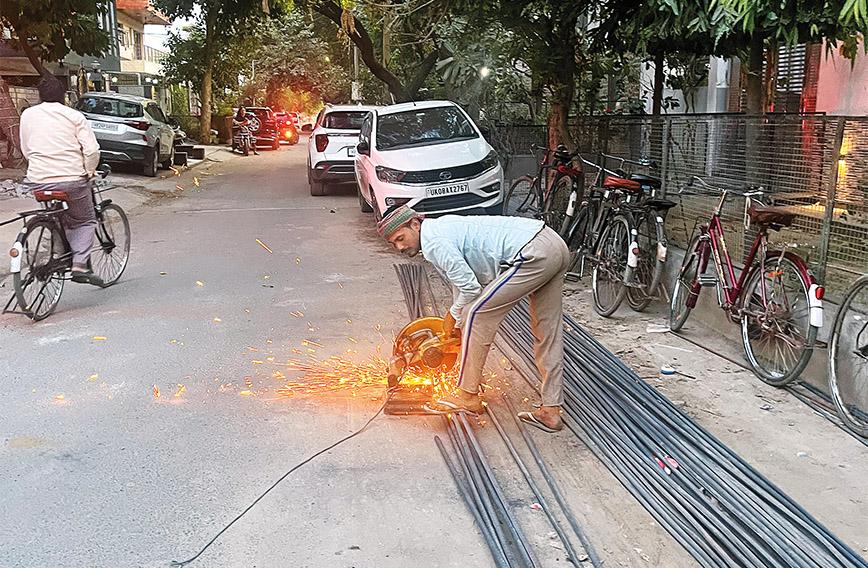
Daily wage earners leave villages in search of employment. They live in oppressive conditions on construction sites and small factories where they are treated almost like bonded labour with no rights. Others carry loads in wholesale markets, take to vending and get employed in eateries. They become household servants and security guards.
Away from the relative security of their villages, unorganized sector workers contend with high levels of uncertainty both in terms of income and their personal well-being. They lack housing, healthcare facilities, safe drinking water and nutrition.
During the recent election in West Bengal, such workers in the National Capital Region (NCR) were compelled to travel twice to their villages. First to comply with the intensive revision of electoral rolls. The second time to vote. Not voting would have meant losing their status as residents in those villages despite land records and other proof. For many the journey back was in overcrowded trains and buses.
Daily wage earners are compelled to cope with mounting levels of stress. Safe In India, an NGO, has found workers routinely losing their limbs in accidents on the shopfloors of automobile ancillary units.
 |
|
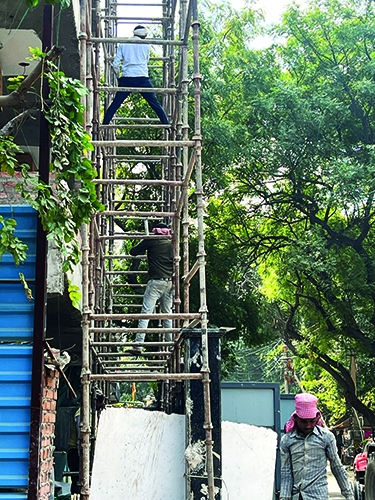
Safety norms are ignored on building sites, adding to the stress of workers |
Safe In India’s report has appeared every year for several years and it has been based on actual cases in the automobile hub of Gurugram. Despite this, the industry has been slow to improve conditions in units.
The workers are entitled to compensation and medical attention at government-run facilities, but accessing such benefits requires dealing with multiple formalities and filling forms that aren’t easy to comprehend let alone push through a government system.
Safe In India’s founder, Sandeep Sachdeva, told Civil Society in an interview last year: “People know that things are worse than what the data suggests. I think one of our big wins is the fact that we are robustly reporting this data, not based just on surveys but on real workers who get into the ESIC (Employees’ State Insurance Corporation) system to get their injuries and sicknesses treated. Our data shows that consistently, year after year, for the past seven years thousands of workers have been getting injured. It’s a well-established trend now.”
Civil Society did a survey in 2022 of deaths in accidents at construction sites and found that 84 workers lost their lives and 60 were injured between January and November. These figures were based only on published reports and could be higher.
The construction industry, like the automobile industry, is a major driver of the economy and attracts daily wage workers in large numbers who often migrate with their entire families for seasonal employment.
There are, however, no housing, education and healthcare facilities for them. Worse still, safety is lacking, causing workers to fall off buildings under construction or die under collapsing walls.
Once again, it is not as though the problems are unknown. It was to address them that 25 years ago a one percent cess began to be levied on big construction projects.
Over these years, more than `78,000 crore has been collected by way of the cess. But of that whopping amount just `47,000 crore has been spent.
The money is supposed to be spent on safety, and improving the living conditions of workers. It is the responsibility of the states to collect and spend the money beneficially under a national law.
There are not only lapses in collection, but even the money that comes in is either not spent on the welfare measures envisaged under the law or, worse, diverted to other purposes.
Mizoram and Kerala are two states that have used their entire collection and, in fact, spent more. For the other states, the record is pretty dismal. Maharashtra collected the most cess at `11,108.87 crore, but 72 percent of it or `8,612.33 crore remains unspent. Uttar Pradesh has collected `7,144.50 crore but spent only `2,873.69 crore. Delhi has collected `2,750.5 crore, but has not spent 82 percent of it or `2,281.22 crore.
Haryana has seen a lot of construction, particularly in Gurugram. The state has collected `3,337.23 crore, but spent only `1,395.61 crore. Gujarat has collected `2,013.84 crore but spent `545.29 crore. West Bengal didn’t spend 65 percent of the `3,648.69 crore that it collected.
Comments
Currently there are no Comments. Be first to write a comment!