



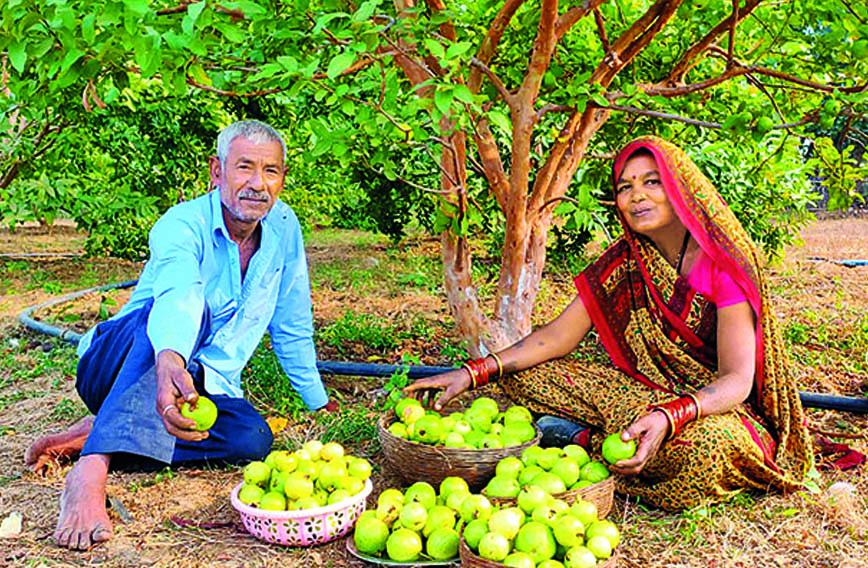
Organically grown guava is proving to be a winner for small farmers
Small farmers with orchards are doing well
Bharat Dogra, Tikamgarh
In India orchards are generally associated with landowners who have a lot of land and money. So, on a recent trip to remote villages, it was heartening to see small farmers raising orchards and prospering from their yield.
Phulabai and her husband, Sarman, in Digaura village of Tikamgarh district in Madhya Pradesh are one such couple. They were finding it difficult to make ends meet on their one-acre farm. While they were mulling what they could do, they came across SRIJAN (Self-Reliant Initiatives through Joint Action), an NGO that works with rural communities.
Inspired by them, they took a big decision — to plant on a significant share of their farmland fruit trees, mainly guava, and a diversity of vegetables. The organically grown guavas have received a very good response in the local market, enabling Phulabai and Sarman to increase their earnings significantly.
“Now I don’t have to go around seeking small loans from others to meet our basic needs,” Phulabai says with a smile. They have also invested in improving their irrigation facilities.

In Pratapgarh district of Rajasthan the incidence of multi-dimensional poverty is high. Meena Adivasis are among the more vulnerable inhabitants in villages. It was very encouraging to see many of them improving their economic prospects by taking up fruit cultivation, especially guavas and vegetables.
In Kalyanpura village of Suhagpura block, women like Ezan and Laxmibai have got together to form a farmer-producer group. Plans are afoot to link it with another farmer-producer company called Dolmashree. Already there is a big smile on Ezan’s face as she speaks about the progress of her organic guava orchard. Villagers here are making their own organic manure too.
Similar progress can be seen in other villages of Meena Adivasis in this district. According to recent estimates, about 140,000 fruit trees were planted in 50 villages over a period of about three years under the Parivartan project, a partnership of HDFC Bank and SRIJAN.
In Shivpuri district in Madhya Pradesh, there is hope and enthusiasm among
women as their orchards have started yielding fruits and a variety of vegetables. They are being harvested every day for family consumption as well as for sale.
In Umrikhurd village, women who are members of a women’s farmer-producer company are delighted to speak about their upcoming small orchards of guava and how they have managed the initial, difficult period.
One problem with raising orchards is that there is no fruit harvest and no income for the first two years. The women got through this lag period with ingenuity and hard work. They intercropped the younger guava plants with some legume crops which also contribute to the growth of orchards with their nitrogen fixing abilities.
Rajkumari says that she has been able to market peas by intercropping and earned `5,000 recently. An added advantage was that she also used the peas for home consumption. Rachna has earned `3,500. Other women have similar achievements to relate. At the same time, they are growing more familiar with natural farming methods.

In Sirsod village Rashmi Lodhi is already harvesting guavas. She is also raising a few lemon and jackfruit trees. In fact, several villagers preferred mixed fruit tree orchards. This makes sense. There is more diversity and risks are reduced too.
Rashmi’s orchard indicates the success of ‘convergence’ efforts whereby the efforts of the government and a voluntary organization are combined to yield greater benefits for the beneficiary household. So, Rashmi’s family was able to get wage payments as well as the cost of plants under a government scheme. Alongside she got the benefit of technical and other support from SRIJAN. Of course, SRIJAN continues to support villagers more directly in many cases, with help from organizations like IndusInd Bank.
As Rashmi’s family is relatively better off, she is also able to invest more in her farm — compared to poorer households like Badami’s in a nearby village.
Despite having a very small landholding, Badami has been able to make a success of her orchard of nearly 60 guava trees. Although these are young trees, some have started yielding fruit. Badami says, “We ate a lot of fruit, gifted some to our relatives and also earned some cash.” Now she is thinking of planting a few mango trees too. “Each tree should be nurtured carefully like a child,” she adds.
Increased availability of fruits for small farmers means better nutrition as well as more cash income.
As many women of these villages are also members of a farmer-producer company, it is likely they will take up processing and value-added initiatives which can further increase their earnings from fruit orchards and vegetable gardens.
Bio-resource centres that help to make organic fertilizers and pest repellants are being set up in several of these villages, further increasing possibilities of the spread of natural farming. These efforts contribute both to climate change mitigation and adaptation.
Since the majority of farmers in India have very small farms, converting their fields into small orchards and vegetable gardens has the potential to improve health and income.
Secondly, if these orchards and vegetable gardens are grown using natural farming methods, it sets the farmer on the path of ecologically protective farming. Setting up of bio-resource centres where farmers can produce organic fertilizers and pest repellants in self-reliant ways will encourage this trend further. It will also help in adapting to climate change and mitigation. ν
Comments
Currently there are no Comments. Be first to write a comment!