



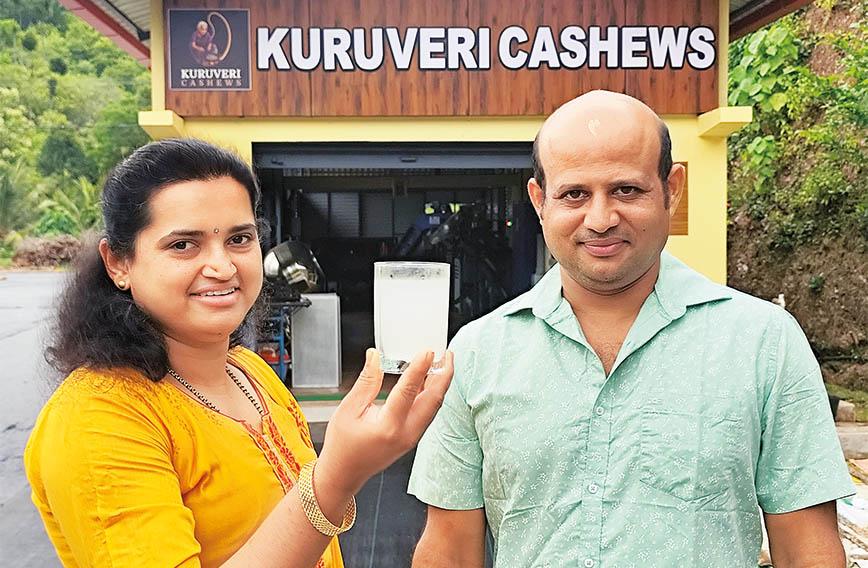
Vishwakeshava and Navyashri Kuruveri produce additive-free cashew apple juice
Cashew apple juice, anyone? Farmers need markets
Shree Padre, Kasaragod
IN April this year, Vishwakeshava and Navyashri Kuruveri, two young areca nut farmers, joined a training programme at the Directorate of Cashew Research (DCR) in Puttur, Karnataka, to learn how to make cashew apple juice and extract its pulp.
After training, the couple returned home, set up a tentative unit and began making cashew apple juice, unsure if it would sell.
To their utter surprise, it evoked huge demand. They sold 300 litres of fresh juice for `100 per litre in their initial pilot. Unwittingly, they became flag-bearers of the new drink as word spread.
The Kuruveris cultivate areca nut near Paivalike in Kasaragod district of Kerala. They also grow cashew on five acres and sell the kernels online.
“From two kg of raw cashew nuts we earn Rs 300. But from 10 kg of cashew apple, which we used to throw away, we earned Rs 875,” says Vishwakeshava, somewhat bemused.

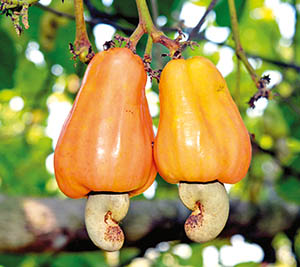
Cashew or kaju is, of course, well known. Lesser known is its brother, the humble apple, fruit of the cashew tree. A small squishy yellow-to-red fruit, it’s cast aside in favour of the nut. Now, after decades of neglect, the cashew apple is finally enjoying the limelight the nutty kaju once occupied.
In districts of north Kerala, cashew apple is having a moment, proving its mettle as juice and pulp. It has health benefits too. The juice has a high percentage of fruit extract, Vitamin C, six times more than orange, plus minerals and antioxidants.
 |
|
|
Cashew apple and nut on a tree |
India is the second largest producer of cashew nut in the world — producing about 795,000 tonnes of raw nuts annually. As for the cashew nut’s apple, which is eight times its weight, 60 lakh tonnes are produced annually. Not even one percent of the apple is utilized. The only commercial use of the cashew nut apple is to produce the Goan feni.
In contrast, Brazil exports cashew apple juice to 15 countries. Twenty-five percent of the country’s cashew apple is converted into juice or pulp. The juice sector is dominated by a few large companies such as Britvic. But cajuína or clarified juice is produced by medium-sized companies that market it under their own brand. There are also thousands of small producers who process it locally and sell without branding the product. Cashew soda is also popular.
India is wasting a whopping quantity of cashew apples which could increase the income of farmers and create a new sector in the food industry.
ON THE SHELF
India does have a few cashew apple production centres.
There is the Cashew Research Station (CRS) at Madakkathara in Thrissur under the aegis of the Kerala Agriculture University (KAU) and the Cashew Technology Centre (CTC) which comes under the Keladi Shivappa Nayaka University of Agricultural & Horticultural Sciences (KSNUAHS) in Shivamogga. Both are administered by universities and do not enjoy complete autonomy.
 |
|
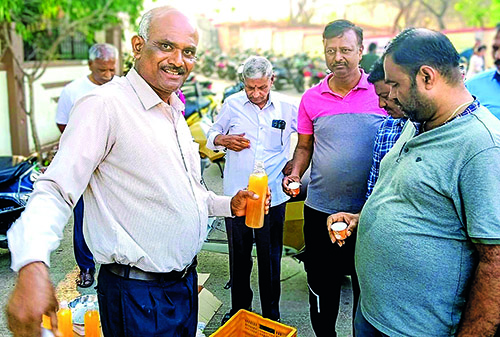
Hardsell: Karnataka farmer N. Thippeswamy hits the street to market his homemade cashew apple juice |
CRS has been developing cashew apple products for the past 30 years. According to Dr Jalaja Menon, associate professor and head of CRS, more than 30 of their products are ripe for commercialization. Ten, she says, are very promising. Around 12 technologies have been bought by institutions and individuals. Son Pandar Sundi, a Farmer Producer Company (FPC) in Maharashtra, is investing Rs 2.5 crore to set up a huge unit for cashew apple beverage.
CRS recently launched a string of new cashew beverages blended with mango, pineapple and grapes which mask the cashew apple’s strong aroma, disliked by some people. CRS has also developed pasteurized cashew apple ice-cream, a tutti frutti, plus cake, chutney, pickle, jam, candy, and an energy bar.
The Plantation Corporation of Kerala (PCK), a state government undertaking, grows cashew on some 4,500 hectares. For the past decade it has been selling fresh cashew apple juice from four centres. Currently, two centres, Periya in Kasaragod district and Mannarkad in Malappuram district, are selling cashew apple juice, priced at Rs 40 for a 300-ml glass.
The drink is pure and natural with zero additives. No sugar, water, preservative or essence is added. “In 2014 when we first launched this drink 75 percent of our revenue used to come from raw cashew nuts. Now it’s 50 percent,” says Sajeev Uchchakavil, PCK group manager.
“We do have many limitations. Juice counters, being on our farms, don’t have much footfall. Besides, sale of juice is not our main activity. We don’t advertise or undertake promotions. If private entrepreneurs take this up, they can earn five times the income they get from selling cashew nut. Our cashew apple carbonated drink also sells reasonably well and has greater potential,” he says.
Puttur’s DCR has developed about 17 products from cashew apple, including Cash Lime, a ready-to-drink beverage, a fruit bar, liquid jaggery, cashew paste and a health tonic.
Unfortunately, hardly anyone has even heard of these products. They sit on lab shelves, because research stations don’t introduce their products to industry or promote them.
IN MISSION MODE
But things are changing, albeit slowly. On March 11 this year, the DCR’s outreach to businessmen attracted 32 representatives from the local beverage and food industry. They sampled five products, mainly beverages, and engaged in a thorough discussion on commercialization of such inventions. Then, in April DCR held a training programme in Puttur for anyone interested in making cashew apple juice and pulp.
Cashew farmers, keen to increase their income, became the first enthusiasts of the cashew juice business. Juice, without additives, is the ideal value-added product for them. The only investment needed is a simple juice extracting machine and a deep freezer. But whom to sell to? They need to be in a place where they can attract health-conscious buyers.
For a week, N. Thippeswamy, an organic farmer in Chitradurga district, worked in mission mode. Every morning, he would travel to his cashew orchard and return with a bag brimful of cashew apples. At night he would extract juice from the fruit. Early morning, at 7 am, he would head for a street where people came to jog, carrying the juice and fruits. Thippeswamy was keen to find out whether his cashew apple juice and fruits would find buyers.
“Today is my fourth day test-marketing my juice and fruit. I find that every day sale of juice is increasing. I don’t need to offer so many free samples anymore. I have repeat customers. I could even sell a few fresh fruits at Rs 40 per kg. Certainly, there is good demand for both juice and fruit,” said Thippeswamy, who has invested in a juicer machine.
Canute Aranha, a cashew farmer, earns an additional Rs 1 lakh to Rs 1.5 lakh every year, selling cashew apple juice. He has 300 cashew trees on his Navaprakash farm near Mulki in coastal Dakshina Kannada district. The trees yield half a tonne of cashew nuts. For five years Aranha has been selling juice. His ‘Ken’s fresh cashew apple juice’ is well known to locals in nearby towns. “Our ready-to-drink (RTD) juice has good demand. I can even sell up to 1,000 bottles per day,” he claims.
For the past 20 years, Soans Farm in Moodabidri taluk has been extracting zero-additive cashew apple juice which it sells in 700-ml bottles. “We are producing juice to demonstrate that anyone can make it and earn money,” says I.V. Soans.
A few entrepreneurs have also joined the cashew apple bandwagon. Dehydrated cashew apple which can be converted into candy and khajoor, is emerging as a promising business opportunity.
 |
|
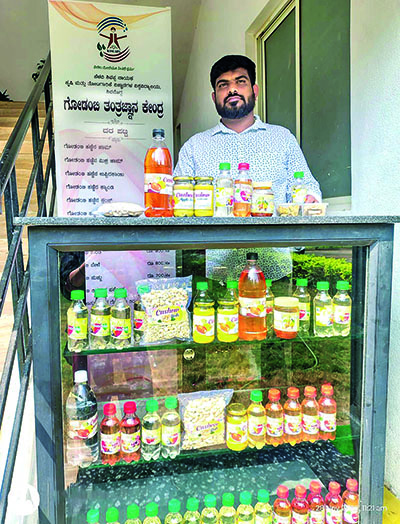
Cashew Technology Centre's marketing outlet in Shimogga |
Very few start-up owners try their hand at incipient food processing. One is K.V. Sushama who is from Taliparamb in Kannur district of Kerala. Adopting technology from CRS, she invested Rs 12 lakh and started a unit which manufactures a carbonated drink with cashew apple juice called Kazecool. A 250-ml bottle is priced at Rs 40.
“The thing is, people suspect there is alcohol in this drink. We have to dispel such wrong notions. In three months, we could sell 200 bottles,” says Sushama.
Kiran Kamireddy, from Andhra Pradesh, is another newbie entrepreneur. While studying at the Central Food Technological Research Institute (CFTRI) for his PhD, he came to know about the sorry state of the cashew apple. After three years of preparation, he is all set to launch his own enterprise which will manufacture a ready-to-drink beverage under the brand name of Jeedi, with three variants. Kamireddy has hired a person to collect the fruits from farmers, extract the juice and send it to Bengaluru for processing.
STATES IN LINE
Maharashtra leads in value addition of cashew apple with squash and syrup, but the state hasn’t been able to promote a marquee drink. Sindhudurg district in the Konkan is the centre of cashew apple industries with syrup being its lead product. With 10 units, Konkan produces an estimated 25,000 litres of syrup.
In West Bengal, it is the state government that has promoted cashew apple syrup through Sufal Bangla, its marketing chain of 600 mobile and static outlets that sell farmers’ products directly to consumers.
In 2018, the then project director of Sufal Bangla, Gautam Mukherjee, introduced cashew apple syrup. Around 1,000 half-litre bottles were sold in two years. “There was good demand from households,” recalls Mukherjee, “but we had to stop because of Covid. If community-based organizations encourage farmers, step up production and create a regular supply chain, this product can move well in the Sufal Bangla marketing network.”
The fruit is also used in traditional Ayurvedic medicine and tonics. Ayurvedeeya Arkashala Ltd, an old Ayurvedic medicine company in Satara, makes two medicines for bronchial disorders which are popular. Prasad Shivaram Marathe, a cashew farmer from Sawantwadi in Sindhudurg district, supplies several thousand litres of cashew apple juice to the company which is located 300 km away.
THE DOWNSIDES
The biggest challenge farmers and entrepreneurs face is the high perishability of the fruit. If the cashew apple drops while harvesting, it gets damaged and is susceptible to contamination. It also begins to ferment. Experts warn entrepreneurs not to use fallen fruit since it could be contaminated with microbes.

The second problem is seasonality. The fruit is available for only three months. There are ways to preserve it as pulp or even the whole fruit, says Dr Jalaja Menon. Both CRS Thrissur and CTC Shivamogga make products through the year using preserved materials.
Dr Anand Tendulkar of Kankavali, a champion of underutilized crops of the Konkan, has invested in a large aseptic preservation plant with his friends. He believes the plant will be able to extend cashew apple’s shelf life up to 18 months. Hopefully, it will attract the attention of bigger players in the food industry to cashew apple.
Marketing cashew apple juice, a new product, is also difficult and expensive for small entrepreneurs. They find that the most inexpensive and effective form of marketing is to interact with consumers.
“We have introduced our best cashew apple products to representatives of industry. If anyone wants to commercialize any of them, we can provide training, a licence for a fee, and help in the initial phase, if necessary,” says Dr J. Dinakara Adiga, director of DCR, Puttur.
With renewed interest in cashew apple products and the backing of a string of research institutes, perhaps the time is ripe for industry to take another look at the overlooked cashew apple.
For technology contact: Dr Thondeiman, 9427881172, Directorate of Cashew Research (DCR), Puttur. For training: Dr Aswathy, 9778040698, Cashew Research Station (CRS), Madakkathara, KAU, Thrissur. Dr Jalaja Menon: 9446141724, Cashew Technology Centre, Shivamogga Agri University, Shivamogga; Dr Jeevan: 7760830449
Comments
Currently there are no Comments. Be first to write a comment!