



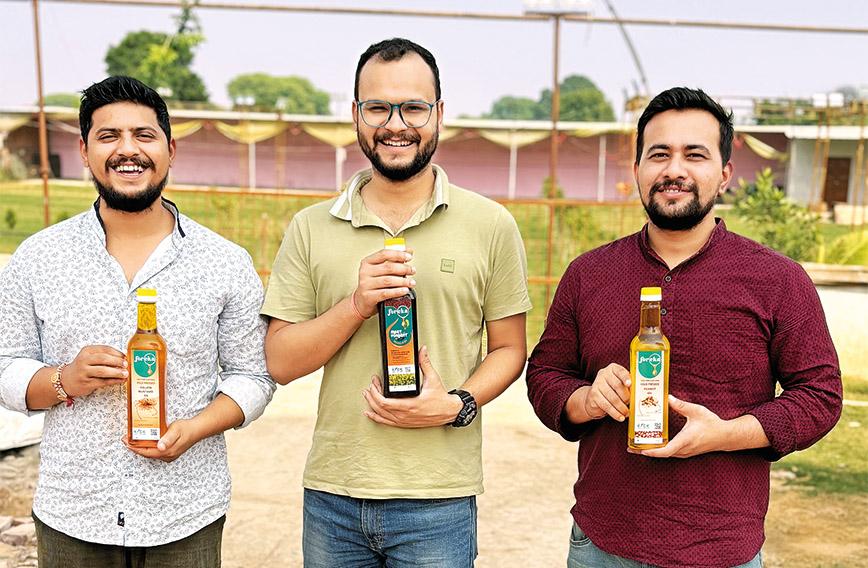
The edible oils are coldpressed and sold under the Foreka brand. There is no blending.
Coldpressed brings FPOs into markets
Bharat Dogra, Karauli
In recent years small producer companies have come up in Rajasthan to tap into the lucrative urban demand for coldpressed cooking oils. The state is India’s largest producer of oilseeds and mustard is its signature crop.
In Karauli district of Rajasthan the Dang Vikas Farmer Producer Company (FPC), started a year ago, has set up a processing unit which churns out coldpressed mustard oil. The processing plant, located near Mandarayal, a small town, is attracting a lot of local attention.
The shareholders of the company are around 2,000 women farmers from Mandarayal, Sapotra and Karauli blocks. The processing unit was set up by SRIJAN (Self Reliant Initiatives Through Joint Action), an NGO which works on rural livelihoods, natural farming and social development.
The NGO helped small farmers here switch to growing mustard organically. But selling the crop at a decent price proved to be tough. So SRIJAN helped the women set up the processing unit to convert mustard seeds into oil and oil cakes.
The unit is ecofriendly. Farmers nearby bring their mustard seeds to the unit for processing. The farmers get a fair price and profits are shared with them. Payment is also prompt.
There’s goodwill and enthusiasm for this effort among villagers here. Three women from the management committee, Rani, Pooja and Priyanka, said they were optimistic about better income for women farmers from this micro-enterprise. Along with the team leader from SRIJAN, Bhavani Singh, they talked about setting up a small plant for making cattle feed and grading farm produce for better prices.
The Dang Vikas FPC also sells its mustard seeds to a social enterprise which produces edible oils called Heart in Hills or HIH. Set up in 2023 by three young entrepreneurs, Satyam Bhandari, Mohit Rana and Rohit Singh, HIH buys oilseeds and produces a range of oils under its brand name, Foreka. Its main oil is mustard but it also produces and sells groundnut, sesame, and coconut oil.
The company’s factory is in Hindaun city of Rajasthan. The oilseeds, preferably organic, are bought from nearby farmers. The oil is made using the cold-pressed technique. No blending with other oils takes place. In a short while, HIH has earned praise from farmers and consumers.
“Farmers become vulnerable to exploitation when they take their produce for sale to mandis because of the number of middle men in the value chain. They don’t get the price they deserve. We have established contact with FPOs so that transactions can be made in a spirit of trust. In most cases we collect produce from the farm gate, saving the farmer transport expenses,” says Rana.
Farmers say that when they sold to middlemen they would get about `6,500 per quintal. HIH offers them `7,000 per quintal. HIH had a tough time convincing the farmers that they really would pay more. Women farmers feel that HIH doesn’t just buy the mustard but tries to empower them. The mustard seeds are checked for pesticides and chemicals before procurement.
HIH also buys oilseeds from the Jhalkari Bai Mahila Kisan FPO, a women-owned FPO based in Mauranipur, Jhansi, in Uttar Pradesh that was incorporated in December 2020. As the company expands, more such reach-outs will be possible.
“Being fair and useful to farmers and protecting the environment and health are non-negotiable aims for us. We are social entrepreneurs and social objectives are integral to our business ethics,” says Bhandari.
HIH plans to help farmer producer groups morph into companies. “The FPOs have noble intentions, good understanding, rural reach and understanding of farmer issues. But they need professional help to become businesses. Since we too have coped with some harsh market realities and unscrupulous elements we can link professional expertise to these practical realities,” says Bhandari.
The three entrepreneurs received valuable support from the Buddha Institute, a SRIJAN initiative which funds enterprises that plan to uplift rural communities. Its Buddha Fellowship Program trains social entrepreneurs to create for-profit enterprises involving agriculture and rural livelihoods.
Bhandari says that as a fellow of the institute he received invaluable help in mentoring, funding, procurement and marketing. The institute also helped them set up the processing unit.
Bhandari, Rana and Singh come from Uttarakhand and their headquarters is in Kedarnath. They are currently procuring and selling millets from farmers in the state as well. At present they are working with 1,200 farmers and plan to scale that up to 10,000 farmers in Rajasthan and Uttarakhand.
In expanding and building capacity, they aim to retain their core values of putting farmer welfare first and providing healthy food.
Comments
Currently there are no Comments. Be first to write a comment!