



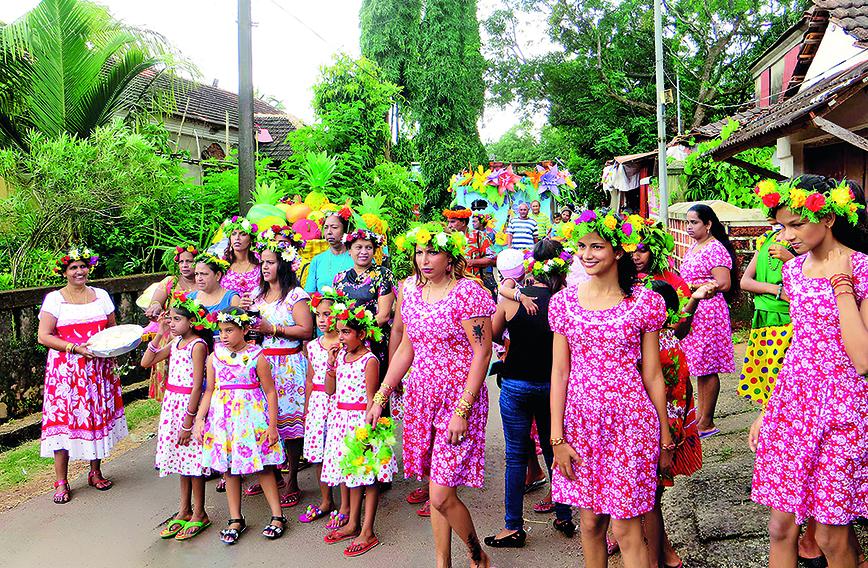
Festivals in Goa are linked to harvests, nature and religion
The art of serenity
The hardcover book draws immediate attention. Eye-catching illustrations on textured paper portray aspects of Goan life: the cashew fruit, water waves, Portuguese architecture, fish, birds, palm trees, a guitar, a boat on water, folding deck chairs on a beach, and the famous azulejo tiles.
I found D’Souza’s book at the 20th anniversary celebration of the Literati bookshop in Calangute, Goa, a month ago. It was a day of book readings, music, drinks, and food, which I attended with four friends from my complex in Revora, North Goa.
The nearest village from my complex is Colvale, and I was delighted to learn that it is D’Souza’s ancestral village. He describes his ancestral home as a traditional Goan house starting with a balcao, a sitting area as you enter the home, usually in a veranda-like space. It opens into a hall, a living room, and a storage room for pickles, rice, coconut, and jaggery. There are bedrooms and a kitchen that lead into a backyard filled with trees. And there is a well.
Of Goan origin, D’Souza is a media professional based in Mumbai who started visiting Goa in the 1980s and became enchanted with the susegad mindset. ‘Susegad,’ writes D’Souza, comes from the Portuguese sossegado, which literally means quiet, contentment, peace, and satisfaction.

The three elements, as D’Souza describes, responsible for susegad are climate, culture, and habits. He explores the history, geography, songs, dances, food, drink, and overall way of life in Goa, all presented in a charming, relaxed style. He interviews various Goans about what susegad means to them.
He introduces us to some important Konkani words and Goan proverbs, which are entertaining. For example, ‘Don’t eat salt before rice’ means doing things in proper order. ‘You can’t catch fish if you don’t wet your loincloth’ means hard work requires getting your hands dirty.
Goan cuisine is a blend of Konkan and multi-continental influences. But central to the meals are fish, rice, and the all-round poi, or bread. For those with a sweet tooth, the Goan queen of desserts is bebinca, rumoured to be named after a Portuguese nun, Sister Bebinca. The seven-layered custard is cooked with flour, ghee, egg yolks, sugar, and coconut milk. It’s one of my favourites. Others include serradura (or ‘sawdust pudding’), dodol (a coconut-jaggery fudge), patoelo (rice flour and jaggery steamed in turmeric leaves), and bolinhas (small, sweet coconut balls). As you can gather, coconut and jaggery are key ingredients in the sweet dishes.
 And for mango lovers, according to D’Souza, there are more than 82 varieties. The most popular is Alfonso, but other varieties are equally delectable.
For those who enjoy the local tipple, feni and urak are the most popular drinks. They are made by fermenting and distilling cashew or coconut sap. The first press results in urak, which is only available from January to March, while the final product is feni. Feni is typically enjoyed with a splash of lime juice and ice, topped with Limca or soda of your choice. A pinch of salt and a sliced green chilli are added for a bit of flair.
The book describes numerous festivals in Goa, too many to list here, but they are linked to harvests, nature, and religion.
Goan open markets are a pleasure to shop in. The most famous and my favourite is the Mapusa market, especially on Friday mornings when locals bring their produce — what they have grown, cooked, pickled, or created.
D’Souza says that for many Goans, this is life. “There is no clear demarcation of white collar, blue collar, no boss or employee. No pondering about a job or a career. There is a sense of ownership and self-respect.”
What about the beaches? D’Souza states there are 48 official beaches, each with about 375 shacks allowed to operate by the tourism department. The tourist season runs from mid-September to the end of May.
The book serves as a helpful guide for tourists who want to learn more about Goa, respect its culture and traditions, are planning an extended stay or have moved there to live. The strength of the book, and what I like, is its focus on how much of the valuable aspect of the Goan way is connected to nature. It also highlights how nature is linked to Goan food, drink, and lifestyle.

D’Souza covers a wide range of topics in his book. While his main message is about susegad, he discusses the uniqueness of Goans, how their history has shaped the susegad lifestyle, and the strong community spirit supported by a distinctive system of local governance.
The interviews with select Goans are somewhat stiff, and there is some self-help advice on how to live amid susegad (both in and out of Goa), although D’Souza claims it’s not a self-help book.
Goa is unlike any other state in India. While it’s blessed with a tropical climate, lush forests, natural beauty, water bodies, and a mix of commercial and leisure activities, it is also evolving like other places. Its appeal to tourists and the focus on tourism create challenges for susegad and the traditional Goan way of life of contentment.
In such times, D’Souza’s book is highly relevant. It’s not just about nostalgia, but a record of the slice of history that keeps people sane.
Anita Anand first visited Goa in 1986 and continued to do so for many years. She moved to Goa in January 2025. She writes, paints and enjoys nature.
Comments
Currently there are no Comments. Be first to write a comment!