



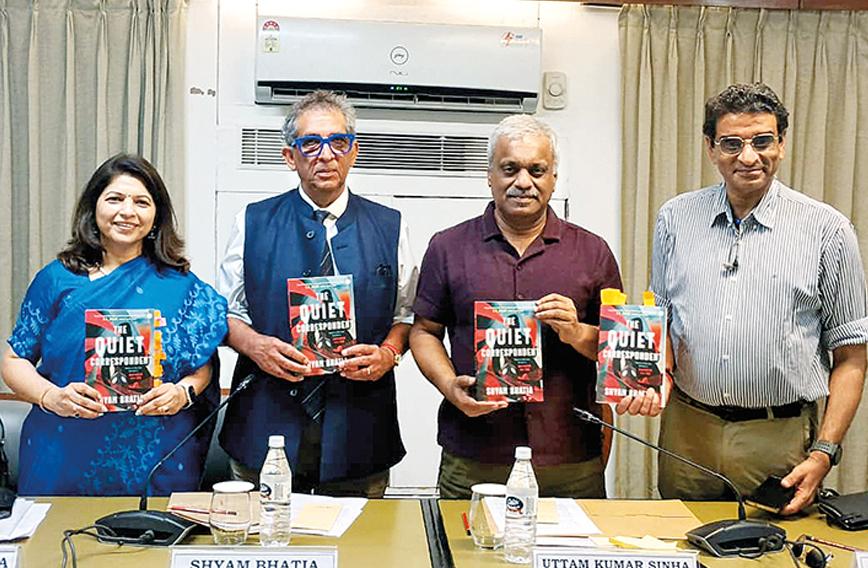
Shyam Bhatia, second from left, at the launch of his book, 'The Quiet Correspondent'
Will you agree to be a spy to get a good story?
Subir Roy, Kolkata
THIS is the story of how an accomplished peripatetic newspaper correspondent journeys to the most troubled region of the world and unearths exclusive stories. And those stories become information for intelligence agencies. The correspondent inadvertently becomes a spy for his minders and delivers what they are looking for.
Within this the correspondent develops a tender romantic relationship which ends for him with an unbearable tragedy. Thus the novel can be read at three levels: high-quality journalism, powerful cloak and dagger stuff, and a human story.
The publisher’s blurb says that the book is about the protagonist, Amol Batty, part-Indian and British-educated, who is a reporter with a conscience, uncovering the secret dealings of governments. This takes him from London to Beirut, Jerusalem and the Balkans. Batty is torn between loyalty and integrity. At the end of the day he has to decide if the story should remain paramount or serve the cloak and dagger machinations of the political powers whom he has chosen to serve.
The author, Shyam Bhatia, is himself a foreign correspondent, which is why the story has such an authentic tone. He currently lives in London and previously reported from Cairo, Beirut, Jerusalem and Washington. He has been the Middle East correspondent and diplomatic editor of the Observer, US correspondent of the Deccan Herald and editor of Asian Affairs. He is currently the London correspondent of The Tribune.
Bhatia has five books to his credit and has received recognition from the British Press Awards. Unsurprisingly, the book is far more than cloak and dagger stuff and aspires to a place among serious literary writing.
The novel’s action is psychological rather than physical, unfolding in embassy corridors and the quiet corners of war-torn hotels. The question it poses is one Bhatia has lived with for decades: at what point does the journalist become complicit?
The book is essentially about the deployment of journalism by 20th century intelligence agencies. Courted into plum postings by the Secret Intelligence Service (SIS) and a fellow compromised journalist, amid the ambience of a rainy London, Batty traverses conflict-ridden landscapes only to discover at the end that he has been used as a propaganda tool by the intelligence agencies.
The relationship between the British press and the intelligence services has been one of the more productive and least examined arrangements of the Cold War order.
The geography — Beirut, Jerusalem, the Balkans — evokes landscapes where information, propaganda, and intelligence have historically been at their most unstable, where the correspondent’s copy and the intelligence report have bled into each other as a matter of operational routine.
Bhatia uses this terrain to argue, quietly but with some insistence, that the foreign desk and the intelligence agency were never entirely distinct institutions.
The story Amol Batty thinks he is telling turns out to be one he has been assigned to tell. That duality is the novel’s central, and most unsettling, proposition.
_______________
Q and A
‘In fiction you have to learn to trust your imagination’
Shyam Bhatia spoke to Civil Society on writing fiction, creating characters and war reporting
You’re a celebrity reporter and an acclaimed non-fiction writer. Why the switch to fiction? Was the process seamless?
I never really saw it as a switch. Throughout my career, whether as a reporter, foreign correspondent or non-fiction author, I have essentially been telling stories.
There were certain experiences and moral dilemmas I encountered over many years that journalism could describe but not fully explore. Journalism tells you what happened. Fiction allows you to ask what it felt like.
The challenge was not the writing itself but learning to trust imagination as much as evidence. As a journalist, you are trained to stay within the boundaries of what you can prove. As a novelist, you have to create an entire world while remaining emotionally truthful. That took some adjustment, but it was also immensely liberating.
West Asia as the background is timely, coinciding with the present imbroglio. What is it about this troubled region that made you return to it in another genre?
West Asia shaped much of my professional life. I spent years travelling and reporting across the region and was constantly struck by the difference between the headlines and the reality.
The region is often portrayed solely through war and political upheaval. Yet it is also a place of extraordinary hospitality, resilience and humanity. Some of the warmest friendships of my life were formed there.
The longer I reported from the Middle East, the less interested I became in who was right and the more interested I became in why people believed they were right. Fiction offered an opportunity to explore those questions through individual lives rather than headlines.
The central character, Amol Batty, is a journalist unwittingly entangled in the spy world, evolving into a watcher. Did you base him on anyone?
Amol is not based on any one individual, nor is he a disguised autobiography.
Like many novelists, I drew on fragments of people, places and experiences accumulated over a lifetime. Some of his reporting assignments echo situations I encountered as a correspondent. Other aspects came from people I met along the way.
What interested me most was the position of the observer. Journalists spend their lives watching history. What interested me was what happens when history starts watching back. Amol begins as an observer and gradually discovers that observers are never as invisible as they imagine.
Amol plunges into dangerous reporting assignments — Gaza, Tehran, Sudan — giving the story an edge. What motivates a reporter into risking life and limb?
There is certainly an element of idealism. Many reporters genuinely believe that important stories deserve to be told, particularly stories involving people who otherwise have little voice.
But there are other motivations too. Curiosity is a powerful force. So is the desire to witness events first-hand rather than rely on second-hand accounts. Most foreign correspondents are not looking for danger. They are looking for understanding. The danger sometimes finds them.
Of the people you write about in West Asia, each has his own version of the reality of conflict. Were you trying to reflect the many layers of West Asia’s many conflicts?
Very much so. The Middle East taught me that every conflict contains at least two truths and usually several lies.
Peace seems like an illusion but it is aspired to anyway in form if not in substance. Is there room for lasting peace?
The Middle East cured me of certainty. The lesson I drew was to be wary of absolute predictions.
There’s this undercurrent of racism which Batty contends with in your story. Have things changed in recent years?
People who live between cultures often see things that others miss. They also belong nowhere quite completely. That is something Amol experiences throughout the novel.
You’ve been promoting your book in India. Any interesting responses?
Many readers have been intrigued by the relationship between journalism and intelligence. As I sometimes put it, journalists and spies have one thing in common: both are paid to ask questions. The difference is what they do with the answers.
Comments
Currently there are no Comments. Be first to write a comment!