




MEGHNA UNIYAL
In 2016, in Jigeesha Thakore Vs Dilip Sumanlal Shah, the Supreme Court upheld a Bombay High Court order prohibiting a family from feeding pigeons even from their own private balcony, stating that “a person cannot feed birds from a flat’s balcony creating nuisance due to droppings and filth for other occupants in a residential society”. Hon’ble Justices U.U. Lalit and Indu Malhotra stated, “If you are living in a residential society, then you have to conduct yourself according to the norms.”
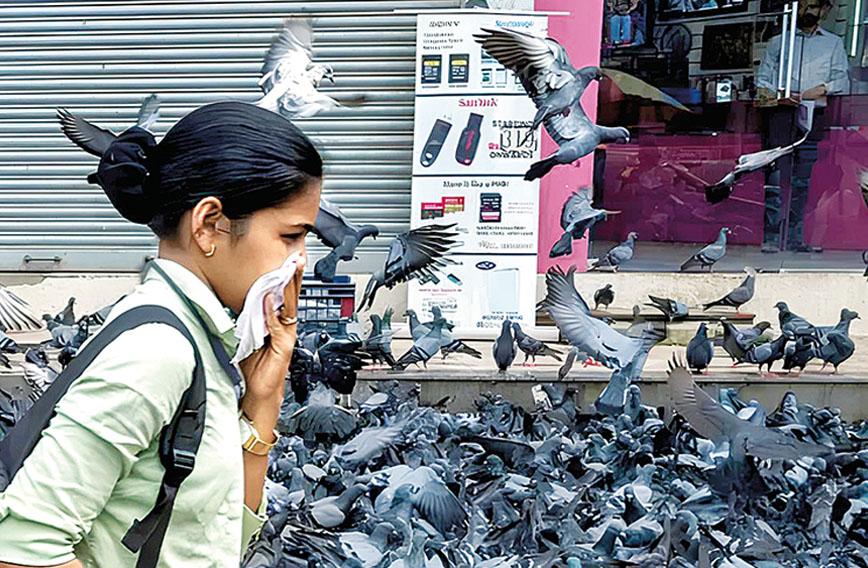
Pigeon feeding is currently banned in Mumbai due to public health concerns over diseases linked to pigeon droppings and damage to heritage structures. The Bombay High Court has ordered the Brihanmumbai Municipal Corporation to enforce this ban, including fines for offenders and the closure of designated feeding spots called ‘kabutar khanas’. An expert committee is also looking into addressing and resolving this critical public health issue.
What these issues reveal, though, is that India has no shortage of compassion or any number of versions and interpretations of it. What it lacks, often disastrously, is ecological literacy. Pushed as ‘kindness’, this behaviour is in fact a socially sanctioned form of ecological harm. It creates stress for the very animals being fed, jeopardizes public health, and causes the deaths of countless other creatures, seen and unseen.
One does not have to be an ecologist to know that animals respond to food availability, not sentiment. When food is available, provisioned or abundant, populations grow. When it is scarce, their populations decline. In Indian cities, stray dog feeding and availability of food via garbage dumps have had predictably harmful results — high population densities, large, artificially subsidized packs that become territorial and aggressive around feeding areas and chronic disease cycles maintained by congregation.
Pigeons follow the same pattern — food handouts like grains, bread and processed flour enable flock sizes that far exceed what any urban ecosystem can sustain. In nature, carrying capacity is fixed and non-negotiable. Provisioning of food to stray and unowned animals means artificially increasing their populations. The consequences are deadly — cities struggle with the spillover, people suffer and so do the animals.
What pro-feeding communities don’t know, or at least don’t seem to want to accept, is that the unseen victims of stray dog and pigeon feeding are millions of other animals. One of the most astonishing moral blind spots in these practices is the invisible violence embedded in the food itself. The chapatti tossed to a stray dog or the grain scattered for pigeons carries a hidden death toll — of insects, pollinators and small, farm wildlife — all killed through pesticide application, tillage, harvesting, land conversion and fertilizers.
India’s cropping systems kill trillions of insects every year. If the ethical impulse is to “save lives” or “care for animals”, then deliberately creating more mouths to feed — each one dependent on ecologically costly agriculture — is ethically incoherent. Feeding stray dogs or pigeons is not kindness; it is moral displacement. The suffering is simply outsourced to species we do not see or care about.
Pigeon feeding produces dense roosts that create chronic respiratory hazards like hypersensitivity pneumonitis or ‘pigeon-fancier’s lung’, asthma, fungal infections and contamination of private and public infrastructure. The birds fare no better — overcrowding leads to constant stress, parasitism and high chick mortality. What people perceive as helping is, biologically, a recipe for suffering. No responsible public health framework can endorse behaviour that makes exposure more likely. Nor does any law allow it.
Artificially inflated dog and pigeon populations impose a heavy toll on urban biodiversity as well. Free-roaming dogs kill ground-nesting birds, small mammals and reptiles. They displace native scavengers like crows, vultures, jackals, and mongoose. Pigeons outcompete native birds for nesting sites and spread disease.
Much of this ‘kind’ behaviour stems from a sentimental, individualized view and favouritism towards ‘cute’ animals as well as practices rooted in cultural and religious norms. The animals one can see become the focus of empathy; the millions invisibly harmed are excluded from the moral frame. This selective compassion is not harmless. It manufactures ecological imbalance, fosters zoonotic risk and produces chronic suffering for the very animals being fed.
True kindness requires aligning intentions with ecological reality. And this means discouraging and stopping deliberate feeding of stray dogs and pigeons and promoting education and awareness programmes that help people understand how species interact and affect health systems.
Compassion cannot just be a warm, fuzzy feeling; it must include responsibility. And responsibility requires acknowledging that feeding stray dogs and pigeons harms more animals than it helps. While public discourse, debates and court cases on the subject continue, it must be recognized that some matters are already settled via law, and our courts, citizenry and the country cannot be repeatedly held ransom to the sentiments of a few.
As far back as 1958, in Md Quareshi Vs the State of Bihar, Hon’ble Justice P.B. Gajendragadkar laid down that “In order that the practices in question should be treated as a part of religion they must be regarded by the said religion as its essential and integral part; otherwise purely secular practices which are not an essential or an integral part of religion are apt to be clothed with a religious form and may make a claim for being treated as religious practices within the meaning of Article 26. Similarly, even practices, though religious, may have sprung from merely superstitious beliefs and unessential accretions to religion itself”. Some religions may promote feeding some animals, other faiths may consider some animals unclean.
Regardless, feeding animals in public places is not an essential feature or integral part of any religion, especially since it threatens public health and safety, and must not be condoned.
Meghna Uniyal is Director, Humane Foundation for People and Animals
Comments
Currently there are no Comments. Be first to write a comment!