



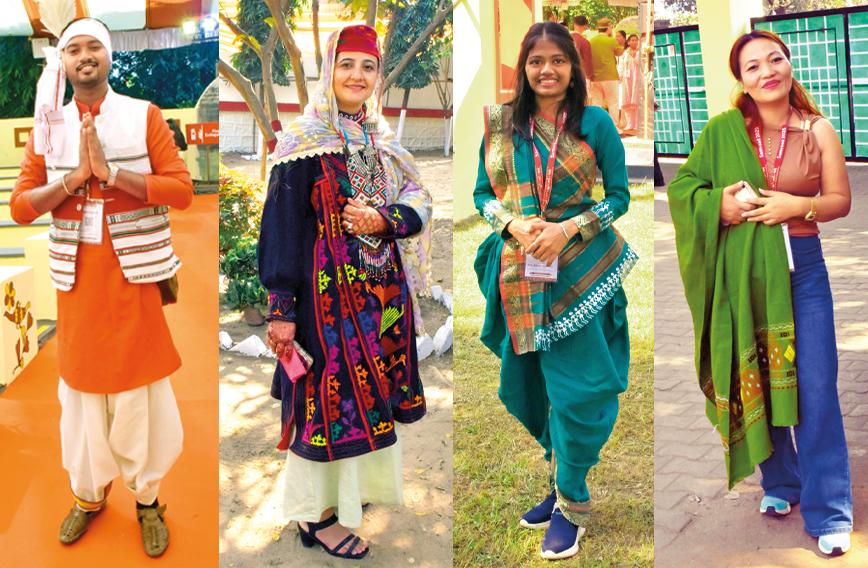
People from tribes across India dressed in their traditional ways and speaking different languages
At Samvaad, magic happens
Civil Society News, Jamshedpur
When 2,500 people from 153 tribes gathered in Jamshedpur in November, there was a convergence of indigenous talents, aspirations, concerns and identities. They showed up from corners of India dressed in their traditional ways, speaking their own languages and looking completely apart, but yet one in their search for a place in a fast-changing world.
Tribal people are prisoners of their remoteness. They aren’t visible because they aren’t easily found. Their slow way of life, rooted in nature, is outpaced. Along with forests and water bodies, their cultures and traditions, too, vanish over time.
Samvaad, held once a year over four days in Jamshedpur, brings them together. It gives them the opportunity to flaunt their identities. On display are their diversity and charisma.
Samvaad literally means dialogue and as an event it provides tribal people with a platform to interact and tell their stories so that they don’t feel alone and also the world at large can know they exist. Food, arts and crafts, song and dance, dress, worship, folk medicine — Samvaad brings forth all that makes up the tribal way of life.

Now in its 11th year, the event is the outcome of a passionate effort put in by the Tata Steel Foundation. Year round, the foundation’s teams reach tribal communities and nurture connections which culminate in the steel city being awash in tribal colours and enthusiasm. Some 43,500 tribal people from 333 tribes have come to Samvaad since the first edition in 2014.
Samvaad fosters with intensity bonds between tribal groups from Kashmir to Kanyakumari, Bengal to Gujarat, Bodoland to Kerala. These are people who didn’t know one another until they came to Jamshedpur. A good many of them remain connected long after.
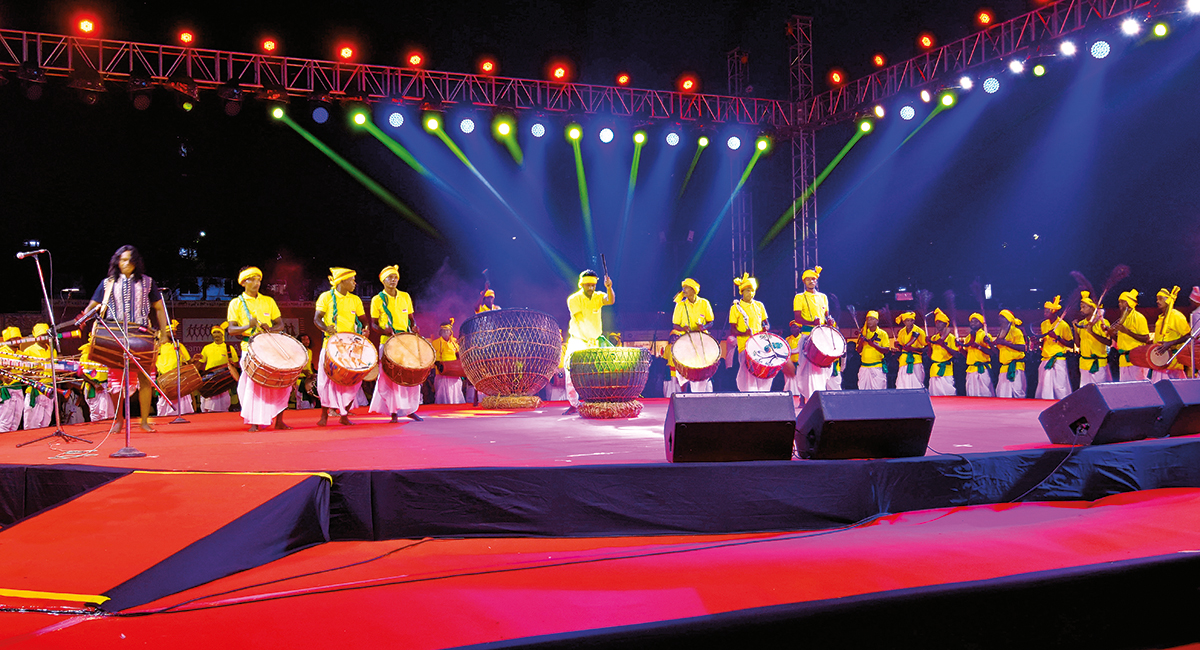 The inauguration of Samvaad to the sound of nagaras and bhers
Each of the four days begins with a sombre prayer session at the Akhra, the shared venue to meet and interact. It is an amphitheatre at the Tribal Culture Centre run by the foundation. The daily prayer is conducted by a different group every day in their own style but is essentially an invocation to nature. Following the prayer, there is an opportunity for different groups to take the stage and talk about their communities and the challenges they face. There is a sharing of ideas and an assertion of their rights.
The Akhra is a sacred space which is purified with mango leaves and the sprinkling of water. It is a ‘safe place’ where people can open up about what matters to them. Samvaad’s hallmark is a coming together in good faith and the Akhra, which fosters trust, intimacy and belief, is in this sense at the heart of the event.
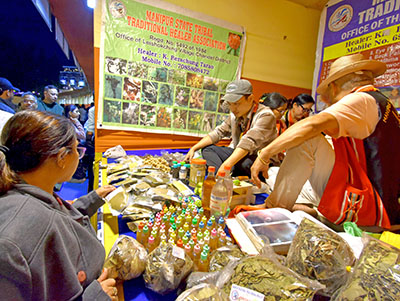 |
A public stage at Gopal Maidan is where bigger events happen and craftspeople and folk healers set up their stalls. Samvaad opens here to the mesmeric beating of 301 nagaras and dhols, which are ancient drums of various sizes, for more than an hour. It is a pulsating experience like no other. The nagaras are supported by bhers which are traditional horns whose high-pitched notes are meant to reach far and wide, chase away animals and collect the community.
It is around the memory of Birsa Munda, the tribal hero, that Samvaad is held. He is worshipped. When the nagara beats end and the event is to be declared open, T.V. Narendran, the MD of Tata Steel, with shoes off, first pays obeisance to the image of Birsa Munda.
But for all its serious moments, Samvaad is essentially a celebration — a joyous coming together of different tribes. The journeying to Jamshedpur from remote parts of the country is in itself a liberating experience for many who travel there from remote villages, several perhaps for the first time in their lives.
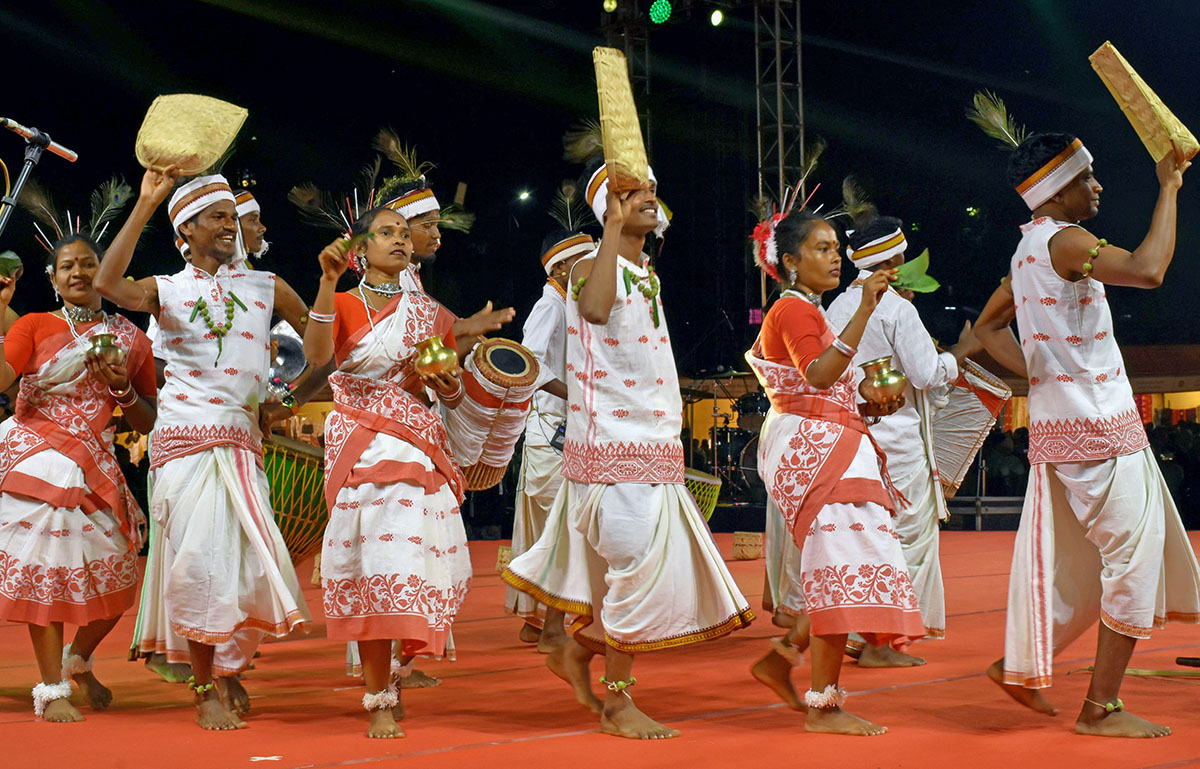
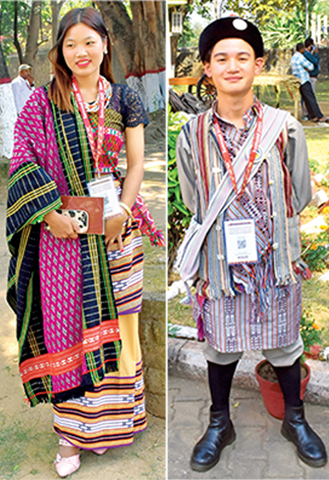 The exuberance of the occasion is perhaps nowhere more in evidence than in the singing and dancing that takes place with abandon during Samvaad. People are seen enjoying themselves with a skip in their steps. It is selfie time all around.
A highlight of Samvaad is the bands that it has spawned and their performances. The renditions by these bands represent an interesting fusion between folk and rock as also the use of traditional instruments along with modern electric ones. Tiny tribes such as the Totos in Alipurduar in West Bengal have been encouraged to come out and perform. The recent Samvaad saw performances by bands from Bodoland, Gujarat, Kerala, Tamil Nadu, Sikkim and Ladakh, among others.
Natural musical talents from different tribes have been mentored and developed and their songs have been showcased in two albums called Rhythms of the Earth produced by the Tata Steel Foundation. When the bands perform it is with enthusiasm and the mood is infectious with the audience breaking out into dance.
As participants settle in, the effervescence of the tribal spirit floods Samvaad. So irresistible is it that at the inaugural ceremony the corporate leadership of Tata Steel joins in, linking arms and swaying to the beat of the nagaras. Such is the flow that everyone goes with it.
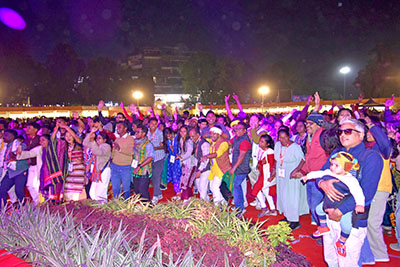 Despite the years, the energy at Samvaad hasn’t diminished. It remains fresh as though each Samvaad is the first. The enduring newness and excitement are palpable.
That undoubtedly is the result of the seriousness with which the foundation takes its outreach to tribes over the year. A large team gets personally engaged with the CEO of the foundation, Sourav Roy, leading by example.
There have also been regional Samvaads that are smaller and localized. The idea is to reach tribes on a sustained basis, understand them better and encourage them to come out. To this end the Tribal Leadership Programme and a Tribal Fellowship develop individuals who can articulate a vision for themselves and their communities that places them as equals in a modern world.
A fellow could be devising a script for a tribe, documenting lullabies or setting up community museums. The list of interesting initiatives is a long one. Five fellows are chosen every year and in all there have been 35 fellows since the fellowships were instituted.

Samvaad has grown by word of mouth. Those who come to it tell others and so the word spreads. But beyond the pulsating event that Samvaad is, the Tata Steel Foundation’s effort under Roy’s leadership is to give tribal people the confidence to discover their dreams and shore up the vanishing communities to which they belong. They are both custodians and ambassadors of their cultures. Some may like to be village-level leaders, others may want to develop a skill or grow a social enterprise.
The foundation, which is the CSR arm of Tata Steel, is behind efforts to prevent the dying out of tribal music and instruments and art. It is also encouraging tribal youngsters to learn to use their traditional languages.
As a CSR initiative formal goals have been set. Over 11 years, the foundation has managed to reach 378 tribes. The plan is to get to connect with twice the number of tribes by 2030, says Roy. Its elaborate vision of helping tribal communities find the confidence to navigate a technological world isn’t the typical CSR initiative that companies take up.
But Roy says there is much learning from getting off the beaten path. First, Samvaad shows collaborations are possible with patience and they result in learnings that don’t get expressed in PowerPoint and Excel sheets. Second, it is important to reach out to the underserved and silent because it teaches you to find the real stories and be a patient listener. Third, not all outcomes can be measured. So, says Roy: “It is important not to be too quantifiably outcome driven because the magic happens.”
Comments
Currently there are no Comments. Be first to write a comment!