



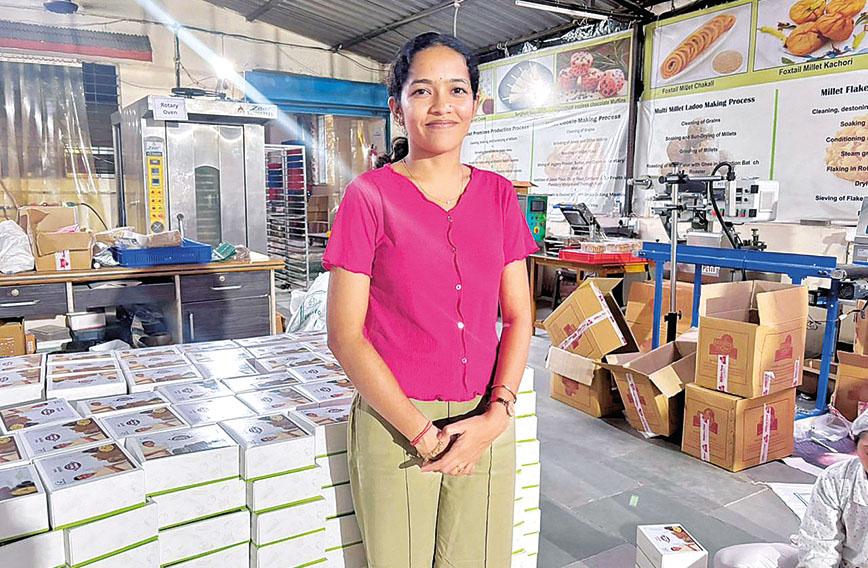
Vidhya Parshuramkar in her workplace
Rural innovator: Putting iron in the school tiffin
Civil Society News, New Delhi
When her fatigue and general weakness were linked to a lack of iron, Vidhya Parshuramkar was just one among millions suffering from anaemia. It was easy enough to fix with a folic acid supplement and she was soon back to normal. But her interest in what could be a balanced and affordable diet was sparked.
Parshuramkar was at the time a master’s student in food technology at the Indian Institute of Technology (IIT) in Kharagpur. What was essentially a personal health episode morphed into an academic pursuit and she began exploring the nutritional values of millets primarily because they are rich in iron.
An internship at Agrozee Organics, a start-up in Pune, further led Parshuramkar to an innovation that would increase the shelf life of pearl millet from a measly 10 days to six months without compromising its iron content. It involved deactivating the lipase enzyme in millet. This prevents it from turning rancid and gives it a longer shelf life.
Increasing the shelf life of pearl millet means that it can be used for products that can be distributed widely and stored and consumed over time. There are other advantages as well with millets. They are easier to grow than other crops, less demanding of water and generally healthier to consume.

With her innovation, Parshuramkar, all of 24, catapulted from intern to co-founder at Agrozee Organics. She has 51 percent of the equity and the founder, Mahesh Londhe, has 49 percent.
“The founder and I have the same vision for propagating millets and so we teamed up,” she explains.
She drives the outfit’s Millets Now programme under which the Nutri Dabba or school tiffin specifically addresses iron deficiency among schoolchildren in rural Maharashtra.
She says the Nutri Dabba has reached 400,000 children. The model is to use Self-Help Groups (SHGs) of women who distribute the dabbas or tiffin boxes. That in itself creates a new level of rural awareness of the value of millets. It also emboldens farmers to grow millets more readily. There are some 7,000 farmers Agrozee Organics says it has been working with.
Parshuramkar was recently awarded the Rohini Nayyar Prize for her contribution to transforming rural India through science and social entrepreneurship. Her work with millets links lab to field to market, making nutrition accessible and affordable. It goes beyond feeding people to promoting healthy eating and encouraging sustainable agriculture.
The Nutri Dabba touches lives at an important formative stage in school-going children and also influences families to reassess their meal compositions.
Parshuramkar belongs to a farming family. She is the first among them to have a master’s degree and that too from an IIT. The transition has been wondrous. It has been a long journey from her life in a conservative family. IIT came with a scholarship, but the really difficult part was to convince her parents to let her study further.
“I am the daughter of a farmer. All my relatives are farmers. Whatever we earn comes from farming. I thought I would complete my MTech from IIT and join a big company and do what I was told to. But then came my iron deficiency problem. It made me think. If I with my education and family background wasn’t getting the right nutrition, what must it be for others. I began looking at pearl millet or bajra because it is rich in iron. It is an ancient grain grown in western Maharashtra but not widely eaten because of the lack of awareness and lack of shelf life,” says Parshumarkar.
The Nutri Dabba serves as a snack and nutrition boost for anyone. But the target audience right now is children and lactating mothers because it is among them that iron deficiency occurs most widely. Getting millets to the people who need them most is important.
Delivery to schools happens through local SHGs in rural areas. That in turn creates the awareness needed for consumption by young mothers and women in general. But Agrozee Organics is a business and there are costs involved in making thousands of Nutri Dabbas every day.
Support for the dabba initiative comes from HarvestPlus, a global NGO, which works to combat hidden hunger — or malnourishment caused by lack of micronutrients. People could be eating good food but not getting the nourishment they really need.

HarvestPlus biofortifies crops. More Vitamin A in rice, for instance. But there is no gene modification in the millet used for the Nutri Dabba. Parshuramkar’s innovation neutralizes the lipase enzyme in millet at the time of production, allowing it to be stored for six months.
“We have seven different products in Nutri Dabba. There is a cookie, a bar, khakra, a laddu, ready-to-cook khichdi and a malt energy drink,” she says.
The Rohini Nayyar Prize provides Rs 10 lakh to a single winner annually. It celebrates rural innovators under the age of 40. Parshuramkar is the fourth recipient of the prize and the youngest so far. She was brought to Delhi to be feted at the India International Centre. The award and citation were given by Prof. S. Mahendra Dev, chairman of the prime minister’s Economic Advisory Council.
The prize is given in memory of Rohini Nayyar by her husband, Deepak Nayyar, the economist, and her sons, Dheeraj and Gaurav. Rohini served in government and was an academician of high standing. She was known for her keen interest in rural areas and worked tirelessly for their development.
An annual award is a whole lot of work right from seeking applications to vetting them and the award ceremony itself. It is a lot of heavy lifting that the Nayyars do. They are supported by friends of Rohini who figure in the jury: Ashok Khosla, Rajesh Tandon, Renana Jhabvala and Seeta Prabhu.
Comments
Currently there are no Comments. Be first to write a comment!