



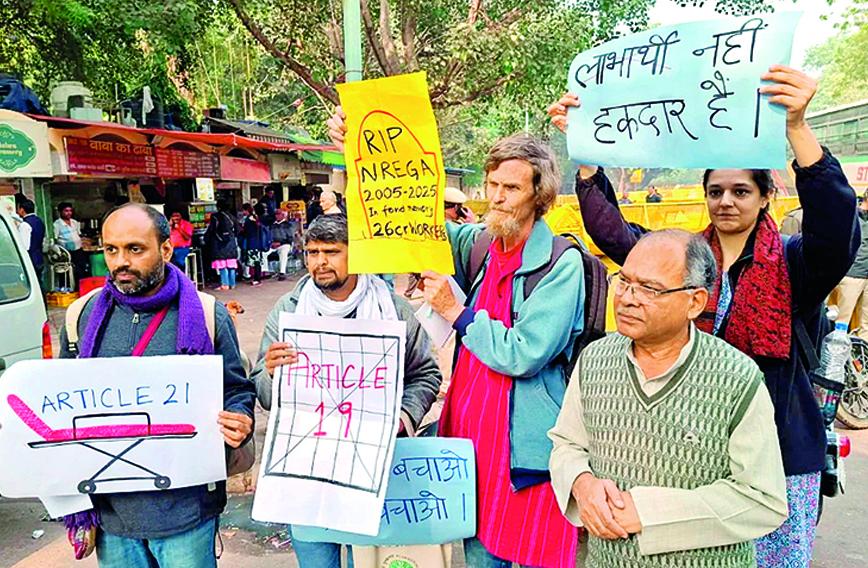
Activists protest against the repealing of MGNREGA in Delhi
A law shaped over 11 years repealed in just two days
By Aruna Roy & Nikhil Dey
THE undemocratic, hasty repeal of the Mahatma Gandhi National Rural Employment Guarantee Act (MGNREGA) and its replacement with the Viksit Bharat — Guarantee for Rozgar and Ajeevika Mission (Gramin) or VB-G RAM G raises many questions. Why was it hastily rushed through Parliament in two days? Despite heavy publicity by both the government and the ruling party, this is an unwelcome move. The government publicity of providing universal eligibility of 125 days of employment annually is also a misnomer. Where MGNREGA established a demand-driven, justiciable right to work backed by enforceable obligations on the State, VB-G RAM G replaces this with a discretionary framework in which employment is mediated by designated areas, notified geographies, capped allocations, and centrally determined priorities. The drastic changes demand detailed deliberation inside and outside Parliament as they impact an existing guarantee of the legal Right to Work: the right to demand 100 days of unskilled manual work in a financial year anywhere in India.
The haste with which the law was passed raises serious questions about the intent of the government and, in fact, the state of India’s parliamentary process. The determination of the government (assisted by the speaker) to pass the law without proper debate and by short-circuiting procedure was intended to deny time for understanding the proposed law; discussion would have raised questions with serious repercussions. The discussions over December 16-18, 2025, in Parliament when the bill was placed for passage were anything but analytical and deliberative. The various objections raised by the opposition and its pleas that the VB-G RAM G Bill be sent to a Standing Committee and discussed clause by clause were flatly disallowed. This flagrant violation of democratic procedure denied millions their right to expect the Lok Sabha to serve as a space for articulation, scrutiny, and debate.

Apart from repealing the act that had Gandhiji’s name and bringing in a new law that highlights ‘Ram’, the government exposed its continual attempt to focus debates on and gain political popularity just from the use of religious symbolism. The core guarantee of MGNREGA was the universal demand-based right to every rural Indian household to seek and secure up to 100 days’ work in a year. This has been reduced to a scheme limited to ‘notified’ areas with budgetary caps to be decided at the whim of the Government of India. This move threatens the bedrock of dignity and access to development for over 2.6 million MGNREGA-registered households. To them, the MGNREGA was a safety net to tide them over days of unemployment. MGNREGA importantly gave bargaining power to India’s poorest and most vulnerable workers.
More than 20 years ago, rural workers, drawing inspiration from the Maharashtra Employment Guarantee Scheme (passed in the 1970s), worked to convince the political establishment to frame and legislate a national rural employment guarantee law. This came to Parliament after the Congress responded to the people’s demands and made a promise of such a law in its election manifesto. The United Progressive Alliance won the election in 2004 and placed it as its first promise, in the National Common Minimum Program (NCMP), one of the most significant pieces of legislation to secure the people’s right to work.
People mobilization, led by social movements, brought unprecedented numbers from across India to Delhi in 2004. They carried over two million signatures inscribed on cloth in multiple Indian languages from Jantar Mantar to Parliament. These banners lined Parliament Street in late 2004, even as the legislative process had begun within Parliament. The essential components of the law were debated, reported in newspapers and reflected in policymaking circles across the country. Economists, social activists, trade unions, women’s organizations, Dalit organizations, lawyers and so on, pledged to make workers enjoy a small measure of the independence that was promised to them in 1947. After intense debate, discussion, and consensus building, the MGNREGA was unanimously passed on September 5, 2005 by Parliament and became what was perhaps the most important initiative to secure development and workers’ rights in India.
The MGNREGA was the result of an 11-year struggle sustained by these committed groups with wide and continuous consultation with workers across the country. The MGNREGA provided the frame for implementing the first structural frame for transparency and accountability across India. Work had to be provided within 15 days, failing which the government had to pay an unemployment allowance — which acted as both a guarantee and a built-in accountability system to monitor performance, corruption and nepotism.
All this has been unravelled and demolished in a few tumultuous days in Parliament this past December. Joseph Stiglitz, Nobel laureate in economics, stated, along with world renowned economists, that he “strongly supports MGNREGA… the world’s most significant demand-driven employment guarantee” and warned against its dismantling, highlighting its role in poverty alleviation, empowering marginalized groups (especially women), and creating rural assets. He cautioned that its weakening through underfunding and shifting the burden to states would be a “historic error” with severe social and economic consequences. The signatories included Thomas Piketty, who has demanded that as a landmark law, it needs to be retained as an essential support by being a safety net.
In the past two decades, cities have experienced a relative decline in distress migration, except among workers seeking higher wages and more skilled urban-centric work. Women workers have been the major beneficiaries of MGNREGA and financial inclusion, opening bank accounts and accessing money at critical times; thereby reducing distress migration. It has enabled their children to attend school, access local health facilities, pay back domestic debts, repair homes — gaining bargaining power at home. Guaranteed wages of 100 days’ work armed them against exploitation by extortionist employers. The bottom-up, labour-centric planning process of MGNREGA increased rural infrastructure, and strengthened and enhanced productivity. Panchayats planned for works at the gram sabha. The labour-intensive nature of work focussed on appropriate technologies, including traditional earth work which conserved the environment and doubled production by converting fallow land into productive farming and horticulture plots.
The most significant impact of the MGNREGA has been during times of economic vulnerability and recession. It served as a safety net for keeping depressed markets alive with injection of the workers’ wages in local markets — the multiplier impact on the economy. In 2008, when the world faced an economic meltdown, local markets in India were thriving because of this multiplier effect. Earnings through the MGNREGA went to purchase of items in rural markets and those engaged in commerce found their businesses thriving — so much so that a silver merchant once sought us out in Bhim to say that the works programme benefitted his business because women invested in silver ornaments which they saw as security. Panchayat budgets touched almost `1 crore in most panchayats in Rajasthan, increasing expenditure on village roads, water harvesting structures, water sheds, grazing lands and infrastructure, including playgrounds and nurseries. Sustainable rural development became possible.
With the repeal of this law, crores of workers will be left without an employment guarantee they have enjoyed for almost 20 years.
VB-G RAM G is not an employment guarantee at all. At best it is a top-down infrastructure programme where the Government of India will pay 60 percent of the costs and the states will have to bear the remainder 40 percent to service the vision of Viksit Bharat and PM Gati Shakti. An examination of a few strategically changed legal clauses explains just how the new law is legislation with different and in some places contradictory objectives.

VB-G RAM G marks a decisive break from the legal logic that underpinned the MGNREGA. The shift is not merely administrative but constitutional: it converts a right-bearing worker into a conditional beneficiary and substitutes democratic obligation with executive discretion. In doing so, it weakens the architecture of accountability that once compelled the State to respond to demand, respect timelines, and submit to public scrutiny.
More significantly, VB-G RAM G recentralises power over rural development by subsuming state and local decision-making within a unified national framework aligned to the Centre’s development vision. This reordering alters the balance of federal responsibility and dilutes the autonomy of states and local governments in shaping employment and expenditure priorities. What is at stake, therefore, is not simply the replacement of one programme with another, but a retreat from the principle that access to work is a guaranteed right central to citizenship, dignity, and democratic participation. VB-G RAM G signals a shift away from a rights-based development paradigm toward a model where employment becomes contingent, instrumental, and politically managed rather than legally assured.
By brazenly short-circuiting due parliamentary process, this repeal of the MGNREGA has compromised not just workers’ rights but the universal democratic rights of all citizens, the right to a deliberative democracy.
Aruna Roy and Nikhil Dey are activists with the Mazdoor Kisan Shakti Sangathan
Comments
Currently there are no Comments. Be first to write a comment!