



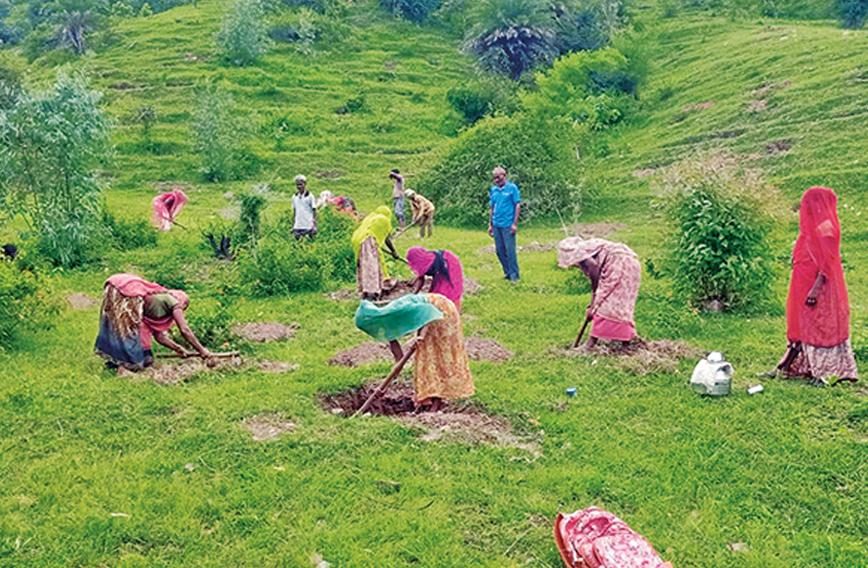
Regenerating pastures: Water retention trenches being dug along with pits for planting trees
The common good in grass
Bharat Dogra, Udaipur
Seva Mandir, a well-known NGO in south Rajasthan, has recently embarked on a daunting mission to regenerate 69 pastures in Jhadol block of Udaipur. The NGO has been working for the past 50 years on building social harmony and restoring environmental degradation.
The first issue Seva Mandir workers and their volunteers in villages are facing is encroachments. Significant parts of public land or common land have been occupied by influential and powerful people.
“The efforts of Seva Mandir have always been to achieve this objective in peaceful ways, even though this may take a lot of time,” says Bhanvar Chauhan, a senior member of the team.
The initial stage in pasture regeneration is to ensure the unity of the community for the task ahead. Differences are resolved through meetings and dialogue, a plan is prepared and volunteers take up responsibilities.

This paves the way for the second stage in which water retention trenches are dug along with pits for planting trees. Saplings of suitable trees are planted, and various other water retention and conservation tasks are also taken up.
The third stage is to put a plan in place for the maintenance of pasture regeneration work. The help of village committees and institutions that have been created for this and related tasks is sought.
In fact, the role of grassroots organizations is of crucial importance, as without their active role maintenance work can be easily neglected.
Regeneration of the environment, whether it is forests, pastures, water bodies or degraded land, cannot be achieved without the involvement of the community, believes Seva Mandir.
The trend today is to direct development activities at individual beneficiaries. The negative fallout of such an approach is that it leaves out important tasks which benefit everyone: the environment, people and animals.
 |
|
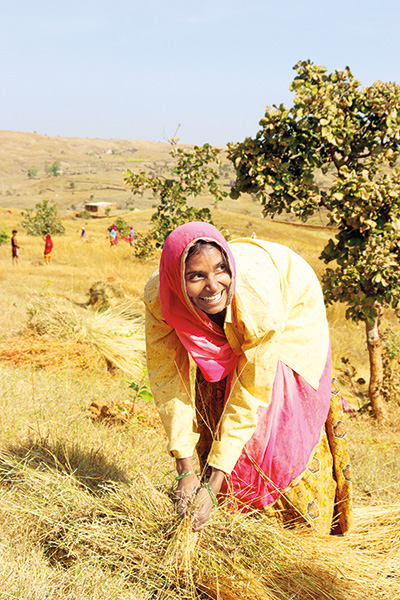
Maintenance of pastures is important |
Seva Mandir’s ideology is to unite the community for the common good. In 2023, the NGO received the prestigious Global Elinor Ostrom Award for Collective Governance of the Commons.
There are several examples from Seva Mandir’s work which underline the importance and sustained success of collective endeavour. When the forest rights law was enacted in 2006, Seva Mandir’s experience in community work placed it in a strong position to promote protection and regeneration of community forests.
In 2022-23, the Rajasthan government realized the importance of community forests and recognized such rights in areas where Seva Mandir had been working. The NGO regenerated nearly 38,000 hectares. The big challenge now is expanding the work of forest regeneration to a wider area.
Preetam Kumar, an activist, said at a group discussion in Jamun village, “Some people discouraged our stand for the common good, but we stood firmly by our ideals.”
The initial results in community forests close to Jamun village have been encouraging and nearly 6,500 trees have been planted here. “These efforts benefit not just one hamlet but all the hamlets of the panchayat and their beneficial effects extend beyond the village. Such efforts are based on unity of the villagers and their increasing ability to work together, but in addition their success also strengthens this unity further,” says Kanhaiyalal, the sarpanch.

In other villages watershed development projects have done much to increase greenery and improve water and moisture conservation in ways that benefit the entire community. Ramaj is one such village in Udaipur district where watershed development work was completed many years ago but people continue to benefit from it in the form of a raised water table and improved livelihood prospects.
Bringing the community together is not an easy task. Seva Mandir’s workers achieve this by promoting equality, dignity for all and removing gender-based discrimination and restrictions. Achieving such unity is particularly important in villages where there are people from several communities and faiths.
Delwara is an urbanizing village or kasba with about 18 communities and as many mohallas or hamlets. Once unity of purpose was achieved, the community was mobilized for tasks like cleaning and restoration of tanks and stepwells which should have been promoted as heritage water sources but had been neglected for years.
Murlidharan, a resident of this village who has been active in these efforts, says, “Once we got rid of narrow divisions and discrimination, we cleared the way for development activities to pick up.” Sabiya, another resident, comments on the sense of unity in her village, “When outsiders come here, they say they like the vibe here, they want to mix with people here.”
Varsha Rathore, another team member who has been involved with several Seva Mandir initiatives, says, “These efforts at increasing community unity may take time but finally they prove very helpful in taking forward various development objectives.”
Ronak Shah, a senior and highly experienced team member, asserts, “In Seva Mandir’s efforts, improvement of social relationships has been a very important part of development initiatives.” This is an understanding that can be helpful for social development initiatives on a much wider scale too.
Comments
Currently there are no Comments. Be first to write a comment!