



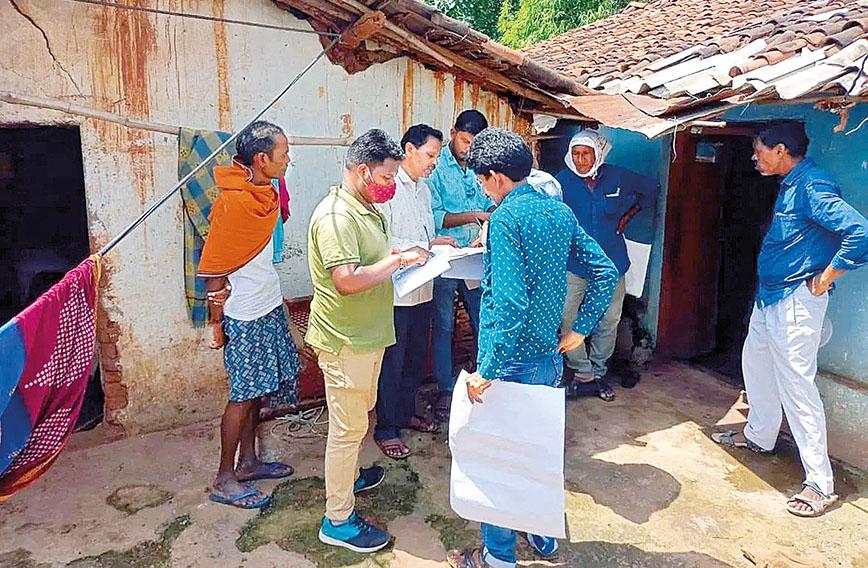
Officials carrying out a survey for the Jaga Mission
Odisha figures out land rights in urban slums
Rina Mukherji, Pune
Across Odisha, the slow pace of urbanization is striking. Towns and cities account for barely 17 percent of the state. Even so, this is where the Jaga Mission for Slum Transformation has been notching up several successes including dealing with the thorny issue of bestowing land rights on slum dwellers.
Since about 40 percent of the slums in Odisha are on privately-owned land, passing on the rights to the occupiers has meant setting up negotiations with owners and local municipal bodies and coming to workable solutions.
This and other interesting insights have emerged from two sessions of a webinar, 'Slums are Solvable,' held by the Habitat Forum which goes by the abbreviation INHAF. The webinar focused on the working of the Jaga Mission, the world’s largest slum development programme.
So far 1,600 slums have been transformed and the quality of life for 412,000 households upgraded. This is an achievement unmatched in other states and also gives Odisha an edge in its governance of urban areas even before urbanization gathers momentum.
Anindita Mukherjee, an urban economist and development practitioner, said the Jaga Mission took shape in 2017, following an initiative by the state government to rid Odisha of its slums. The steps, she explained, involved identification and listing of all slums, participatory needs assessment, an infrastructure gap assessment or I-GAP, executing of slum upgradation followed by completion, delisting, land-locking and relocation after delisting.

Without holistic planning, slum improvement is always at risk, she said. To ensure slum upgradation worked, it was complemented with several other schemes. Mukherjee pointed out that 40 percent of slums in Odisha were not on government land. To deal with slums on private land, negotiations between the landowner, the urban local body (ULB) and the slum-dwelling community had to be carried out to decide on the issue.
Mapping was conducted through satellite imaging and after ensuring that no legal suits were involved, the Jaga Mission began work. Fortunately, there was no dearth of government land available for resettling slum dwellers, if relocation and resettling were deemed essential. Relocation was generally avoided but, when undertaken, was never done beyond a kilometre from the original settlement.
The INHAF webinar featured beneficiaries speaking about the transformation the mission had brought about in their lives. Mamata Rani Adhikari, member of the Slum Development Association (SDA) from Khurda, recounted how slum upgradation had provided running water, roads, electricity, and all facilities akin to what middle-class residents enjoy in urban centres. Most of all, she said, it had empowered women like her who now had a voice in their neighbourhood.
Since there were more women than men in the SDA in her neighbourhood, women felt important. “Everyone respects us now. We had never heard of a community centre, or a play area in our slum colony. This is the first time that we are benefiting from having both and we feel so happy,” she said.
However, the slum dwellers had one major grouse. In spite of having land rights, banks were unwilling to give loans against their homes. Shishir Dash of Tata Steel explained that land rights were made non-transferable. Hence, slum dwellers could not transfer ownership of their land to anyone nor borrow money against it. This actually ensures stability of residence and prevents land speculation.
In the penultimate session of the webinar series, Kirti Shah of INHAF referred to the then ongoing COP-30 at Belem, Brazil, and how strengthening cities was an important part of Urban Climate Action. This was followed by several speakers analyzing the role of community participation in improving and upgrading slums.
Anand Iyer, chief policy and insights officer, Janaagraha, pointed out that one-fourth of urban residents worldwide, numbering more than a billion, live in slums, a figure that is expected to double by 2030. He spoke of the role of community participation in transforming and overhauling slums globally.
Iyer compared the success achieved by the Favela Bairro programme in Brazil, the Cano Martin Pena Community Land Trust in Puerto Rico, the Shack Dwellers Federation Project in Namibia, the Baan Mankong Programme in Thailand, the Ranya Low Income Housing Project in Indore, the Slum Networking Program of Ahmedabad, and the Kalyanpuri Redevelopment Project in Delhi. He noted how a flexible design in keeping with the needs of the community, finance and access to credit achieved the best results.

He also pointed to the commitment of elected representatives and administrators in every case. In Namibia, Thailand and Puerto Rico, land was held by the community through a trust. In Brazil, Indore and Delhi, selling was not allowed. In Namibia and Puerto Rico, selling, sub-letting and renting were all managed by the slum community through a trust. In some cases, the community arranged for and managed basic facilities. In others, individuals built their dwellings with access to inexpensive finance, while the government provided basic facilities.
Sangramjit Nayak, former director, municipal administration and mission director of the Jaga Mission, spoke at length about the processes involved in bringing the mission to fruition in Odisha. Every house in the upgraded slums now has an individual toilet, running water, and electricity. Slum colonies also have street lights, tarred roads, and stormwater drainage, money for which was provided through the concerned ULB or municipal administration. Funds had also been tapped through using 25 percent of funds allocated to every ULB for slum upgradation. After a slum was upgraded, it was the Slum Dwellers Association of the respective slum that was put in charge of applying for the delisting.
M. Srinivas, former executive officer, Konarak NAC (Notified Area Council) and administrator, municipal governance, spoke of participatory urban development, and the role of women’s credit societies in upgraded slums. “The women in upgraded slums are now supplementing their income by selling vegetables and eggs,” he said.
Ankita Khuntia, manager, state program (Odisha), Janaagraha, recounted the major challenges the mission faced and how such hurdles were overcome. The design of the mission, its processes and outreach, converted it into a people’s mission from a government one, imparting dignity to slum dwellers.
Comments
Currently there are no Comments. Be first to write a comment!