



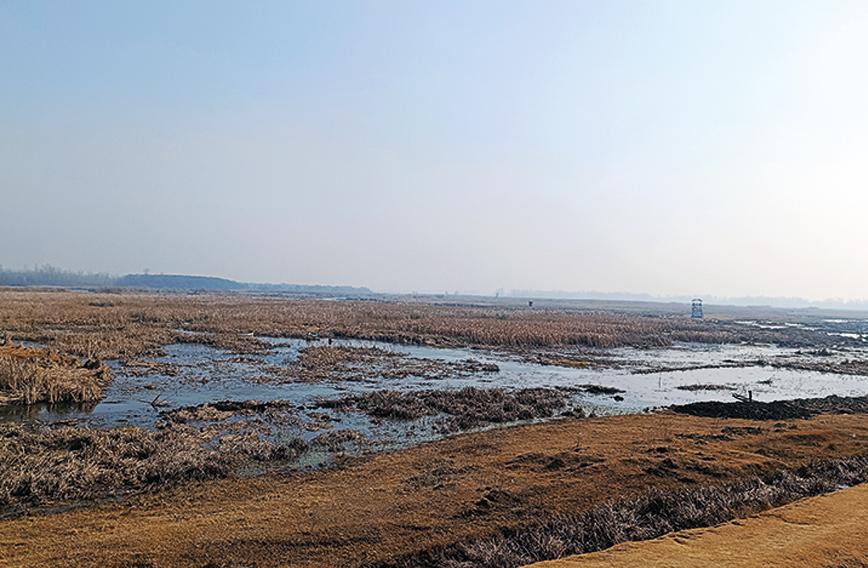
The Shallabugh wetland where there have been five breaches | Photo: Civil Society/Bilal Bahadur
Wetlands in Kashmir are withering
Jehangir Rashid, Srinagar
Although there are five wetlands of international repute in Jammu & Kashmir (J&K), they don’t attract tourists. Even birds will begin to flee from these wetlands due to their abysmal state, fear environmentalists. All five wetlands are Ramsar sites.
“Our wetlands are not vacant lands but living systems that sustain water security, biodiversity and community resilience. What we are witnessing is not natural decline, but human-induced collapse,” says Prof. Bilal Bhat, president, School for Rural Development and Environment (SRDE).
“SRDE’s documentation of nearly 50 wetlands across Kashmir, both notified
and unnotified, presents a sobering reality. Rampant encroachment, pollution, siltation and hydrological disruption are steadily degrading these fragile ecosystems. Climate change has intensified the crisis,” he says.
Early glacial melting, rising temperatures and altered water regimes are destabilizing wetlands beyond their capacity to regenerate. This is further aggravated by unchecked sand mining that drains wetlands, disrupts natural hydrology and accelerates physical shrinkage of the wetlands.
The five wetlands are Shallabugh, Hygam, Surinsar-Mansar, Hokersar and Wular lake. A sixth one, Tsomoriri, is in Ladakh. The Shallabugh and Hygam wetlands became Ramsar sites recently, in 2022.
Engineer Ajaz Rasool, an expert in hydraulic engineering, blames the wetlands wing of the Department of Forests as well as the Irrigation and Flood Control (I&FC) department for the degradation of the wetlands.
“The two departments need to work together. On the ground it’s clear they are working in opposition to each other,” he says.
“We visited the Hokersar wetland and found that the I&FC had dug a water channel right in the middle of the wetland. They had dug deep but there was no water in the channel. There are clear-cut directions that soil dug out has to be shifted two and a half kilometres away from the site but that was not done,” pointed out Rasool, who is a council member of the Environmental Policy Group (EPG), a think tank in Srinagar battling environment degradation and unscientific planning.
After the EPG intervened, the I&FC department took action. It has constructed inlet and outlet gates at this wetland. Rasool also flagged encroachment. Buildings are being constructed, he alleged, with the support of a legislator.
“The legislator tried his best to justify such wrongful activities but we raised our voices. As a result, such encroachments have been stopped. We found carcasses in the water in Hokersar and noted other types of pollution. The two gates that have come up at a cost of `28 crore were inaugurated some time ago in the presence of civil administration officials,” said Rasool.
Of deep concern is water pollution. “Urban pressures have added another layer of damage,” says Prof. Bhatt. “Untreated sewage, bio-medical waste and solid waste are directly contaminating wetland waters, destroying aquatic life and food chains. The wetlands are increasingly being reduced to dumping sites rather than protected ecosystems.”
Bhatt rues the absence of “an integrated and coordinated governance approach”.
“Fragmented institutional roles, weak inter-departmental coordination and lack of accountability continue to undermine conservation efforts. Wetland protection requires scientific planning, coordinated action and transparent governance. Safeguarding Kashmir’s wetlands is not just an environmental necessity, it is a collective responsibility toward future generations,” he emphasizes.
“In Shallabugh wetland, five breaches had taken place. When we asked the officials concerned to plug them, we were surprised by their reply. They said the breaches would only be plugged after due tendering process. It was with great difficulty that we convinced them that breaches can be plugged simply by arranging sacks of soil,” said Rasool.
JCBs were used to dig up a water channel at this wetland though use of such machinery is not prescribed for wetlands. It was only after the efforts of the EPG that water could be restored. Migratory birds have now returned.
As for the Hygam wetland, there is complete mismanagement, as Rasool outlined. “No water is coming in from the Gulmarg side. The plan was to develop a pond. But that was shelved for reasons best known to people at the helm.” He alleges that the I&FC department has allotted the contract for carrying out dredging work to a favoured contractor.
“When I visited this wetland, I rang up the executive engineer of I&FC Narbal division and told him that water was being drained out. I also raised objections over the usage of the JCB. It would lead to chaos and result in birds running away,” said Rasool.
The EPG has proposed that in-service training be given to officials of the Department of Forests since they are posted to the wetlands wing at some point during their careers. He demanded a blanket ban on JCBs in the wetlands.
One reason for the degraded state of the wetlands is the absence of people’s participation. The wetlands are meant to deliver both ecological security and economic dignity, points out Dr Shaikh Ghulam Rasool, founder of the Nature Conservancy Alliance (NCA).
“Yet, in reality, these wetlands reflect a disturbing imbalance. While ecological value is repeatedly highlighted, economic benefits for local communities remain absent, raising serious concerns about how commitments were presented to the Ramsar Convention authorities,” says Dr Rasool.
Communities who have historically depended on these wetlands are now treated as intruders rather than custodians. The wildlife department’s restrictive, top-down approach has alienated people and weakened conservation. Without local livelihoods, conservation cannot survive, Dr Rasool emphatically points out.
“Institutional accountability is non-negotiable. Integration of modern science with traditional knowledge systems, combining ecological research with lived community wisdom, is what can truly safeguard Kashmir’s wetlands with their original ecological character. Conservation must shift from control to collaboration if these ecosystems are to survive,” says Dr Rasool.
Comments
Currently there are no Comments. Be first to write a comment!