



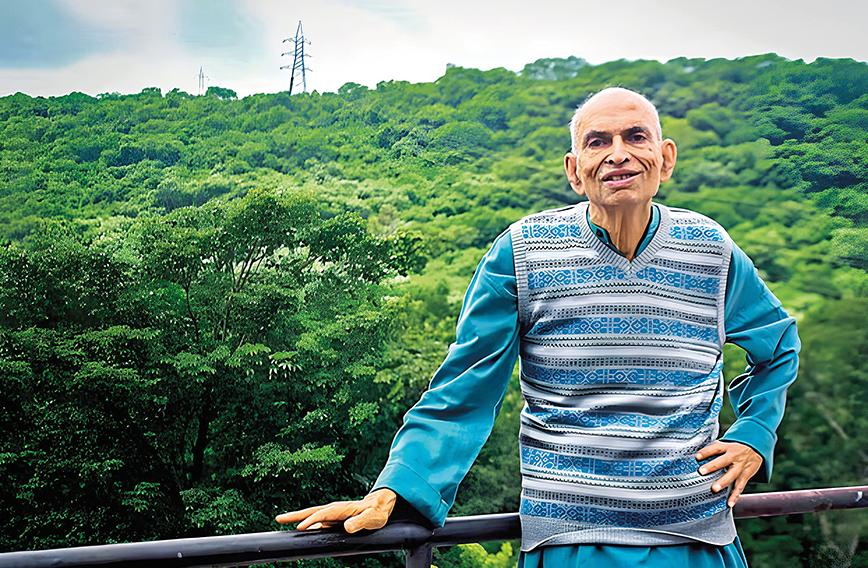
Madhav Gadgil: Scientist and campaigner
Gadgil’s concern for ecology was rooted in realism
Rashmi Gopal Rao
OFTEN called the ‘people’s ecologist’ for speaking up for the rights of marginalized communities, Madhav Gadgil will be remembered as one of India’s best known ecologists. He championed the cause of tribals, who he said were an integral part of the ecosystem. His approach to conservation was democratic. Gadgil was known to ‘speak’ for forests, rivers and communities.
He passed away at the age of 83 on January 7 at his home in Pune after a brief illness. A well-known writer, columnist and scientist, Gadgil founded the Centre for Ecological Sciences at the Indian Institute of Science (IISc) in Bengaluru in 1983.
He meticulously researched sacred groves and the importance of such carefully conserved community forests. He spent years in the Bandipur Tiger Reserve studying the behaviour of elephants, their habitat and even mahouts. Gadgil played a key role in the establishment of the Nilgiri Biosphere Reserve in 1986. He was deeply involved in the Save Silent Valley Movement and in the protection of the forests of Bastar.
But his seminal work which made him a household name was as chairman of the Western Ghats Ecology Expert Panel (WGEEP), later known as the Gadgil Commission. The Western Ghats, a UNESCO World Heritage Site and a global biodiversity hotspot, was a landscape that Gadgil dedicated his life to.
In 2011, he submitted his report which recommended designating around 64 percent of the Western Ghats region as an Ecologically Sensitive Area (ESA). The report laid out several guidelines on activities like mining, quarrying and the construction of dams in the region. While it did not call for a complete ban on such activities, it advocated a decentrallized approach on decision-making and called for the participation of gram sabhas (village councils).
The report, however, was met with resistance and rejection by commercial and political lobbies. It was ultimately sidelined by the then United Progressive Alliance (UPA) government and later superseded by the Kasturirangan Committee which eventually reduced the areas under protection and recommended a top-down approach to decision-making.
Irrespective of the end result, Gadgil continued to have an immense love for one of India’s most fragile ecosystems. Honouring his immense contribution, a new species of plant from the Nelliyampathi hills of the Western Ghats was named in Gadgil’s honour in 2021 — Elaeocarpus gadgilii.
Gadgil also had a prominent voice in public policy. He was a member of the Prime Minister’s Science and Technology Advisory Council and also backed implementation of the Forest Rights Act. He was one of the architects of India’s Biological Diversity Act.
Looking back and ahead
Born on May 24, 1942 to Pramila and Dhananjay Ramchandra Gadgil, a well-known economist and Cambridge scholar, Madhav Gadgil graduated in biology from Fergusson College in Pune and did a master’s in zoology from Mumbai University. He went on to earn his PhD in theoretical biology from Harvard University after which he returned to India.
Gadgil was always passionate about nature. He went on birding walks with his father as a boy and met the great ornithologist, Salim Ali, at a young age. He was deeply interested in wildlife. Even as a teenager he was aware of how destruction of natural resources and displacement were consequences of development. Pioneering Indian anthropologist Irawati Karve was his neighbour. She had a profound influence on Gadgil during his formative years. He often accompanied her on field trips. Karve encouraged him to develop an outlook that was beyond the barriers of class, caste and creed.
Gadgil joined IISc in 1973 and worked there for over three decades during which he made the institution a pioneering centre for ecological studies. He is credited with launching several research programmes in the institute and was known for his evolutionary approach in his extensive body of work spanning conservation biology and environmental policy. He retired from IISc in 2004.
Gadgil authored six books, scores of peer-reviewed journal publications and several articles. He co-authored the well-known book, Fissured Land and Ecology and Equity, with Ramachandra Guha. Apart from English he also wrote in Marathi.
He received several awards for his exemplary contributions in conservation and ecology. These include the Volvo Environment Prize in 2003, the Tyler Prize for Environmental Achievement in 2015, and the UN Champions of the Earth 2024. He was conferred the Padma Shri in 1981 and the Padma Bhushan in 2006.
“Madhav Gadgil’s achievements in the field of ecological sciences was truly noteworthy. He balanced academics and activism with great ease and always exhibited deep sensitivity towards issues relating to people’s concerns and livelihoods. His work will always be a source of inspiration and learning for many of us,” said Ashish Kothari, an environmentalist based in Pune.
Gadgil is survived by his son and daughter. His wife, Sulochana Gadgil, who was a reputed Indian meteorologist and professor at the Centre for Atmospheric and Oceanic Sciences (CAOS) in Bengaluru, passed away in July 2025.
Comments
Currently there are no Comments. Be first to write a comment!