



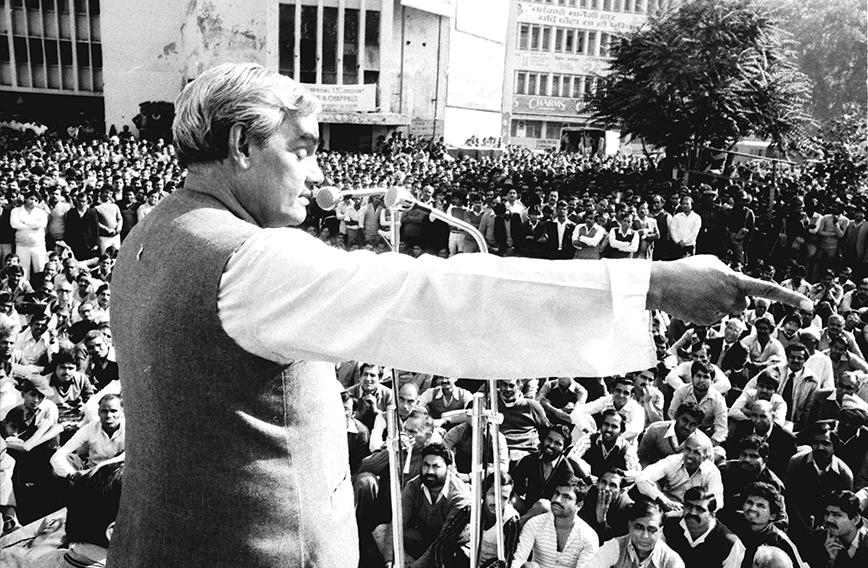
A poet and orator, Vajpayee was known for his principles and humanity
The all-time mentor
Umesh Anand, New Delhi
Politicians are generally seen as being episodic and transactional. They move on easily and look back only when there is something in it for themselves.
So, when a politician who prefers to be different comes along, it is worth sitting up and taking notice. Vijay Goel, a veteran of the Bharatiya Janata Party (BJP), is one such.
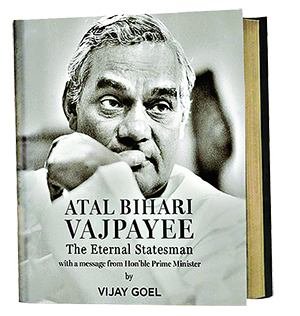
Painstakingly and with considerable emotion, he has put together a tribute to Atal Bihari Vajpayee to mark the late prime minister’s 100th birth anniversary. A large-format book, it traces the life and career of Vajpayee in rare pictures, creatively displayed with production values that could hold their own in just about any quarter of publishing.
Vajpayee was a colossus in politics. A poet and orator, he was known for his principles and humane values, treating his adversaries with empathy and affection. He was universally liked and showed how it is possible to be in the cut and thrust of public life and yet rise above it.
Like most icons, Vajpayee has been given his pedestal but allowed to recede from public memory. Not so for Vijay Goel for whom Vajpayee was a mentor with whom he worked closely for over five decades. He was deeply influenced by Vajpayee from his student days and knew him personally as well because of his father. In formal politics, the high point of their association was when Goel served as minister in the Prime Minister’s Office (PMO) under Vajpayee.

Goel remembers Vajpayee when it is not necessarily expedient to do so. His is a selfless, passionate effort. It comes at a time when politics needs all the nourishment it can get.
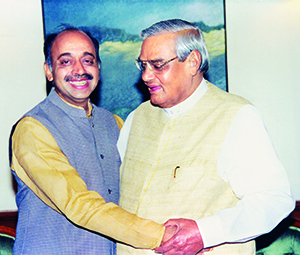 |
| Vijay Goel with Vajpyee, his mentor |
Goel’s curation of pictures brings alive a Vajpayee not many will easily recall — and coming generations are certain to forget. To present Vajpayee over the years in his many avatars in a single volume is therefore a service and a contribution to contemporary history. It is a biographical mode that should be used more often. Many leaders come and go, remembered only by those who were close to them. In an age of AI creations, a personalized tribute has its own value for posterity.
The book has much biographical value. It begins in Gwalior in 1924 where Vajpayee was born, covers his student days at Victoria College and DAV College and his early association with the RSS. There are the Bharatiya Jana Sangh years under S.P. Mukherjee and Deendayal Upadhyay, and the protests of the 1960s and 1970s.
Vajpayee rose to the highest echelons of public life, but he rose from being a grassroots politician and what better way of tracing this narrative than through the rare pictures that Goel has assembled.
His speeches at rallies were in a style of his own and drew crowds even in parts of the country his party didn’t have significant followings.
 Vajpayee’s hallmark was his warmth and it showed in his dealings with his political competitors as well. The book captures this, a particularly interesting picture being of Vajpayee and Indira Gandhi before the 1971 war.
The rise of regional politics and entities was recognized by Vajpayee and he foresaw the need to accommodate diversity rather than crush it. His inclusive nature was suited to governance through coalitions. It helped also that he was accepted personally across a spectrum of interests.
Goel’s tribute has much to do with his own interest in photography. He shoots pictures. That he has a clear eye for a good book is evident from this one. He is a restorer too and has revived a haveli in Chandni Chowk in Delhi, a constituency he once represented.
Atal Bihari Vajpayee: The Eternal Statesman has been published by the Heritage India Foundation. It is available on Amazon.
Comments
Currently there are no Comments. Be first to write a comment!