



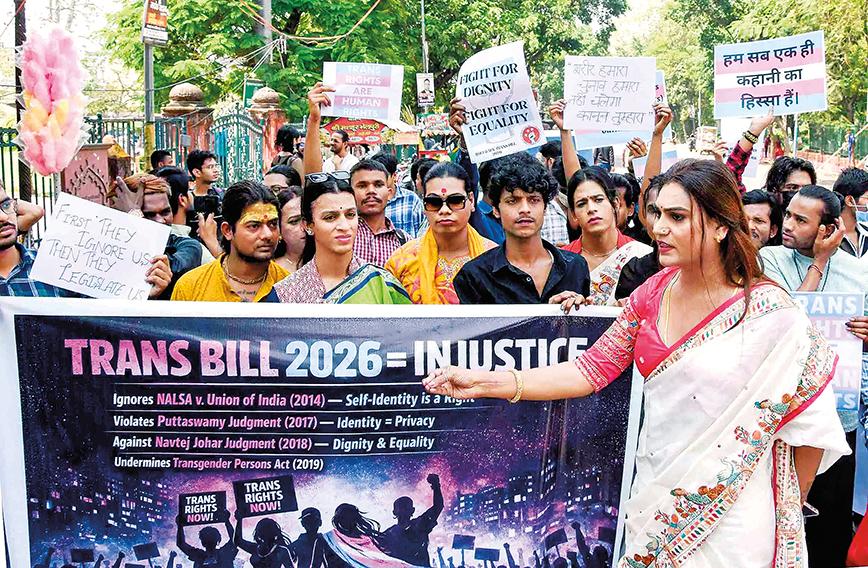
The Transgender Persons (Protection of Rights) Amendment Bill, 2026, triggered mobilization across India
Trans people put in a fix after new law is passed
Aiema Tauheed, Kolkata
Rochelle Pinto, a 29-year-old transwoman who works as a human resources professional in Mumbai, has been undergoing Hormone Replacement Therapy (HRT) for over a year. Pinto was legally recognized as a transwoman until now.
The recent Transgender Persons (Protection of Rights) Amendment Act, 2026, invalidates her identity. The Act does not recognize people with ‘self-perceived’ gender identities as transgender.
“I would even be seen as a criminal, as someone who is living in this country without any legal aid or without any legal document,” says Pinto.
The new law removes self-identification and narrows the definition of transgender. It includes the kinnar, hijra, aravani and jogta which are socio-cultural identities traditionally recognized as transgender. It also recognizes as transgender those with intersex variations at birth, and those “forced to assume a transgender identity by mutilation, emasculation, castration, chemical or hormonal procedures”.
Also, to be recognized as transgender, the person will need to obtain a certificate after applying to the district management and undergoing a medical examination.
The transgender community points out that removing self-identification violates provisions of the landmark 2014 National Legal Services Authority (NALSA) vs Union of India judgment which officially recognized transgender individuals as the “third gender”, and granted them fundamental rights under the Constitution. It upheld their right to self-identify their gender, based on their psychological, not biological criteria, and without having to undergo sex reassignment surgery.

Introduced in 2016, the Transgender Persons Bill faced nationwide protests, with activists arguing it had been drafted without consulting the transgender community. After revisions, it was eventually passed as an Act in 2019.
At least the 2019 law allowed them to self-identify. The question of who is a transgender person was also largely accepted. The transgender community has been demanding changes since then but the new amendment is even more regressive, it says.
“It goes against the spirit of the Constitution and the essence of saying that we belong to this country,” says Pinto, who calls it “fascist”. By reinforcing that trans people like her are illegitimate, access to education, employment and a life of dignity will become harder than it already is for a community that lives with daily discrimination.
Twenty-five-year-old Rihaa, a human rights professional in Delhi and a transwoman, says the amendment completely disrupts her life.
“I’m not recognized under the law,” she says. “My Aadhaar card, my PAN card, passport, and everything else says I am male. And unless I deny myself my self-perceived gender identity, I will face harassment at every single place.”
“What you can’t deal with is when people keep asking you to change queues at an airport. You look like a woman, so please go stand in the women’s queue. When you’re in the women’s queue, the security guard will see your Aadhaar card and say, Oh, please, can you go to that male queue? A lot of these seemingly small things have a major impact because they become the gateway to harassment.”
 |
| Chittaji Mitra |
Chittajit Mitra, 32, is a gender queer translator and writer from Uttar Pradesh (UP). He is also general secretary of the state’s People’s Union for Civil Liberties (PUCL) and co-founder of the Resistance Alliance for Queer Solidarity (RAQS), founded in 2016 in Allahabad to address the lack of Hindi conversations on queerness in UP.
The three markers used in the legislation to understand transness — physical appearance, chromosomes, and genitalia — is a regressive step, he says. It confines all trans people as belonging only to socio-cultural identities like hijra, kinnar and so on. It also reinforces myths that trans people abduct children, force their transgender identity on others and are basically criminal.
“It feels less like a measure aimed at improving the lives of transgender people and more as if it draws from uninformed, everyday conversations happening at another tea stall in UP,” he says, sardonically.
After the 2014 NALSA judgment, bodies like the National Council for Transgender Persons and state-level transgender boards had brought together members of the community from across the country. Yet, he says, the government chose not to engage with them while drafting the 2026 amendment.
By removing the right to self-perceived gender identity, the new law upends Section 4(2) of the 2019 Act and the 2014 landmark NALSA judgment, he points out.
Sex is what one is born with and gender is a social construct. “One can have gender dysphoria due to which some persons would like to change their biology. But gender by itself doesn’t have anything to do with biology,” says Mitra.
 |
|
Rochelle Pinto |
“Basically they have divided the transgender community into three groups—socio-cultural identities like hijras and kinnars, intersex persons, and those allegedly ‘forced’ into being transgender. Many in the more expansive ecosystem of trans people that the original 2019 Act recognized are nowhere in this law. It’s very undefined.”
He cites the example of Manipur’s Nupi Maanbi and Nupi Maanba. These are indigenous trans communities that find no mention in the new legislation. “There are many trans groups outside this conventional idea of hijra and kinnar,” he says.
By centring on only a few recognized groups, he argues, the legislation risks reviving regressive ideas of “real” and “fake” transgender identities.
He points out that the law is harmful even to the socio-cultural communities it claims to recognize as it redundantly includes kidnapping and abduction provisions which are already covered by criminal law. “There is no need to put such provisions into the transgender protection of rights bill, unless you want to give this message that transgender people are specifically known to kidnap and abduct people.”
Besides, Mitra explains, many young trans people in India wait to turn 18 to escape from natal family violence. They find refuge with NGOs or with hijra or kinnar gharanas. But families often respond by filing abduction cases. It becomes a case of the family’s word versus the young adult’s before the police. The consequence is that the spaces that offer safety to queer and trans individuals are put at risk.
“The police will target you if you choose to save a trans person from their own family, who might even kill them. It is not unheard of in India for young transwomen to be raped by their own family members to teach them how to be a good ‘woman’.”

The amendment also puts in place a medicalised process of recognition, believes Mitra. “Now a medical board is basically going to check the bodies of transgender people when they approach the district magistrate for a transgender card. The magistrate, if he or she has doubts, will refer that person to a medical board.” It is intrusive and flawed. In any case, the hospital will have to register the person undergoing the examination as a transperson.
A revised certificate of identity now requires undergoing surgery to change gender. Many adult trans people prefer to undergo transition surgeries privately. “If you are going to force them to change their documentation and force the hospital to report this, their lives will become very difficult,” says Mitra.
“We need to understand that many trans people hide these facts from their parents, even while they are going through transition," explains Mitra.
The message from the community is clear — the fight for their rights is far from over.
Comments
Currently there are no Comments. Be first to write a comment!