



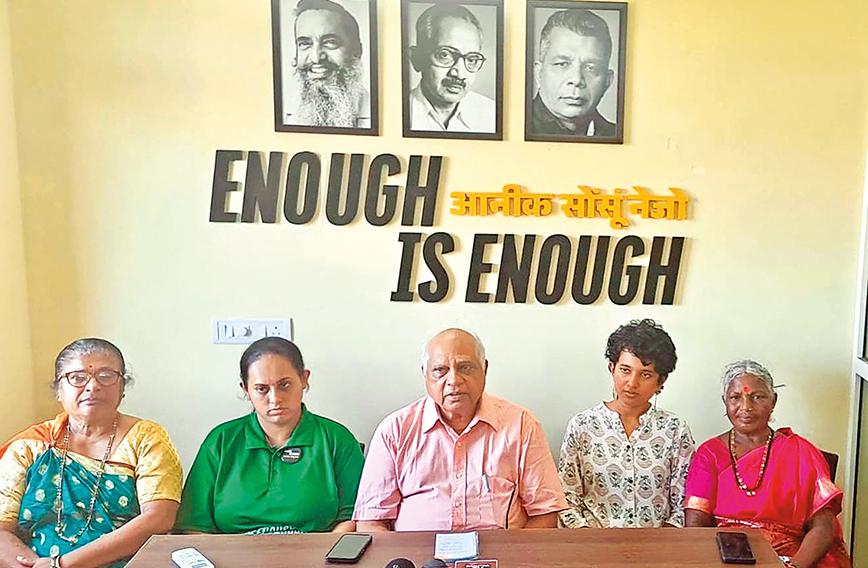
Rebello with women supporters in Panaji
Violations in crosshairs, Goa stir gathers steam
Praveena Sharma, Panaji
Early this January, a message addressed to Niz Goenkar, or the original Goan, rapidly circulated on social media across Goa. Posted by Justice Ferdino Rebello, former chief justice of the Allahabad High Court, it invited Goans to join the public meeting of the ‘Enough is Enough’ movement on January 6 at the Institute Menezes Braganza Hall in Panaji.
His note seemed to spark a fiery resolve in Goans, who have been pushed to the brink by illegal construction, altered laws for outside investors, indiscriminate development, and unchecked environmental destruction in their state. To Justice Rebello’s surprise, the turnout at the event was beyond expectation. That day, the Enough is Enough movement took off with a bang.
Since then, Justice Rebello and his core team — consisting of civil society groups, individual activists and lawyers — have been holding public meetings across Goa, in villages and towns, to create awareness on the 10-point charter drawn up by them to reclaim Goa, which they feel has been systematically destroyed over the past few years.

Based on the demand charter of the Enough is Enough crusade, a draft bill titled The Goa Protection of Agricultural Lands Act, 2026 has been prepared but is yet to be tabled in the assembly for discussion.
The growing movement has put the state government and authorities on the backfoot, compelling them to pussyfoot on environmentally sensitive projects and policies. Justice Rebello revealed that the recent postponement of elections in 11 municipalities, scheduled this month, to a date beyond the 2027 assembly elections could have been due to brewing discontent against the government following the launch of his movement.
“One does not understand why the municipal elections were delayed. I believe they did not want to test the waters in urban areas now that people are more conscious (of how their policies and governance are destroying Goa),” he says.
 |
|
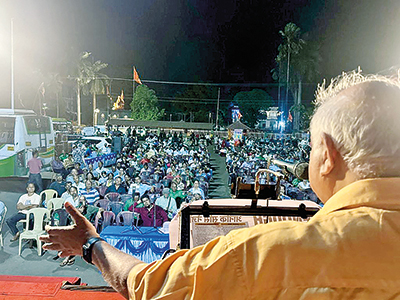
More people are turning up at meetings to listen to Rebello |
As awareness, sparked by the Enough is Enough movement, spreads Goa has witnessed the government backtracking on projects and land use zone changes in Pernem taluka, Chimbel village and Mirabag even as people in Siridao village and Karapur town continue to relentlessly protest against irregularities in projects approved by various authorities.
In Pernem, the Town and Country Planning (TCP) Board — headed by TCP Minister Vishwajit Rane — last month cleared reclassification of around 10 lakh sq. m of land to No-Development Zone (NDZ) in Regional Plan 2021. This move is being seen as a retreat by the minister with land parcels in Chopdem, Mandrem and Arambol — earlier classified under mixed-use categories such as settlement, orchard, and natural cover — reverting to NDZ category.
For over a month, residents of Karapur in Bicholim taluka have been protesting steadfastly against the House of Abhinandan Lodha’s villas-with-private-swimming-pool project. There are no signs of fatigue as yet. If at all, the movement has picked up momentum with the Bombay High Court at Goa hearing the petition filed against the replacement of a 70-seater casino ship with a new 2,000-seater vessel on the Mandovi river.
Clearing out a cluster of casino ships from the Mandovi river is one of the goals of the Enough is Enough campaign. A team of activists called ‘Ponnjekars (Panaji residents) Against Casinos’ is exclusively working on it. They believe the floating casinos are a navigational threat and disturb the river’s ecosystem.
For now, the court has barred a 112-metre casino vessel, which reached Mormugao Port in Goa on May 6, from entering the Mandovi without proper certification and its permission.
The crusade is being driven by dedicated teams, which are toiling hard to move the needle on the 10-point charter. Justice Rebello said it was Right to Information (RTI) activist Sudip Tamankar and his own lawyer son Akash Rebello’s extensive research on casinos that gave him the confidence to go ahead with the writ petition.
“Research on the casino petition took a lot of time and effort. Frankly, it is my son and I who had to do most of the research. Of course, Tamankar has been single-handedly taking up the issue for a long time. The extensive material gathered by him over the years has helped us build a strong legal case on the casino issue. A former chief justice of Odisha is also appearing pro bono in the case,” says Justice Rebello.
Further, another legal team is giving final touches to a second petition — on hill cutting — to be filed soon in court. According to Justice Rebello, the biggest challenge is getting senior lawyers to assist him. Since the movement took off, the retired judge, who was all set to pursue his passion for wildlife photography, is finding himself perpetually buried in the legal workload of the movement.
As the Enough is Enough movement navigates several challenges, it has fallen slightly behind its deadline for putting an organizational structure in place. What began as a five-member core group has now expanded to about 15 members. Justice Rebello wants to extend it to more than 50 members.
Activist Francis Coelho, who was among the first five members of the core committee of Enough is Enough, says they have already held public meetings in eight of the 12 talukas in the state and plan to have covered all by the end of May 2026.
The movement will be driven by a three-tier organizational structure with the core committee at the top followed by the taluka committee at the next level and the village committee at the bottom. There will be constant exchange of information and consultation between each layer of the structure to achieve the 10-point agenda.
“The effort to put the structure in place is on. We already have a 15-member core committee. It will expand further once we have representation from the taluka committee on it. The taluka committee will have representation from the village committee. Every village and taluka will be represented in our movement,” says Coelho.
“Our next meeting is in Calangute. You can come for that. You will see how people are coming out and supporting the movement. We are getting a lot of traction. The whole idea of doing all this is to educate people on how systematically land in Goa is being sold piece by piece and converted,” he adds.
Explaining how things came to such a pass in Goa, Coelho says the state’s woes stem from the minuscule opposition in the assembly. He claims that it is this situation that has emboldened the current regime to get away with anything with no checks and balances in place.
“The opposition is so small that the government is getting a free hand to do anything it wants. That’s where the challenge is. That’s why we have to wake up. People have to come out and take care of themselves. There was no awareness among people of what was happening. Now, they are better aware of issues,” he says.
However, the movement is encountering several hurdles. A major constraint is a shortage of senior lawyers to appear pro bono in the high court. Justice Rebello says his son has “put together a group of young lawyers from Mumbai” but the movement will need more legal hands.
In the pushback by affected parties, activist Swapnesh Sherlekar, who has been diligently working on the Karapur hill cutting issue, was recently slapped with a `15 crore defamation suit in the Bombay High Court by House of Abhinandan Lodha. The court gave him just 24 hours to appear before it.
Similarly, another activist, Govind Shirodkar, who had successfully led a protest against the government projects of Unit Mall and Prashashan Sthamb in Chimbel village to protect the wetland around the Toyyar lake in January, faced a defamation suit on a frivolous charge.
There have also been attempts to sabotage public meetings — through local politicians deliberately holding popular events like dhirio (bullfights) to coincide with the meetings or by delaying permissions for microphones at gatherings held in open grounds.

Though these roadblocks have done little to alter public perception of the movement, Nilesh Borde, professor of management studies at Goa University, believes Enough Is Enough is addressing the “critical issue of protecting Goa’s land through its 10-point charter”.
“Any movement that works in the interest of a state is welcome; whether that movement is short-lived or has some political agenda or is selfless. You can brand it the way you want, I have no problem as an individual as long as it is going to act in the best interest of the state,” he remarks.
Nonetheless, he cautions that rollbacks and stalling of projects by the government should not be prematurely celebrated as victories.
“It is very dangerous to feel elated or satisfied about the government stalling or rolling back projects. One needs to understand whether such action is going to convert into a sustainable policy. If yes, then that makes me feel good about it. Only then does it make sense,” he emphasizes.
Comments
Currently there are no Comments. Be first to write a comment!