




VENKATESH DUTTA
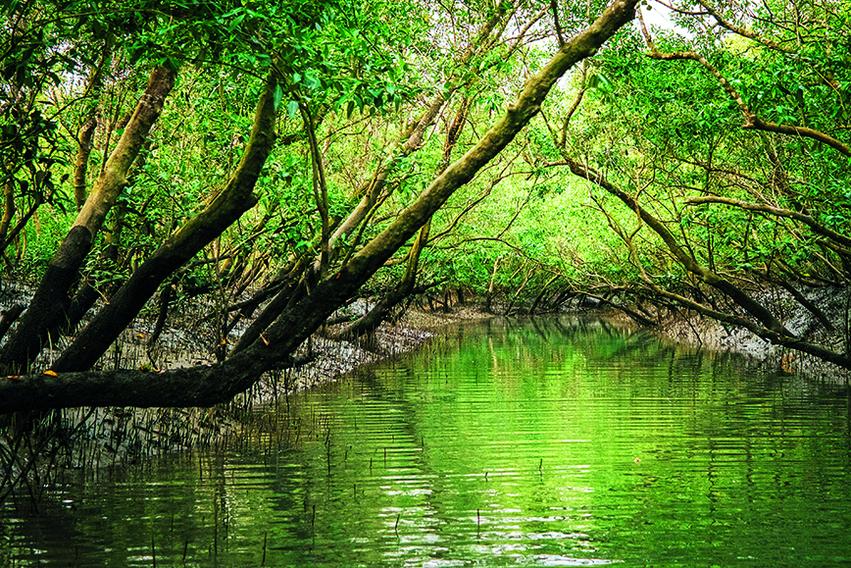
The Sundarbans, located in the Ganga delta across India and Bangladesh, is the world’s largest mangrove forest. The forest covers over 10,000 sq. km of which about 60 percent is in Bangladesh and the remainder in India. The word Sundarbans comes from ‘Sundari’ which is the local name of the dominant-abundant mangrove species Heritiera fomes. There are two dozen other mangrove species found here.
The delta came into existence over thousands of years through sediments carried down by the Ganga, Brahmaputra, and Meghna rivers. These three rivers confluence into the Bay of Bengal, making the estuarine tails of multiple streams. The delta becomes the transition zone connecting the freshwater of the rivers and the saline waters of the Bay of Bengal.
There are numerous islands, typically 3 m to 6 m in height, made up of silt and silty clay brought from these rivers. These islands get inundated during high tide. From the Landsat 7 satellite image of the Sundarbans, released by NASA Earth Observatory, the entire landscape looks like a painting intersected by multiple tidal streams, drainage lines and channels. The waterways are so distributed in the forests that one can navigate through the forest by boat. And the boundary of the forests follows the natural river channels.

The entire mangrove forests are known for their unique maze of tidal waterways, mudflats, and rich biodiversity, especially as the only mangrove habitat supporting a good number of Royal Bengal tigers that can swim. The mangroves provide nursery, breeding, feeding and resting grounds to a variety of other animals and birds. The forests act as unique carbon sinks, also working as a crucial natural barrier against cyclones, supporting a rich variety of fisheries.
The Sundarbans has a long history of forest management. The British East India Company obtained proprietary rights over the Sundarbans from Mughal Emperor Alamgir II in 1757. They started mapping the area and completed the exercise in 1764 — describing it as a “jungle” full of deadly diseases and man-eating animals like tigers, crocodiles and snakes.
They also found that the total area of the Sundarbans in India and Bangladesh was around 36,000 sq. km. Systematic forest management started a century later. In 1875 a large portion of the mangrove forests was declared reserved forests under the Indian Forest Act of 1865 (the first major British legislation to assert state control over India’s forests).
Frequent tiger attacks were widely reported in the Sundarbans, and these incidents came to be viewed as a major impediment to human settlement and economic development in the region. In response, the government appointed professional hunters and offered cash rewards for killing tigers. The British converted considerable areas in the Sundarbans to cultivable land between 1781 and 1875. However, they realized that it was not profitable due to the hostile environment and poor production capacity of the soil.
The Sundarbans Tiger Reserve came up in 1976 and was later declared a National Park in 1984. UNESCO gave it the status of a protected World Heritage Site in 1987. A 2009 study reported 1,259 tiger deaths during 1881 to 2006.
While deforestation is rising in many forests throughout the world, the Sundarbans’ mangroves have been comparatively well-preserved, thanks to its designation as a protected World Heritage Site, inclusion of the Sundarbans among reserved forests and the presence of the inimitable Royal Bengal tigers.
However, in recent years due to increasing population around the area, there is much pressure in the buffer zone. Centuries of habitation, fuelwood harvesting, and conversion of mangroves for agriculture and aquaculture have taken a profound toll of this unique landscape, resulting in extensive habitat loss and steep declines in biodiversity.
It also faces submergence threats from climate change and sea level rise. In fact, rising sea levels have already submerged around 20,000 acres of forest area and the Sundarbans faces severe coastal erosion. The Sundarbans floor varies from 0.8 to 2.5 metres above sea level, which means a two-metre rise in sea level may submerge 90 percent of the delta.

Considering the present sea level rise of about 4 mm per year, it is estimated that by 2050, almost 40 percent of the Sundarbans forests could be under water. There will be no suitable tiger habitats remaining, especially in the Bangladesh part of the Sundarbans. Also, due to severe coastal erosion and flooding, thousands of people living around the fringes of the coastal forest delta will become homeless or environmental refugees. It is observed that the delta is bearing the brunt of several cyclones and storm surges in recent years. Almost 25 years are required for vegetation to recover from each storm. The climate scenario predicts that the frequency of these will increase in future. So the forests get little time to recover.
With rising sea levels, salinity is also increasing. The type of forest differs depending on levels of salinity. Where salinity is more, there will be a brackish swampy mangrove forest with salt tolerant species; with freshwater, there will be a freshwater swamp forest. It has been observed that with an increase in salinity, species that prefer low saline conditions, such as Sundari, have started to disappear. Therefore, the biodiversity of the mangrove forests is being reduced slowly.
The Sundarbans is indeed one of the most beautiful biospheres in the world, but also highly vulnerable with its unique fragility. It needs protection and serious conservation efforts. The degraded sites demand special restoration, by planting mangrove species in large gaps of the forest. Seagoing vessels increase habitat isolation for the tigers and they must be regulated. What we need is a dedicated agency or task force with a clear mandate and budget lines for resettlement, disaster risk reduction, biodiversity conservation, and livelihoods.
Venkatesh Dutta is a Gomti River Waterkeeper and a professor of environmental sciences at Ambedkar University, Lucknow.
Comments
Currently there are no Comments. Be first to write a comment!