




VENKATESH DUTTA
Over the past weeks, we surveyed six tributaries of the Gomti river — Mala, Kathina, Bhainsi, Sarayan, Sai and Behta — across Pilibhit, Shahjahanpur, Lakhimpur Kheri, Sitapur and Hardoi districts. These lesser-known alluvial streams are sustained by groundwater and rainfall. We first surveyed these rivers 15 years ago in March 2011.
Returning now, we see a clear change — flows have diminished and natural vegetation on the banks had been levelled for crops. In many stretches, the flow had noticeably diminished. Some channels that earlier carried steady water now show signs of sluggish discharge, shallow depth, and fragmented connectivity with surrounding wetlands and floodplains.
At several places, stretches of these rivers dried up due to encroachment and farming on the riverbed, which also endangered aquatic biodiversity. At many places, we could simply cross the river in barely knee-deep water.

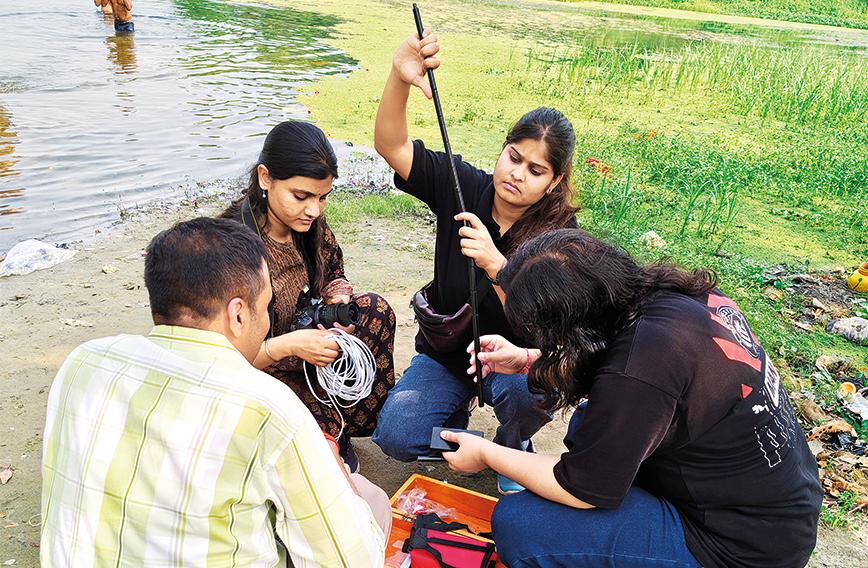
From early morning to late evening, my scholars walked through the river channels, measured water quality, stream flow, and riparian vegetation, and listened to what these rivers were telling us. These rivers may look small and inconspicuous on the map, but they are lifelines. They are vital ecological arteries that sustain the Gomti, which in turn contributes to the flow of the Ganga. The Mala and Kathina pass through the Pilibhit Tiger Reserve where tiger population has increased by 300 percent in just 12 years. These rivers are important biodiversity corridors. The natural vegetation on the banks is a safe refuge for insects, birds, reptiles and mammals.
But the signs are worrying. The landscapes that once sustained these rivers are rapidly being converted to intensive farmlands powered by groundwater extraction. Aquifers are being pumped faster than they can recharge, and floodplains are steadily shrinking. Unlike snow-fed rivers, their perennial nature is maintained largely by the steady seepage of groundwater into the channel. When aquifers are healthy and floodplains remain intact, these rivers continue to flow even during dry months. But when groundwater is excessively extracted or the natural floodplain is altered, the baseflow that sustains the river begins to decline.
Tubewells and pumps operate continuously during the growing season, extracting water from aquifers at rates that often exceed natural recharge. When groundwater levels fall, the consequences are felt directly in nearby rivers. The groundwater that once seeped slowly into river channels — maintaining baseflow during dry months — no longer reaches the surface in sufficient quantities. As a result, rivers that were once perennial gradually become seasonal.
Another factor contributing to the degradation of these rivers is the absence of effective floodplain regulation. Floodplains are not merely vacant lands awaiting development; they are crucial ecological zones that absorb floods, recharge aquifers, and support river biodiversity. When these areas are encroached upon, levelled, or converted for agriculture and construction, the natural processes that sustain rivers are disrupted.
Large rivers often dominate public attention, policy debates, and restoration efforts. Yet the health of these major rivers depends critically on a network of smaller streams and tributaries that sustain their flows. In the Ganga basin, these lesser-known rivers quietly recharge landscapes and replenish the larger river systems. Today, many of them are under severe stress.
Despite the ecological importance of these rivers, they rarely receive the policy attention given to larger water bodies. Conservation programmes and public discourse tend to focus on major rivers such as the Ganga or Yamuna, while their smaller tributaries remain largely overlooked. Yet the reality is simple: without healthy tributaries, large rivers cannot sustain themselves.
There is some progress. We have secured official floodplain zoning orders for the Gomti and Kukrail rivers, and we are pushing for similar protections for other rivers. Such measures represent an important step towards recognizing the ecological value of river corridors. However, floodplain zoning must expand to include more rivers, and enforcement must be consistent and science-based.

At the same time, regulating groundwater extraction has become an urgent priority. Groundwater management policies must account for the ecological requirements of rivers, not just agricultural demand. Sustainable extraction limits, aquifer recharge strategies, and landscape-based water management approaches are essential to restore balance between water use and river health.
If the current trends continue unchecked, many of these tributaries could lose their perennial character within the next five years. Such a transformation would not only affect local ecosystems but would also weaken the hydrological resilience of the entire Gomti basin. Reduced flows in tributaries eventually translate into reduced flows in the main river, amplifying water scarcity, degrading aquatic habitats, and undermining the long-term sustainability of the region’s water resources.
The message emerging from the field is clear. Protecting large rivers must begin with protecting their smallest streams. Conservation efforts should prioritize the protection of groundwater recharge zones, the restoration of riparian vegetation, strict regulation of floodplain land use, and the adoption of sustainable water management practices.
These small rivers may not command headlines, but they are the hidden lifelines of the river basin. If we fail to protect them today, the consequences will inevitably flow downstream. The time to act is now — because the future of our great rivers depends on the survival of these small ones.
Venkatesh Dutta is a Gomti River Waterkeeper and a professor of environmental sciences at Ambedkar University, Lucknow.
Comments
Currently there are no Comments. Be first to write a comment!