




VENKATESH DUTTA
The recent water contamination crisis in Indore has damaged its reputation as India’s cleanest city. At least 15 deaths are linked to consuming contaminated drinking water in just over two weeks, while local media reported 21 deaths. The laboratory tests confirmed faecal contamination in the municipal water supply, including bacteria found in sewage containing human excreta. This shows long-standing failures in public water supply systems, their safety and monitoring. Periodic water quality monitoring, contamination risk assessment and corrective actions are essential to prevent waterborne diseases, but our public water utilities and municipalities have failed to deliver. According to UN-Water, approximately 3.5 million people die each year globally due to inadequate water supply, sanitation and hygiene.
Indore was once a riverside village, which settled on the banks of the Saraswati — a tributary of the Kshipra river. The Kshipra originates at Ujjaini, on the eastern side of Indore district. In its upper stretches, the river is seasonal with sluggish flow. Indore was a halt for pilgrims travelling between two religious cities — Ujjain on the banks of the Kshipra river and Omkareshwar on the banks of the Narmada river.

Today, the Saraswati does not have freshwater, it is grossly polluted due to the pollution of its tributary, the Kanh river. The Kanh receives mostly sewage from residential areas and open drains. This is also the reason for deterioration of groundwater quality. In 1906, Indore municipality started its own powerhouse and established a new water supply system from a pond, the Bilaoli Talab — the source of the 72-km-long Kanh river.
The water supply in Indore is fraught with a unique set of challenges. Firstly, it is located on the southern edge of the Malwa plateau, at an altitude of 1,814 ft above sea level, so water has to be lifted and pumped to large elevations. In fact, it features among the costliest water supply cities in India. About 80 percent of the city’s supply comes from the Narmada. Water is pumped from the source 70 km away, and to an altitude of almost 500 metres.
Secondly, it is among the most densely populated cities in central India. The city is distributed over an area of just 530 sq. km with 30 lakh residents. So, pipelines have to navigate through dense settlements, sewage lines and drainage systems.
The total daily water demand, according to the Indore Municipal Corporation (IMC), after accounting for supply losses, is 700 million litres per day (MLD). Currently, the IMC is able to supply about 500 MLD, resulting in a shortfall of around 30 percent. About 425 MLD domestic wastewater is generated in the city. The IMC has installed 10 STPs (sewage treatment plants) at different locations for the treatment of wastewater. However, about 80-90 MLD wastewater goes into the Kanh river without treatment.
The groundwater from borewells constitutes only about 15 percent of the total water supply in the city. A large proportion of the Narmada supply is used to supply water to colonies of higher income groups. The coverage of the water supply network to low income settlements is really poor. According to a 2017 report of the IMC, Indore’s water supply network is able to serve 46 percent of its population.
A 2019 Comptroller and Auditor-General (CAG) audit report flagged extensive non-revenue water losses in Indore ranging between 65 to 70 percent. The water leakages have been directly linked to both poor water quality and shortages. The audit also reported a significant gap between the volume of raw water drawn and the amount actually supplied to households. The average per capita water supplied was found to be just 58 litres per day, against the norm of 135 lpd. About 268,000 households in Indore did not have water connections at all in 2018.

It was found that between 2013 and 2018 the IMC received about Rs 2,352 crore but spent only Rs 1,137 crore, leaving Rs 1,215 crore unspent. Despite significant budgetary allocations, the IMC couldn’t repair the water supply lines and lay new ones in unserved areas.
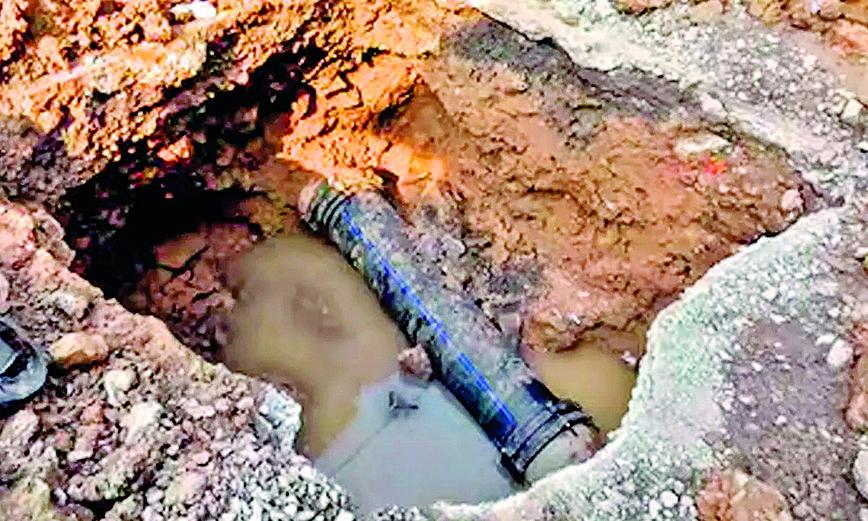
Cases of disease outbreaks due to sewage-contaminated piped water supplies are routine. Go to any old city in India, and you will find water supply lines running dangerously close to sewer lines. Due to low pressure or inadequate volumes, people often use booster pumps. Any leakage or drop in pressure allows sewage to seep directly into the supply lines. Many municipalities in India do not have steady maintenance contracts for leak repairs.
Public utilities replace or repair aged and damaged pipelines only when there are casualties. Sewer and water lines run parallelly or intersect — a known risk factor for contamination. The Indore bench of the Madhya Pradesh High Court remarked that access to clean drinking water is a fundamental right and there can be no compromise on the issue.
There are plans for riverfront development on the Kanh, Saraswati and Kshipra but these channellization projects are just cosmetic efforts. How can we ensure freshwater instead of sewage in these rivers? The interventions must be systematic, multi-barrier and preventive across the entire water supply chain, from source to tap. Do our public utilities care about the sources of water they lift water from?
Venkatesh Dutta is a Gomti River Waterkeeper and a professor of environmental sciences at Ambedkar University, Lucknow.
Comments
Currently there are no Comments. Be first to write a comment!