



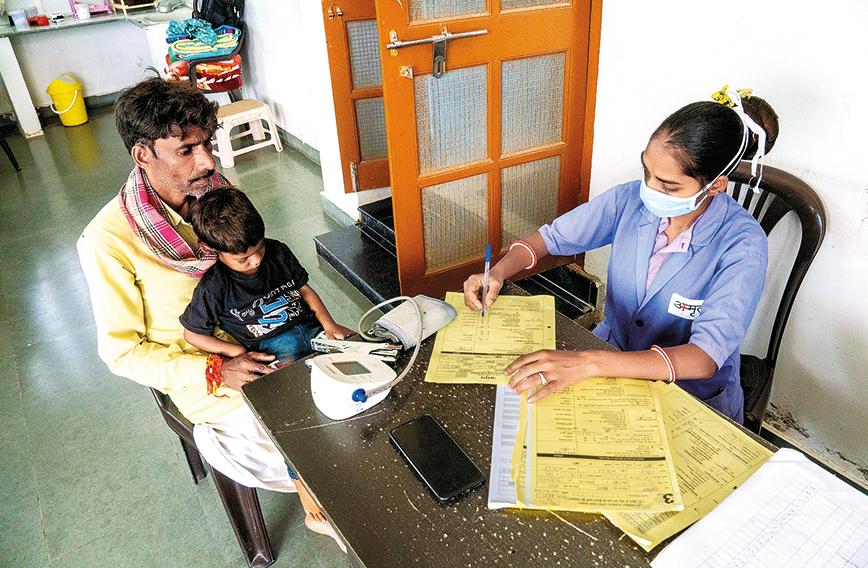
A nurse notes down a patient’s vitals
Low-cost clinics built on community trust
Bharat Dogra, Udaipur
Medical help a few huts away was unthinkable in remote tribal villages of South Rajasthan. People here migrate to cities and return with silicosis and TB (tuberculosis). There’s malnutrition, maternal and child ill health, cancer and other illnesses villagers grapple with. They used to turn to quacks or travel to indifferent district hospitals — until the AMRIT clinics came up.
Started in 2012 by Basic Health Services (BHS), a voluntary organization founded by Dr Pavitra Mohan and Dr Sanjana Mohan, the AMRIT clinics are catching the eye of health experts due to the earnest efficiency and impact of their operations.
BHS has six clinics in Udaipur and Salumbur districts. Each clinic has experienced doctors on hand as well as nurses and village-based health workers, mostly women. Interestingly, the nurses and health workers are mostly from the tribal communities they serve.
Before starting BHS, Dr Pavitra Mohan led the child health programme of UNICEF in India. Explaining the philosophy underlying his mission, Dr Mohan says, “First the health needs of the poorest should be prioritized. Second, we recognize the right to health of all people. Third, our initiative is highly participative so that the community’s real needs are properly understood by all those involved in our health initiative.”
Dr Sanjana Mohan underlines the importance of building trust and treating patients with dignity. “The success of any such initiative,” she says, “should be seen in terms of their durable and lasting impact, and not just temporary gains.”
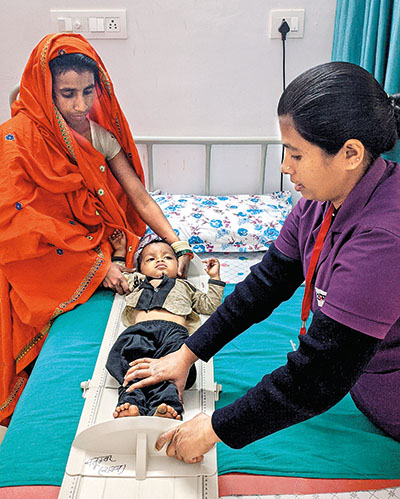
The nurses stationed at the clinics attend to patients in the daytime. But they are also available for night-time emergencies. They can consult BHS doctors anytime on the phone or through video calls. Doctors visit the clinics one day in the week. On other days, nurses refer patients with more serious problems to hospitals in Udaipur where a BHS staffer is especially posted to provide help to such patients.

Nurses are assisted at the clinic and in villages by health workers called swasthya kiran. At village level there is an advisory committee, a peer group and partner organizations. AMRIT clinics also run phulwaris (creches) with nutrition support and play centres for small children in many villages.
The BHS head office ensures a ready supply of medicines and other requirements. Three out of six clinics have portable X-ray machines so an X-ray can be provided on the same day. Efforts are on to set up X-ray machines in the remaining three clinics as well.
Most lab tests are available in the clinic. In the pipeline are sputum tests which will be made available soon. The clinics have also linked up with other labs for prompt testing.
The AMRIT clinic is a low-cost model. It can help patients even more if the government’s free medicine schemes, maternity benefit schemes and other schemes are extended to them.
 |
|
A nurse examines a child at the clinic |
Currently, patients pay Rs 50 for a weekly consultation which includes a supply of medicines for the week. This often has to be subsidized by the organization. But no one is turned away because of inability to pay. If the patient is too poor, charges are waived.
One AMRIT clinic, despite its remote location, is also accredited for safety and quality by the National Accreditation Board of Hospitals and Health Care Providers.
Health workers speak frankly about the range of health issues they tackle. Ganga, who works in the Bagdunda AMRIT clinic, said that one day she got a call from a man saying that he had been walking to the clinic with his wife who was in a very late stage of pregnancy, when she began experiencing unbearable pain. She was now lying on the grass near the roadside, he said.
Leaving the clinic to the care of fellow nurses, Ganga rushed out with her bag on a health worker’s motorcycle after obtaining the woman’s exact location. She found her on the verge of delivering the baby. Fortunately, she could help the delivery take place safely.
On another occasion, says Ganga, a woman turned up for delivery in such a serious state that there was no time for referral to a bigger hospital. So, with a prayer, Ganga rang up BHS doctors for advice. Following their instructions, she performed the procedures and both mother and child were saved.
Himmat, which means courage, is another nurse of this clinic. She lives up to her name. A memorable case she relates is of a girl, Jivi, who had always been bedridden. Her parents had resigned themselves to her fate. They hadn’t even taken her for treatment. However, Himmat insisted on taking her to see a doctor and, according to the doctor’s advice, arranged for physiotherapy. One day, the little girl started walking. The joy of the parents knew no bounds. She now goes to school.
Despite being struck by cancer twice, Chandrabhanu, a nurse in Salumbar district, continued providing medical care to people. She also contributed to improving health services at a government primary health centre which was being helped by the BHS. She is now a mentor to nurses in three clinics.
Community health workers in villages have played a big role in combatting malnutrition and tackling TB.
At Rawach clinic, health workers cited several examples of how they dealt with cases of TB. Invariably, if one person is infected, it spreads within the family. A woman who had lost her husband to TB later found that she too had developed similar symptoms. At the time her economic condition was precarious. She had to work as a labourer on daily wages to support her family. However, BHS workers encouraged her to continue treatment. She was finally cured. But her happiness was short-lived. Her 10-year-old son contracted the disease. BHS workers then encouraged her to get her son treated and finally he too was cured.

A migrant worker who was found to have TB on returning to his village, infected his wife and two brothers as well. The family confronted a full-blown crisis. However, all of them could complete their treatment successfully with the help of the AMRIT clinic.
The clinics also provide food and nutrition support to TB patients and malnourished children. BHS runs several phulwaris where children learn, play and are served nutritious food. Surveys reveal that the nutrition status of children has improved in such villages. The creches promote kitchen gardens and poultry units to improve nutrition among rural households.
Silicosis is another deadly disease which the clinics tackle. It takes a lot of effort to visit such patients in remote hamlets to do the best that can be done to provide relief.
The clinics also found that, due to the stigma attached to TB, people affected by the disease often hesitated to come to them. BHS then formed peer groups of patients who had recovered from TB to talk to those who had contracted the disease and encourage them to get treated.
This year excessive rain has ruined the kharif crop in many villages, leading to more nutrition problems and more pressure for migration. So BHS is faced with a need for more resources to help distressed people.
Comments
Currently there are no Comments. Be first to write a comment!