



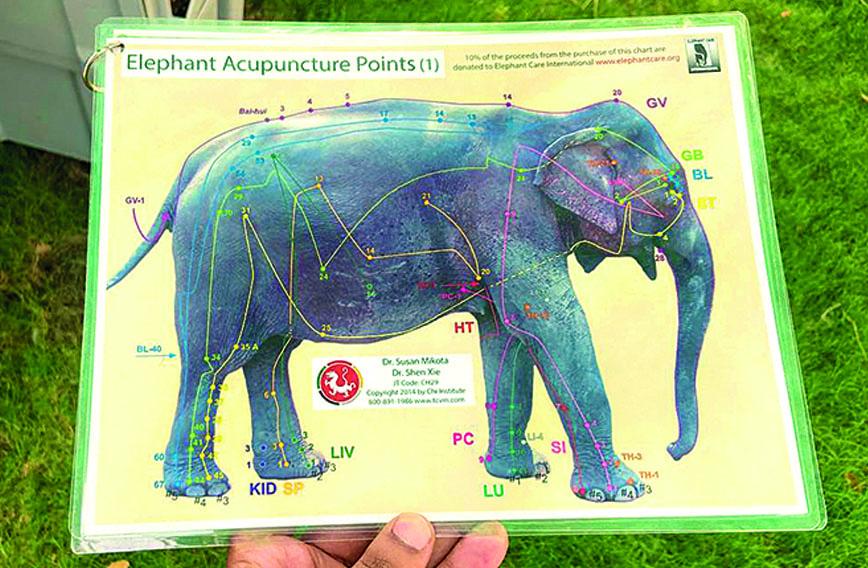
The acupuncture points on an elephant: Bani is given electro-acupuncture treatment once a week for120 minutes
Acupuncture for an injured elephant: Bani’s story!
Swapna Majumdar, Mathura
Bani, an injured two-year-old rescued elephant, is about to wade into the coolness of her pool to beat the sweltering heat when she hears a familiar voice calling her name. She is at the Elephant Hospital run by Wildlife SOS in Mathura district’s Gadi Churmura village.
Without further ado, Bani turns around and lumbers towards a special enclosure fenced on three sides. Her gait is a little unsteady, her movements slow as she drags her hind legs. But that doesn’t deter her. She has spotted her mahouts, Vijay Soren and Shiv Murari, sitting on the other side of the enclosure with two fruit-laden buckets. Bani knows today is that special day in the week when she gets a two-hour, non-stop supply of her favourite treats. She immediately stretches out her trunk through the bamboo slats expectantly.
A year ago forest officials were certain Bani wouldn’t survive. In January 2024, a train in Uttarakhand critically injured Bani, then a nine-month calf, and instantly killed her mother. When forest officials found Bani, she was lying with grievous multiple injuries near her dead mother. Unwilling to give up, they transported Bani gently to the Elephant Hospital.
An innovative acupuncture therapy, administered by a reputed veterinary doctor from Thailand and given for the first time to any elephant in India, is helping her recover steadily.

As Soren begins feeding Bani small pieces of unpeeled bananas, sugarcane, watermelon and cucumber cubes to keep her happily distracted, senior veterinarian Dr Ilayaraja Selvraj and his team spring into action. They need to keep up with the rapid pace at which Bani is using her trunk to pop the treats on Soren’s palm into her mouth.
The acupuncture machine has already been turned on and the points where acupuncture needles are to be inserted are quickly marked and the needles gently put in to stimulate nerve function, reduce pain, and support the healing of her hind legs. Over the next two hours, the intensity of the electro-acupuncture therapy, given once every week for 120 minutes, will be slowly increased under close supervision and monitoring to ensure it doesn’t cause any discomfort or pain. Bani has been receiving this treatment for a year now.
Train hits have been the second highest cause of elephant deaths, the first being accidental electrocution, according to the Ministry of Environment, Forests and Climate Change. With elephants already classified as endangered, their population in India has been on the decline according to a 2024 assessment by the Wildlife Institute of India and various state forest departments. Over 200 elephants were killed by trains between 2010 and 2020.
Though 150 elephant corridors have been validated by the government across 15 elephant range states, trains caused the deaths of 47 elephants in the past four years.
In Uttarakhand, the population of elephants has shown a decline of 2.6 percent between 2017 and 2023, with many dying due to critical injuries and lack of adequate medical care.
Bani, too, was precariously close to becoming another statistic. When the Wildlife SOS team led by Dr Ilayaraja Selvraj, deputy director, veterinary services, assessed Bani’s condition, they found she was unable to stand, with complete loss of movement in her right hind limb. Her condition was critical, with multiple abrasions and open wounds scattered across her body, especially on both sides and between her limbs.
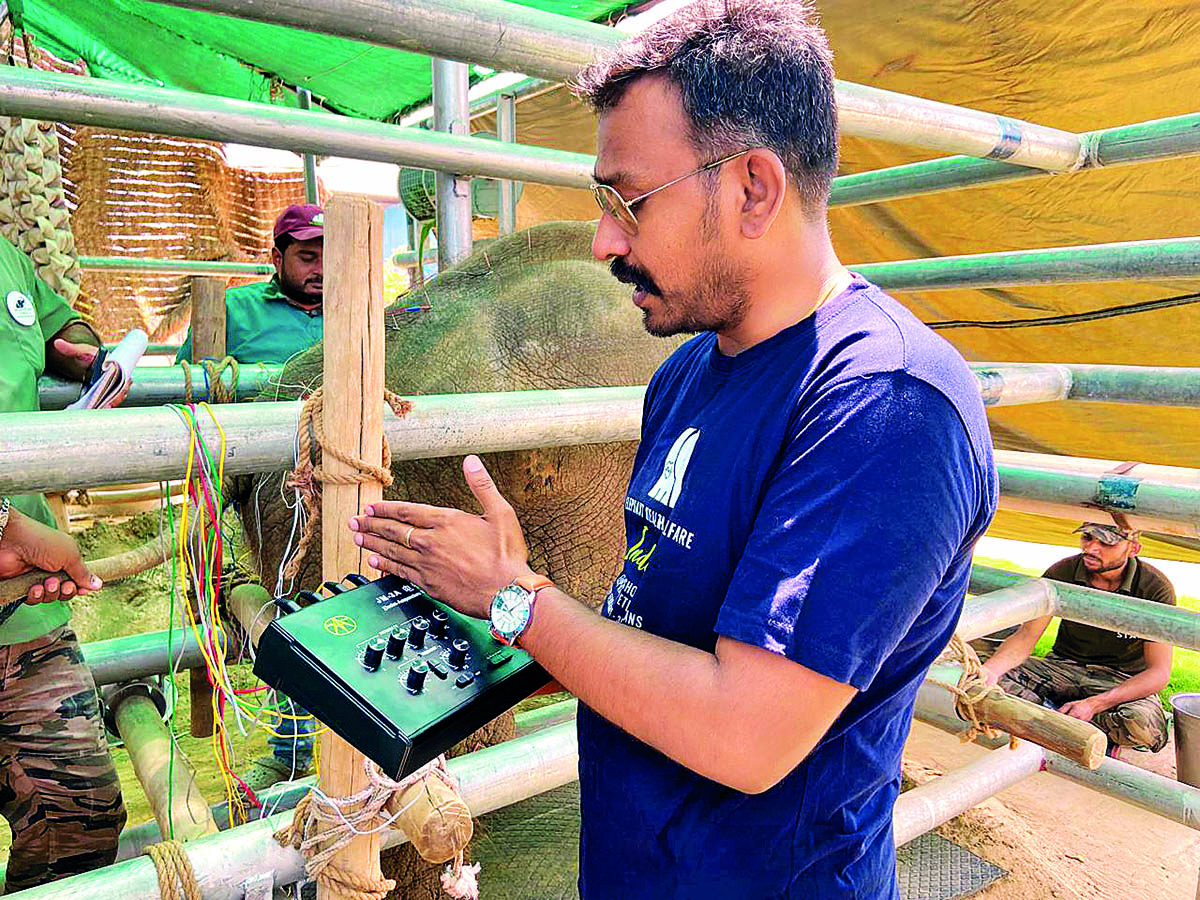 Dr Ilayaraja Selvraj gets ready to start the therapy
Bani’s initial radiographic and thermal imaging assessments revealed musculoskeletal issues along with neurological disorders that required a multifaceted approach. Unless she received intensive and long-term treatment, it was clear that Bani was unlikely to survive. Forest officials agreed that this would only be possible collaboratively at the Wildlife SOS hospital.
So, after all transfer protocols were completed and the team ensured she was stable enough to travel, their ambulance was specially modified keeping in mind her severe injuries. The floor was layered with soft hay for cushioning. Gunny sacks filled with hay served as pillows to support her legs to prevent sores. Blankets to keep her warm and bananas, papaya, and sugarcane leaves along with milk and water bottles were stocked to ensure she remained nourished during the 10-hour journey to Mathura.
Based on the advice of orthopaedics, neurosurgeons and Ayurveda practitioners, Bani’s initial treatment at the hospital included photobiomodulation therapy, laser therapy, hydrotherapy and Ayurvedic hot oil massages. However, it was the smart decision to try acupuncture that proved to be a game changer. Dr Porrakote Rungsri, veterinary acupuncture specialist from Thailand’s Chiang Mai University, flew in to share expertise and give hands-on training to the hospital team. Interestingly, a full-size model of Bani in soft cotton, was used to demonstrate the precise points for needle insertion.

“We are using electro-acupuncture therapy as part of a comprehensive veterinary care programme tailored to Bani’s specific paralytic condition. Electro-acupuncture therapy promotes nerve regeneration, diminishes inflammation, and speeds up the healing process after injury through electrical stimulation. The acupuncture machine being used is a specialized veterinary-grade device that has been thoroughly tested and calibrated for large animals, including elephants,” informs Dr Selvraj.
Initially, the therapy was given for three consecutive days followed by a three-day gap. Then, based on her recovery, the sessions were reduced to twice a week. Currently, Bani undergoes acupuncture every Wednesday for 120 minutes. The number of points of insertion has been increased from 27 to 29 to accelerate her progress.
Her weight has also increased from 279 kg to 545 kg in 18 months, thanks to her initial diet of 18 litres of milk per day, along with 10 chapattis made from finger millet (ragi) and wheat flour.
While this is good news, the team doesn’t want her to become overweight as it will put pressure on her hind legs which are still under treatment. So she has been put on a diet to regulate her weight. While porridge made from moong dal, wheat grain, milk and water remains a dietary staple, she is also given a protein-rich, semi-solid laddoo made from mashed and soaked horse gram and Bengal gram.
The Uttarakhand forest officials, who came to look her up some months ago, were amazed at her remarkable progress. Bani has also surprised the hospital team with her tenacity, resilience and determination to stand on her own feet. The success of electro-acupuncture in her inspiring recovery holds hope for the hundreds of others of this endangered species, critically injured in train hits. ν
Comments
-

Bharati Mullick - Aug. 11, 2025, 5:20 a.m.
There is always a positive twist to every issue! This is refreshing and heart warming.
-
Judith B Geraci - Aug. 7, 2025, 8:23 p.m.
Wonderful care and hope for Bani.