



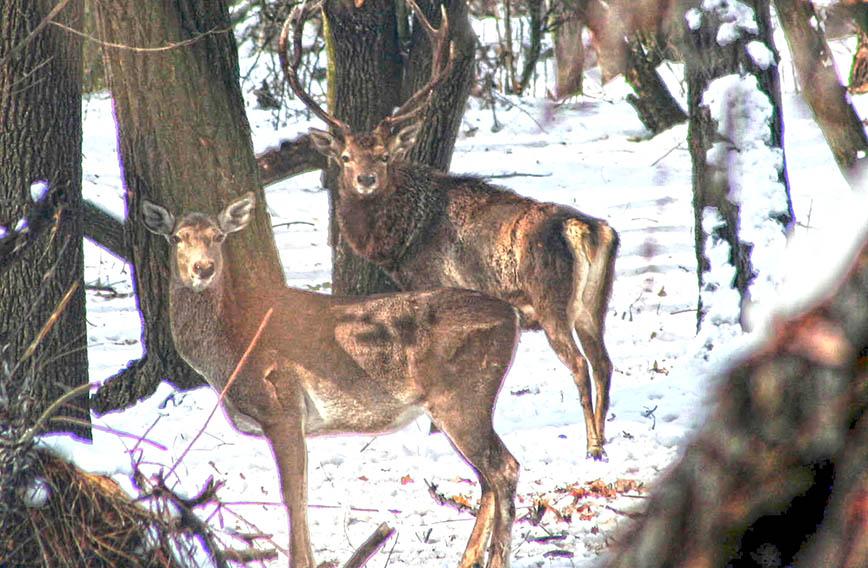
Hangul in the wild
Hangul at 300 and not moving
Jehangir Rashid, Srinagar
Wildlife experts are worried about the stagnant population of the hangul or the Kashmir red stag, a sub-species of the elk. It is the state animal of Jammu and Kashmir (J&K) and listed as a critically endangered animal by the International Union for Conservation of Nature (IUCN). Conservation strategies were put in place but have not succeeded in increasing its numbers. Is a change of strategy needed?
Wildlife expert Mansoor Nabi, who is currently associated with the Himalayan Brown Bear Trust as a project coordinator in Ladakh, says that in 2003 a hangul census revealed that its population was just 150. Alarmed, the Department of Wildlife grew serious about its conservation. Subsequently, from 2009 onwards, a hangul census was carried out every two years. It was carried out this year too.
“According to the latest figures the hangul population has been constant, around 300, give or take a small number. This has remained the same for the past few years. The hangul is our state animal and an endangered species. There is a need for more concerted efforts to save the animal,” said Nabi.
But what can be done? Wildlife experts say the primary reason the hangul population is not growing is because it is confined to one particular area, namely, the Dachigam National Park. Free movement of the animal would encourage qualitative breeding, leading to an increase in population.
“There was a time when the hangul population was huge. As of date the picture is not bright. Many factors are responsible for a stagnant population. The most glaring one is the limited movement of the animal,” says Dr Khursheed Ahmad, professor and head, Wildlife Sciences, Sher-i-Kashmir University of Agriculture Sciences & Technology — Kashmir (SKUAST-K).
Apart from the Dachigam National Park, a few hangul can be spotted in the Shikargah-Tral and Wangath-Kangan areas of the Kashmir Valley.
“We need scientific interventions. Studies have been carried out. There was a time when the hangul used to be spotted right from Kishtwar in the Chenab Valley to Gurez in the Kashmir Valley,” points out Dr Ahmad.
Nabi says that in the early years of the 20th century the population of the hangul was estimated to be around 5,000. The animal at that time was widely spread over areas that are now in Pakistan and Pakistan-occupied Kashmir (PoK). Kashmir has always been its ideal habitat.
“Once Pakistan was formed and PoK came into existence, the natural habitat of the hangul was disturbed. The Line of Control made matters worse. Alongside, poaching took place since there was no law enforcement. This led to drastic reduction in the hangul population,” Nabi explains.
He says hangul breeding centres have been set up in Shikargah-Tral in Pulwama district and in Mamar-Kangan area in Ganderbal district. The two centres should help increase the population of hangul. “Evidence about the presence of hangul at Shikargah has been substantiated by locals since the animals eat vegetables being grown in the area,” said Nabi.
Dr Ahmad says that ideally the hangul population should have been much more evenly distributed in the areas falling under the Dachigam National Park, Shikargah-Tral and Wangath-Kangan. However, there is a silver lining. Some hangul have been spotted moving between the Dachigam National Park and Shikargah-Tral.
“This is a positive sign and needs to be carried forward. The hangul must be provided with a safe and secure habitat where they can move freely without any human intervention. Once hangul of different families come into contact with one another, breeding will be qualitative — leading to a bigger population of this animal,” says Dr Ahmad.
He also says that unforeseen circumstances like a disaster or a fire incident tend to wipe out animal populations, including the hangul. For successful breeding there should be a population balance between males and females. At present females outnumber males.
“For better movement of the hangul it is important that there be very little human intervention. It was noticed through satellite collaring that during the pandemic these animals could move from one place to another smoothly since very few people were venturing out. Providing a safe and secure corridor to the animal should be given paramount importance,” says Dr Ahmad.
The Shikargah-Tral breeding centre is intended to augment the hangul population and that too on a qualitative basis. Only then will the new generation of hangul be healthy and the females have good offspring-bearing capacity, emphasizes Dr Ahmad.
According to Nabi, the wildlife department and the other agencies involved in the conservation process are also supremely focused on vaccination of hangul. Veterinarian intervention is of utmost importance to ensure that the animal is protected from fatal diseases. “It has to be ensured that if one hangul contracts a disease, it does not spread to the others,” says Nabi.
Some reports suggested that hangul have been spotted in areas like Machil, Gurez and Ladakh but this could not be substantiated. “The primary informers were the security forces personnel posted in these areas and the Bakarwals who move around forests with their livestock,” says Nabi.
Comments
-

bashir ali - Aug. 13, 2025, 12:23 p.m.
Commendable research needs govt agencies to come up now for protection of Hangul