



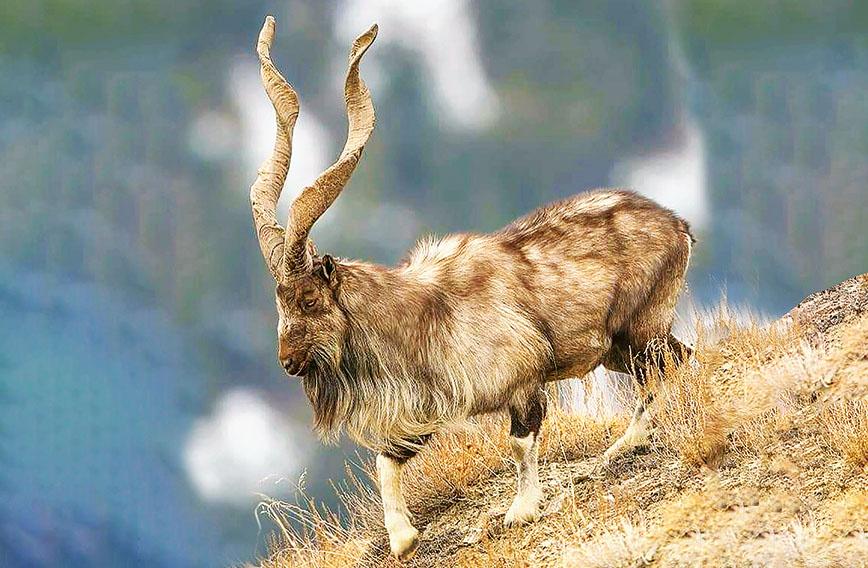
The markhor with its unique spiral horns | Civil Society picture/Bilal Bahadur
Time runs out for the markhor in Kashmir
Jehangir Rashid, Srinagar
THE sanctity of the Gulmarg Wildlife Sanctuary, with its rare animals, is likely to be upended by noisy tourists in cars. A road leading right up to the sanctuary has been approved and is expected to be constructed soon.
Environmentalists and wildlife experts are deeply worried. They point out that the proposed road will seriously impact wildlife, fragment corridors and endanger the survival of the markhor, listed as an endangered species.
On May 4, Manoj Sinha, lieutenant governor of the Union Territory (UT) of Jammu & Kashmir, approved the construction of the Asha-Cheema-Gurdaligali-Aphrawat-Sarson-Anita Road during a meeting of the UT’s Wildlife Board.
The markhor is the world’s largest wild goat, renowned for its incredible ability to scale steep cliffs. The male has striking, corkscrew-shaped horns that can grow up to five feet in length. The goat is native to the Pir Panjal and Kazinag ranges of J&K and parts of Pakistan and Afghanistan.
“The road is not merely an infrastructure project. It is a direct intrusion into one of the most ecologically sensitive landscapes of the Pir Panjal Himalayas,” says reputed conservationist Dr Shaikh Ghulam Rasool, founder of the Nature Conservancy Alliance (NCA).
“It will fragment vital wildlife corridors linking the Kazinag National Park, Limber Wildlife Sanctuary and the Tatakuti–Hirpora conservation landscape, thereby disrupting the movement of the endangered markhor. It will also disturb critical habitats of the Himalayan musk deer and brown bear.”
And once fragile mountain ecosystems are fragmented, their restoration becomes nearly impossible, Dr Rasool warns.
As it is, Gulmarg, a noisy tourist hotspot, has swapped its greenery for concrete hotels. “Once a road is built, tourists will drive their vehicles right up to the sanctuary. This will lead to noise and disturbance. The movement of animals will be severely affected. The onus lies with the government to restrict the movement of civilians,” points out Mansoor Nabi, wildlife expert who works as project coordinator with the Himalayan Brown Bear Trust.
Nabi emphasizes that an environmental impact assessment (EIA) should be carried out before going ahead with the plan to build a road in an ecologically sensitive area. Environmentalists and wildlife experts must be included to ensure wildlife is not endangered in any way.
“Gulmarg was basically a ski resort. But now we have minimal snowfall there so the skiing schedule has gone awry. As it is, scores of trees were cut for the two phases of the Gulmarg gondola project,” says Nabi.
The Gulmarg Wildlife Sanctuary is a safe corridor for the markhor but it also hosts other important animals like the goral, barking deer, musk deer, black bear, brown bear, the monal pheasant and others. The sanctuary is strategically located, stretching from Trikanjan-Uri in North Kashmir to the Pir Panjal range on the border with Himachal Pradesh.
The worry is that the markhor may become extinct. In 1990, a markhor was captured in an injured condition. According to Nabi, no scientific survey has been carried out since to ascertain the exact number of markhor in J&K. There have at best been random sightings of the animal.
“In 2004 the Wildlife Trust of India (WTI) carried out a survey but for reasons best known to them they confined their research to Limber in Baramulla and Hirpora in Shopian. In the past, the movement of the markhor was also restricted due to the firing range at Tosa Maidan. We need proper research to assess the markhor population,” says Nabi.
The Gulmarg Wildlife Sanctuary is also the corridor of the hangul, the Kashmir stag, which is a subspecies of the Central Asian red deer. It is the only surviving Asiatic member of the red deer family and classified as critically endangered. It is on the International Union for Conservation of Nature (IUCN) Red List. According to a census in 2019, only 237 hangul exist in the wild. It is a protected species under Schedule 1 of the Wildlife Protection Act and is J&K’s state animal. The government is legally obliged to protect it.
Hangul used to be sighted at multiple places in Hirpora-Shopian before the construction of the Mughal Road that connects the Kashmir Valley with the twin districts of Rajouri and Poonch located across the Pir Panjal range.
Nabi believes that the markhor will meet the same fate as the hangul, if immediate steps are not taken to save it from extinction.
“We have already lost the hangul, a treasure of J&K. If apathy towards the markhor continues we will lose this treasure as well. It is imperative that any steps that go against the protection of this endangered animal are avoided and that too without any delay,” he emphasizes.
Owais Ahmad, an environmentalist, feels that instead of wrecking the habitat of wildlife species the government should be working to protect the animals. He seeks an immediate roll-back of the LG’s approval of the controversial road to ensure the animals are left in peace.
“It is important that the decision taken by the Wildlife Board to construct the road up to the Gulmarg Wildlife Sanctuary is withdrawn and that too at the earliest. The LG should withdraw his approval. Otherwise we will lose our rich stock of wildlife,” says Ahmad.
Comments
Currently there are no Comments. Be first to write a comment!