



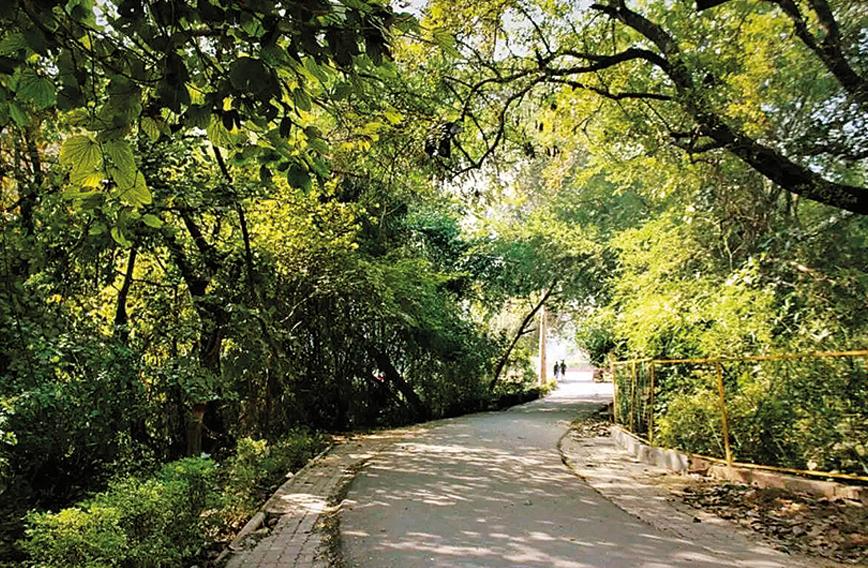
The Kukrail forest is vital green space for the city of Lucknow
Forest is not a zoo
Uma Shanker Singh
Increased human activity, bright lighting, even if muted like ‘moonlight’, noise, and visitors at the night safari will severely disrupt the habitat of the animals and cause them stress as well.
According to zoo management authorities, the creation of a night safari offers visitors a unique opportunity to observe cathemeral, nocturnal and crepuscular species or non-diurnal species in specialized settings. Apart from entertainment, they claim, these specialized experiences contribute to conservation education, ecological awareness, and sustainable tourism by fostering a deeper understanding of animal behaviour and their ecological role.
A snapshot of nocturnal species to be displayed are mammals like bats, raccoons, leopards, flying squirrels, skunks and so on, and birds such as owls, nightjars, frogmouths, kiwi as well as moths, catfish, geckos, frogs.
Examples of crepuscular species (active at dawn/dusk) are deer, rabbits, hares, coyotes, foxes, lions, bears, hyenas; birds such as the common nighthawk, owlet-nightjar, chimney swift; and insects like moths, beetles, flies.
The fact is that these species may not attract enough visitors because Indians are drawn more to seeing carnivores and big animals in the wild. Several research papers reveal this partiality.
A paper titled “Tigers, tourists and wildlife: visitor demographics and experience in three Indian Tiger Reserves” (Mathur et al) in Biodiversity Conservation (2017) reveals that domestic tourists formed 82.7 percent of visitors in all three Protected Areas studied. Tourists chose to have close encounters with large mammals, especially tigers. The primary attraction for visitors, apart from tigers, consisted of peacefulness, photography opportunities and bird-watching.
Tigers and leopards are among the most visited species in zoos globally. But, according to a research study of eight big cats in Delhi’s National Zoological Park (Avni Gupta), both tigers and leopards displayed a high proportion of inactive and stereotypical behaviour — signs of acute stress, exacerbated by high visitor density.
People love to see big animals in the zoo but the night safari offers visitors the opportunity to observe cathemeral, nocturnal and crepuscular species. Therefore, spending more than `1,500 crore on a Kukrail night safari project which does not have big animals may not be financially viable.
There are other issues to be considered.
Section 1c of the Night Safari Guidelines 2025 clearly says, “CZA (Central Zoo Authority) will not accord approval for creation of night safaris and safaris diverting forest land. The existing zoos may establish night safaris without causing any adverse impact on the animal facilities in the zoo.”
The guidelines were framed in 2025 and the FCA (Forest Conservation Amendment) Act, 2023 is still under consideration by the Supreme Court by a February 19, 2024 interim order. The matter is sub judice and the government should wait till a final verdict is passed.
Section 21 of the Night Safari Guidelines 2025 states: “No same animal should be displayed for day viewing and in night safari.” The state government has not mentioned anywhere in its application to the Supreme Court the names of the animals in the night safari and day zoo, their procurement plan and the place of procurement.
In the chapter titled “Scope and Applicability”, the guidelines state: “All such operations, including those involving night safaris, must comply with the Wild Life (Protection) Act, 1972.” But the word ‘safari’ does not find mention at all in the 1972 act.
In its application to the Supreme Court, the state government admits that Kukrail is in the centre of the city and surrounded by human habitation. The forest is highly vulnerable to encroachment. During 2014-17, several encroachments were removed and boundary walls constructed in critical stretches.
The UP government also states that no other accessible land of adequate size near the city with existing clusters of trees was available. Hence the proposed zoo and night safari site was identified within Kukrail forest over an area of 855.07 hectares. But it fails to say what local people feel about establishing a night safari in their area.
The adverse impact this may create on the neighbourhood has not been studied. The government admits that the project is expected to attract approximately 4,000 visitors per day on weekdays and around 8,000 visitors on weekends and holidays. This may result in devastating social and health impacts.
The Kukrail forest extends over 2,027.4 hectares and has been developed through sustained plantation efforts by the Forest Department. It forms a green lung and vital urban green landscape for the community. Hence, their opinion is extremely important. An environment impact assessment (EIA) should be undertaken.
According to the state government: “Soil of the project site is characterized by alkaline, poor-quality soil dominated by Prosopis juliflora (vilayati babool) shrubs with a few tall trees suitable for meeting the light-concealment requirements of the night safari.”
Research papers support the assertion that Prosopis juliflora acts as a pioneer species in alkaline and degraded soils and is eventually replaced by native broad-leaved species in later stages of ecological succession. Therefore, it is a successional species. Prosopis juliflora grows well in areas having high salinity or alkalinity levels.
According to the Chief Wildlife Warden the total number of trees at the project site is 24,274 of which 4,808 trees are proposed to be felled and 877 trees are to be translocated. If the project site has poor soil quality, there is no need to fell a small shrub and definitely not trees. Trees ameliorate soil. The state government has also not provided an enumeration list of trees according to species and diameter class.
The Kukrail forest should be preserved in its natural state. At a time when temperatures are rising due to climate change it is not wise to destroy Lucknow’s only green lung.
Uma Shanker Singh is director and North India head, Vanashakti
Comments
Currently there are no Comments. Be first to write a comment!