




SHYAM BHATIA
Six months before the Red Fort trials turned officers of Subhas Chandra Bose’s Indian National Army into national symbols, another Indian force raised during the war was quietly dismantled and sent home. There were no crowds, no lawyers, no slogans and no trials. Most Indians have never heard of it.
That silence is now being disturbed not in Delhi or London, but in Berlin. The German Historical Museum has begun revisiting the story of the German-raised Free India Legion — often called the Tiger Legion — as part of its effort to examine German history “from the outside”. The rediscovery is not driven by Indian commemoration, but by Germany’s own attempt to confront how it instrumentalized colonial soldiers. What emerges is not a forgotten battlefield epic, but a case study in how soldiers are mobilized, managed, and erased once they outlive their political use.
The timing matters. In the final weeks of the Second World War, as Nazi Germany collapsed, the legion attempted to withdraw southwards towards neutral Switzerland. Indian soldiers in German uniform marched through Alpine border regions hoping geography might spare them the reckoning they feared. It did not. They were disarmed by Allied forces near the Swiss frontier, taken into custody, and by the spring of 1945 the unit had ceased to exist.
Numbering roughly 2,500 to 3,000 men at its peak, the legion was repatriated quietly to British-controlled India months before the first INA trial opened at Delhi’s Red Fort in November 1945. There was no equivalent public moment. No dock. No chance to defend themselves — or to be turned into symbols.
This is where comparison becomes unavoidable.
When the British prosecuted INA officers later that year, the charge was explicit and theatrical. They were accused of “waging war against the King-Emperor”. The trials were meant to reassert imperial authority at a moment when Britain’s grip on India was already slipping.
Instead, they produced martyrs — and, in at least one case, a future minister. Shah Nawaz Khan, one of the three officers tried at the Red Fort, went on to serve as a deputy minister in independent India. The attempt to criminalize the INA ended by legitimizing it.
Nothing comparable was allowed to happen with the men who had served in Europe.
The German Historical Museum’s material helps explain why. Drawing on German military records, propaganda photographs and internal correspondence, it shows that the Free India Legion was never intended to become a sovereign Indian force. Historian Baijayanti Roy, whose research informs the museum’s work, has described it as a product of “political calculation and Nazi propaganda”.
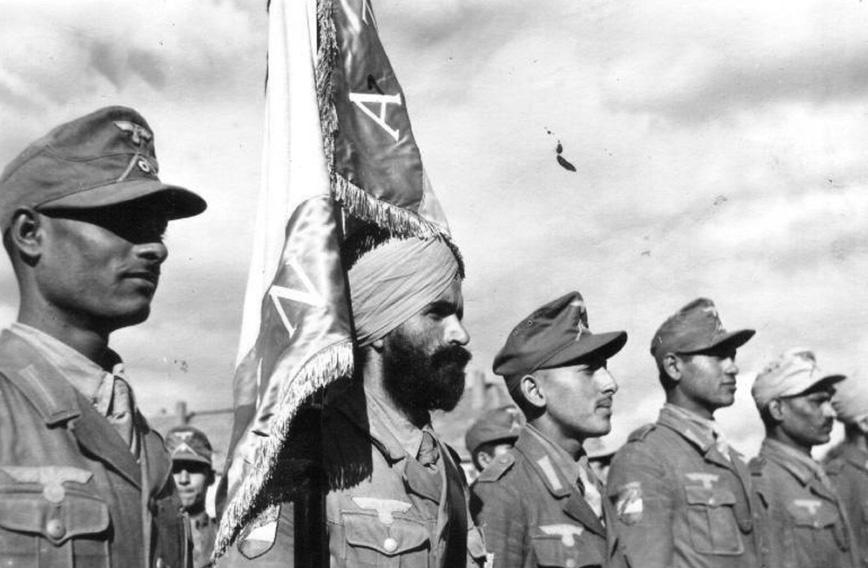
That calculation extended even to recruitment. Sikhs were heavily over-represented in the legion, not because of ideology but because German recruiters inherited the British Indian Army’s own “martial race” demographics. Many of the Indian prisoners captured by Rommel in North Africa came from Sikh-heavy regiments. German propaganda leaned into this inheritance, highlighting turbans, beards and martial imagery in parades and inspections. Muslims and Hindus were also present, but Sikh soldiers were made visually central to the spectacle.
The irony is sharp. A colonial stereotype developed to serve the British Empire was recycled intact by Nazi Germany for its own ends.
Yet for all the pageantry, the museum material makes clear how little trust underpinned it. Indian soldiers were not commissioned as officers. Command remained entirely German. They were mobilized but never empowered.
Daily life in the legion exposes the racial hierarchy even more starkly. German officers worried obsessively about discipline, sexuality and “moral corruption”. While stationed in southern France, the Wehrmacht established a separate brothel for Indian soldiers so that German troops would not have to share prostitutes with men they regarded as racially inferior, according to records cited by the museum. This was not camaraderie; it was segregation.
To hold the unit together, German officers produced a daily internal magazine in Hindustani called Bhaiband. Written in awkward language by men who barely understood modern India, it mixed fabricated war news, praise for Hitler and Bose, crude humour, and clumsy lectures about Sikh gurus. The museum presents this as an attempt to manufacture loyalty in a unit the Germans themselves did not fully trust.
Nor was this a fighting army in any meaningful sense. Indian soldiers were photographed laying barbed wire, manning static positions, and guarding stretches of the Atlantic Wall. Aside from a brief deployment in Italy, the legion barely saw combat. It existed primarily as managed display.
That display included ritualized loyalty. They were made to salute and chant slogans as part of a spectacle they did not control. There is no evidence they initiated these rituals or embraced Nazi ideology. What the museum reveals instead is coerced performance under German command.
All of this shaped what happened after defeat. Because the legion never developed an Indian officer corps, Britain had no senior Indian commanders to put in the dock. There were no equivalents to Shah Nawaz Khan, Prem Sahgal or Gurbaksh Singh Dhillon. The German archives preserve many names of officers, academics and propagandists. They preserve almost none of the Indian soldiers’.
Britain’s decision was therefore quiet, but not accidental. By early 1945, the empire already sensed the danger of turning Indian prisoners into future martyrs. Silence was safer than spectacle.
Subhas Chandra Bose grasped the limits of the German experiment and left Europe for Southeast Asia, where the INA offered Indian command, Indian officers, and a political future. He believed that sacrifice demanded recognition; if not victory, then dignity. What would he have made of Indian soldiers mobilized in Europe, denied command, denied trials, and denied even remembrance?
India has spent decades arguing about the meaning of the INA. Almost no one has argued about the fate of the Indian soldiers who surrendered near Switzerland and were sent home in silence months before the Red Fort trials began.
It has taken a German museum, 80 years later, to make visible what the empire chose to forget.
Shyam Bhatia is the London correspondent of The Tribune.
Comments
Currently there are no Comments. Be first to write a comment!