



SHYAM BHATIA
On a London high street lined with Persian grocery stores and kebab shops, Iranian exile politics has found an unlikely stage. A restaurant window advertises a 20 percent discount to anyone who walks in and says a phrase long taboo in the Islamic Republic: Javid Shah, long live the Shah.
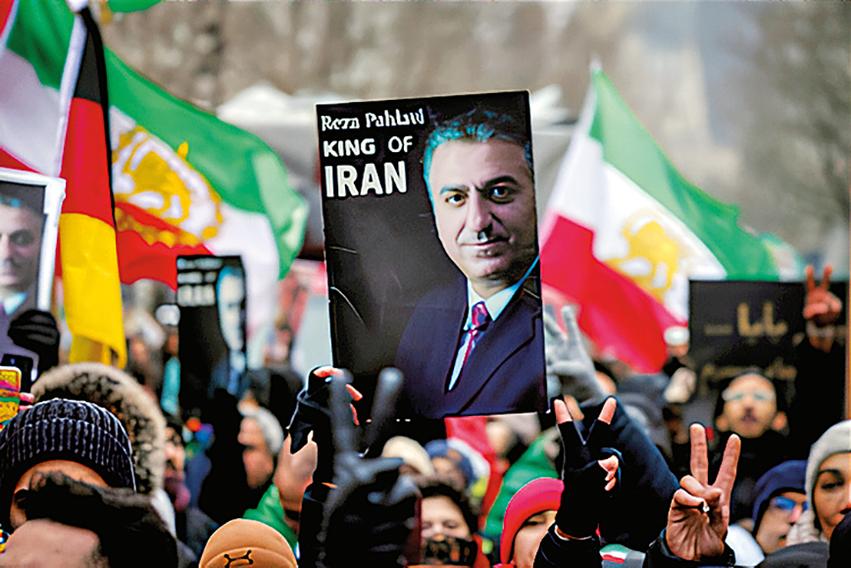
The poster shows Reza Pahlavi, son of Iran’s last monarch, framed by images of his father and grandfather beneath the old lion-and-sun emblem of pre-revolutionary Iran. The message is simple: say the words and receive the discount.
It is a small and almost playful gesture, but it captures something real about the mood among parts of Iran’s diaspora. What for years survived mainly as nostalgia has begun to surface more openly. Protest against the Islamic Republic, many exiles now believe, has reached its limits. What must follow protest, they argue, is a credible alternative — though republicans, secular liberals and other exile opposition groups remain sharply divided about Iran’s future — and that inevitably revives the question of the monarchy.
The scene in that London shop window brings back a memory of the man whose name now appears on so many diaspora posters.

In July 1980, a colleague from the French news agency Agence France-Presse (AFP) asked if I would accompany him to Cairo’s Maadi Military Hospital. Iran’s deposed ruler, Mohammad Reza Shah Pahlavi, lay unconscious there, suffering from the cancer that would soon kill him.
There was little security as we made our way along the corridor and into his room. The once powerful monarch lay motionless beneath the bedclothes. A metal hoop-like frame raised the sheets above his midsection. No guards stood watch, no courtiers hovered nearby. Only the upper part of his forehead was visible above the bedding.
As we stood there, a cockroach suddenly scuttled across his forehead before disappearing beneath the bedding.
A few days later the Shah was dead.
His funeral later that summer in Cairo was a subdued affair. Egypt’s president, Anwar Sadat, attended, along with a handful of foreign dignitaries including former US President Richard Nixon and Greece’s exiled King Constantine. Nixon later wrote of the Shah: “He was one of the most courageous leaders I have ever met.”
More than four decades later, memories of the Shah’s rule have become strangely selective.
Many younger Iranian exiles speak admiringly of the Pahlavi era. They point to the economic expansion of the 1960s and early 1970s, when oil revenues funded ambitious industrialization projects and Tehran aspired to become a regional power.
Iran’s international profile also expanded during this period, with the Shah cultivating close ties with leaders across both Western and non-aligned countries, including India, whose leaders maintained cordial relations with Tehran during the Cold War era.
They recall the Shah’s White Revolution of 1963, which expanded education, redistributed land and granted women the right to vote and hold public office.
Compared with the restrictions imposed by the Islamic Republic, the pre-revolutionary era can appear, at least in retrospect, as a period of relative openness. Women were not required to wear the hijab. Western music and cinema circulated freely. Iran projected an image of modernization and prosperity.
Yet the Shah’s rule was far from the golden age nostalgia sometimes suggests.
Political life remained tightly controlled. Opposition parties were suppressed or marginalized, and the regime’s secret police, SAVAK, developed a reputation for surveillance, imprisonment and torture of political opponents. Critics of the monarchy — whether secular or religious — faced censorship and harassment. Among those forced into exile was the cleric, Ayatollah Ruhollah Khomeini, who would eventually return to lead the revolution that overthrew the Shah in 1979.
Many Iranians were also angered by the extravagance of the royal court. The most famous example came in 1971, when the Shah staged an elaborate celebration at Persepolis marking what he described as the 2,500th anniversary of the Persian Empire.
Heads of state, royalty and senior officials from around the world attended the lavish desert ceremony, including representatives from countries such as India, whose president, V.V. Giri, attended as the Shah sought to underline the ancient cultural ties between Persia and the Indian subcontinent. For the Shah it was meant to symbolize Iran’s return to the centre of world civilization. For many Iranians watching from afar, however, it reinforced the image of a ruler increasingly detached from the realities of life at home.
By the late 1970s the discontent had become impossible to ignore. Demonstrations against the regime spread across the country. Students, clerics, merchants and intellectuals joined the protests. In a televised address in November 1978 the Shah attempted to calm the crisis, telling Iranians: “I have heard the voice of your revolution.”
Within weeks he would leave the country.

What followed was not the democratic transformation many protesters had imagined. The Islamic Republic that emerged under Ayatollah Khomeini imposed its own system of political control and social restriction. Over time, that disappointment has fuelled a growing nostalgia among some Iranians for the stability of the pre-revolutionary era.
But memory has a way of simplifying the past. The Shah’s rule combined genuine modernization with authoritarian politics, corruption and widening inequality. The revolution that overthrew him was driven not only by religious fervour but also by widespread frustration with repression and political exclusion.
Today many Iranian exiles mourn the fall of the monarchy and imagine that restoring the Pahlavi dynasty might offer a path back to stability. Yet the history they recall often leaves out the reasons why millions of Iranians once took to the streets demanding that the Shah’s rule come to an end.
A restaurant doorway in London may now invite customers to say the forbidden slogan aloud. Whether the same words would be spoken with the same enthusiasm in Tehran is another question entirely.
Shyam Bhatia is the London correspondent of The Tribune.
Comments
Currently there are no Comments. Be first to write a comment!