



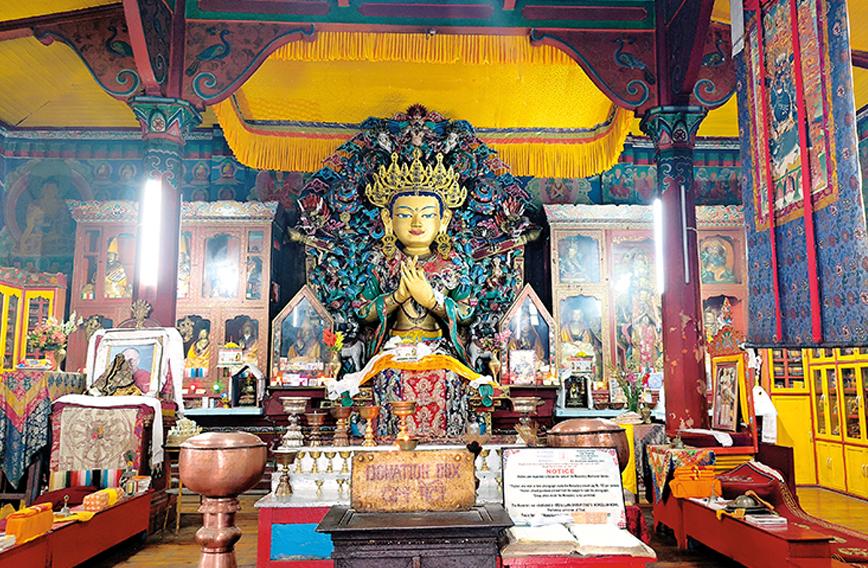
Inside Yiga Choeling monastery
An adventure in Darjeeling
Rashmi Gopal Rao
Achill in the air, towering pine trees, misty skies, rhododendrons, and the shrill whistle of the toy train. As I entered Darjeeling, the Queen of the Hills was just as I had imagined it to be. It is indeed a compelling place that offers a kaleidoscope of experiences in history, culture, religion and heritage.
Perched at an altitude of over 6,700 feet in West Bengal, Darjeeling is often touted as the gateway to the Himalayas. This is mainly because the hill station offers a stunning view of the third highest peak in the world, the mighty Kanchenjunga.
Replete with verdant tea gardens, Darjeeling was the summer capital of the Bengal Presidency during the colonial era. Whether you want to explore Tibetan culture, visit Buddhist monasteries, enjoy a ride on the heritage steam railway, catch a glimpse of colonial architecture or indulge in a session of tea tasting, Darjeeling is the place to be.

Rise with the sun:
Watching the sun rise at Tiger Hill is one of Darjeeling’s tried and tested adventures. “An early morning drive to Tiger Hill is an experience you will cherish forever,” promised our guide and driver, Manish, as he drove us to our resort in Ghum in Darjeeling.
As promised, Manish arrived at what seemed a rather unearthly hour — 2.30 am! We quickly got ready and within minutes we were navigating steep winding roads to reach the top of Tiger Hill, which is around 1,650 feet above Darjeeling.
 |
|
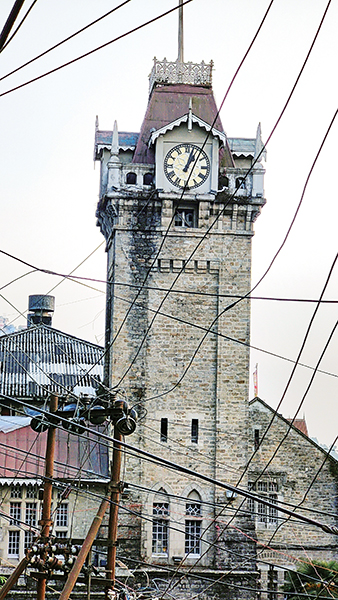
Darjeeling’s historic clock tower |
To my utter surprise, the roads were quite crowded at that hour. We had to park some distance away and, as we trudged uphill, we were greeted by hordes of locals who had set up shop on both sides of the road. They were selling everything you thought you might have needed at 4 am — piping hot lemon tea, shawls, stoles, socks and even steaming Maggi noodles!
The excitement was palpable as the time for sunrise approached. Nothing had prepared me for the breathtaking beauty of the sunrise. The crimson red head of the sun slowly appeared and grew in size, painting the sky in fiery tones of orange, yellow and even purple. It finally morphed into a fiery ball. People were ecstatic. I realized no picture or description could do justice to the incredible spectacle of nature we had witnessed.
Nature lovers can also head to Lepchajagat, home to the Lepcha tribe. Most of this region is blanketed with thick pine forests. As you approach the village, the fragrance of fresh pine and the chirping of birds is unmissable. The stunning beauty of the pine forest as the sunlight infiltrates the thick canopy is awesome.
A Tibetan trail:
Located close to our resort was the Yiga Choeling Monastery, the first Tibetan Buddhist monastery to be built in Darjeeling. Belonging to the Gelukpa or the Yellow Hat sect, the highlight of the monastery is its 15-foot statue of the Maitreya Buddha. The monastery was built in 1850 and was home to several abbots who fled Tibet when it was occupied by the Chinese in 1959.
We then visited the Himalayan Tibet museum and admired its display of Tibet’s topography, history, flora, fauna, socio-economic life and the Dalai Lama. Detailed photographs, models, objects and artefacts give visitors an insight into Tibetan religious customs, beliefs and rituals. Further, it has engaging displays on key Tibetans in Darjeeling, important political developments, and the Tibetan community in exile. One can also buy books, postcards and other souvenirs in the museum.
If you’d like to buy Tibetan handicrafts, visit the Tibetan Refugee Self zzHelp Centre in Lebong. Also known as the Hermitage, the centre was established in 1959 when the Dalai Lama fled Tibet. What started as an initiative with just four people has grown to a centre where over 130 Tibetan families reside. Apart from caring for the old, sick and needy, it is a centre where artisans are trained and handicrafts like shawls, bags, masks and prayer flags are made.
The Japanese Temple and Peace Pagoda situated atop the Jalapahar hills in Darjeeling is also worth a visit if you have time.

Train ride and Mall walk:
Of course, no visit to Darjeeling is complete without taking a ride on the toy train which is part of the Darjeeling Himalayan Railway (DHR). This vintage narrow-gauge train built in 1881 is 145 years old. It is an engineering marvel and has a UNESCO World Heritage Site tag. We took a joy ride from Darjeeling to Ghum via the Batasia loop. It was nostalgic, picturesque and an adventure.
Ghum Railway Station is the highest railway station in India at 7,407 feet. Do visit the Ghum museum which has some invaluable information on world heritage and the DHR. The history, building and unique aspects of the DHR are displayed along with information on its loops, gradients and Z reverses.
Back in Darjeeling, we decided to stroll along the celebrated Mall Road and admire some relics from the British era. We gazed at the iconic city clock tower and St Andrew’s Church. The clock dates back to 1850. It has a brick façade replete with arched windows, stone pillars and cast-iron awnings.
We also went to heritage outlets like Keventer’s, Glenary’s, and Das Studio. They exuded oodles of old-world charm.
Comments
Currently there are no Comments. Be first to write a comment!