



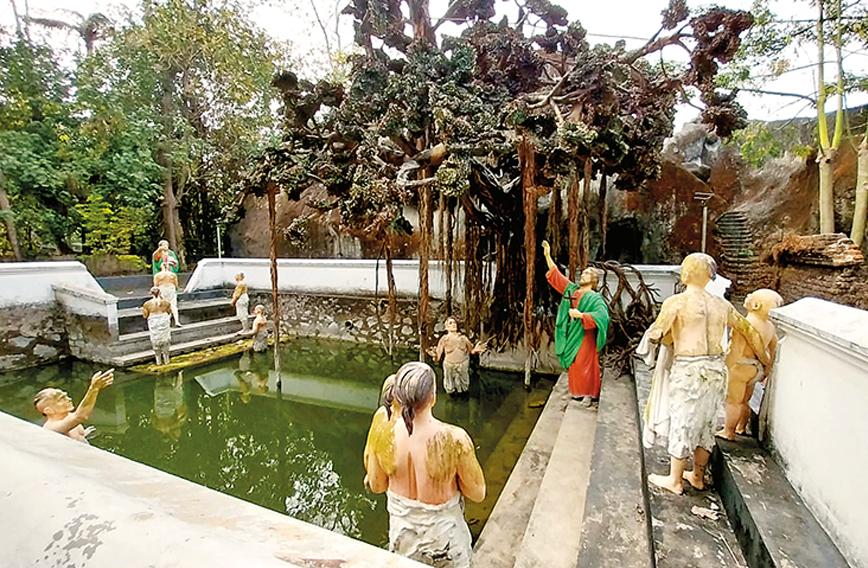
The pond where St Thomas baptized his followers in Kottakavu Church
Getaway by the Periyar
Susheela Nair
I woke up to the chirping of birds, and watched cormorants and kingfishers diving for fish from my window while I sipped a cup of tea. I could see canoes gliding in the river as I relaxed with a book in a chair on a sprawling veranda in Cranganor History Café & Riverside Chateau, a boutique resort overlooking the tranquil, uninhabited island of Dharma Thuruthu and the Periyar river. Sprawled over 1.5 acres, the 150-metre riverfront resort in Ernakulam district of Kerala is more than a destination — it’s an invitation to connect with a royal legacy.
The most compelling feature of this enchanting resort is its architectural elegance. It is inspired by the Indo-Dutch language of Kerala architecture that is seen all over the Kochi region. An example is the Paliyam Palace where the Maharaja of Kochi stayed, a double-storeyed structure with luxuriant colonnaded verandas all around.
Cranganor is also inspired by Geoffrey Bawa’s style of tropical modernism. The resort’s deep, open verandas seamlessly connect the indoors to the surrounding landscape. The resort tries to juxtapose the best of Indian tradition and Western creature comforts without any false notes of opulence.
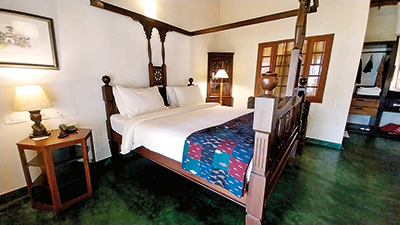
It features 10 well-appointed rooms with modern comforts. The River Meadow and River Panorama rooms overlook the river. The Riverside Pool Deck Rooms face a 20-metre infinity pool on the river’s edge. The resort’s crew, proudly led and staffed by women, has been winning awards and accolades.
 |
|
The rooms are spacious and comfortable |
The attention to detail by the owners and hosts, Rasmi Poduval and Vineet Viswambharam, is discernible in every nook and crany of the resort. The enthusiasm of this enterprising duo is infectious. They quit their corporate jobs and forayed into the hospitality industry.
The aesthetically done, unpretentious interiors have design elements which celebrate local handicrafts. I found a profusion of colonial-style furniture, antique dressers, bookshelves stacked with books, and vintage artefacts, like an old piano, a chessboard and other knick-knacks, complementing the architecture.
Nature, at its finest, is all around. You can revel in nature in the open-to-sky jacuzzi even as you bathe. The bright green of the manicured lawns is highlighted by splashes of bougainvillea colour. This eco-conscious getaway deserves green points for rainwater harvesting, garbage segregation and recycling norms, recycling of food waste as animal feed, waste management, planting of a hardy lawn made of buffalo grass, and striving to be a plastic-free enterprise.
“Sustainability is a philosophy we live by. We believe that providing employment to local communities, preserving and promoting our rich textile traditions and varied art forms of the region is an equal if not stronger measure of sustainability,” affirms Rasmi.
The long veranda that runs all along one side has been made part of the resort’s multi-cuisine restaurant. I pampered my palate with an assortment of superfresh seafood preparations. Food is made to order. The alfresco waterfront restaurant serves ethnic Kerala coastal food like a typical Kerala home. There’s also Chinese and Continental cuisine on offer. I had a scrumptious spread of delicacies for breakfast, lunch and dinner.
Give the kitchen staff sufficient time and they will dish out some amazing Kuttanadan fare: grilled lobster, karimeen pollichathu (pearlspot steamed in banana leaf with spices), prawn and duck curry. The traditional Kerala food made by local chefs is authentic and superlative, especially the Ulli Theeyal (shallot curry), idiyappams and egg roast, the legendary puttu and kadala or the combo of appams and stew.
There are a myriad of ways to keep oneself engaged. A medley of myths, legends, local lore and history surprises you at every turn down the narrow, meandering roads in the region near the delta of the Periyar. You can embark on a cycling expedition to nearby fields or stroll down quiet country lanes, absorbing the ambience of the village.
The resort has tourist attractions in its vicinity. We embarked on the Muziris History Trail accompanied by Stanley, our exuberant guide who led us through ancient temples, churches, synagogues, vibrant markets and handloom weaving centres. He impressed us with his deep knowledge of the region as he took us into the Muziris Heritage Tourism Circuit, which is layered with Dutch, Portuguese, Roman and Arabian histories.
Muziris is one of the biggest archaeological conservation projects in India, conserving three millennia of heritage. Conveniently located for exploring nearby Muziris sites, the entire stretch is dotted with monuments and buildings and is an outstanding specimen of markets, streets, footways, bridges and cemeteries, among other fascinating constructions of an era gone by.
The site has some of the oldest mosques, churches and synagogues in Paravur and Chendamangalam which speak volumes for cultural tolerance and peaceful coexistence, so relevant in today’s world. From here, we explored one of Kerala’s oldest synagogues, the oldest mosque in the subcontinent, Cheraman Masjid, and Kottakavu Church, one among the eight churches established by St Thomas in AD 52.
We stopped by the ancient market of Kottapuram which thrives even today and the restored Paliyam Palace, the seat of the Paliath Achans who served as the prime ministers of Cochin, the Palace Museum and the excavations at Kottapuram Fort. One can experience handloom weaving, an integral part of village life, coir making, and archaeological finds from the Indo-Roman port dating back to 200 BC.
Evenings come alive with rare traditional performances hosted by the Chendamangalam Arts Society. After a day’s sightseeing, we were treated to Tholpaavakoothu, Kerala’s traditional shadow puppetry performed using leather puppets, depicting stories from Hindu mythology. ν
Comments
Currently there are no Comments. Be first to write a comment!