



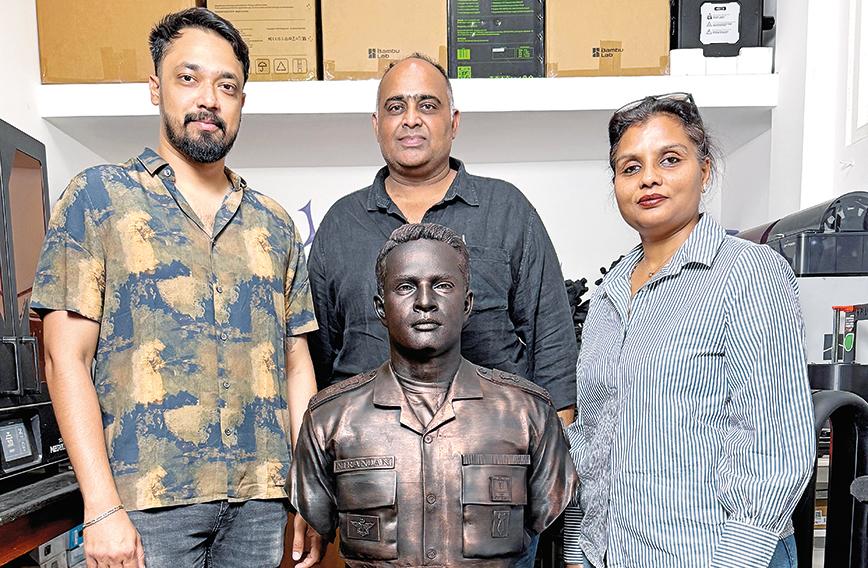
Sriram Seshagiri, N.M. Spoorthy and Shilpa Spoorthy with the bust of Lt Col Niranjan Ek, martyred at the Pathankot airbase
Keepsakes are keepable when they are curated with love
Rashmi Gopal Rao
At the end of a trip, you invariably arrive home with touristy souvenirs in your bag to gift or as keepsakes. It’s the usual stuff: keychains, fridge magnets, maybe coasters, or T-shirts emblazoned with slogans. But what if you could pick up something more inimitable?
Reinventing the meh souvenir is the passion project of N.M. Spoorthy and Shilpa Spoorthy, architects and husband-wife duo. They believe souvenirs are more than shelf-fillers. They are vessels for storytelling.
Their enterprise, IND in a BOX, an acronym for India in a Box, creates keepsakes that embody the spirit of the city, town, village through sculptures, murals, dioramas. Think dioramas of the Mumbai dabbawalla, monuments like Victoria Terminus or sculpted scenes or murals. Families, keen to preserve the memory of a loved one, approach them for busts and portraits.
“Souvenirs are way beyond trinkets like plastic keychains and magnets,” says Shilpa. “They are objects that connect a person to a place, a moment, or a personality. Whether it is a monument or a memory, we believe any kind of nostalgia can be given a form which you can touch and feel.”
“There is a dearth of souvenirs that meet global standards while remaining authentically Indian,” she adds.
The objective of the team is to create pieces that you would be proud to display in a high-end living room or on a corporate desk.

The Spoorthys work closely with Sriram Seshagiri, a digital artist and head of 3D production. He manages the complex journey of a design from a 3D digital model to physical reality, bridging the gap between architectural precision and industrial production.
Bonds that bind
IND in a BOX’s journey began with a simple, profound observation by the founders: we are surrounded by an incredible wealth of history and culture, yet it often feels disconnected from our modern, daily lives.
 “A pivotal moment for us was in 2023, when we curated exclusive keepsakes themed after the great Kannada actor, the late Dr Puneeth Rajkumar. After we witnessed the joy these pieces brought to his family, we realized that we could create souvenirs that encompass the vastness of India into an exclusive tangible experience. Driven by this desire to bridge the gap between deep-seated nostalgia and the humble souvenir, we launched IND in a BOX in 2025,” says Shilpa.
IND in a BOX is a multidisciplinary collective and acts as a link between the past and the future. “Our background in architecture allows us to view heritage not just as a static image, but through the lens of spatial design and curation. As ethnographic curators, we dig through dusty archives, interview stakeholders and uncover human stories that are integral to the object. In short, we set the soul of the project before the first sketch is even drawn.”
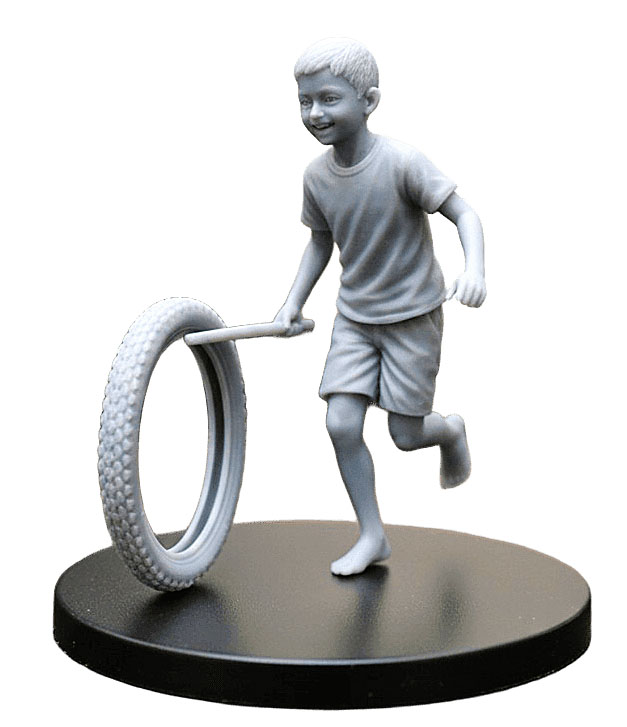
They have sculpted scenes that evoke nostalgia, like that of a child happily rolling a tyre with a stick, or two children turning the chore of pumping water at a borewell into a rhythmic game. They have also reimagined the first streetlamp in India into a functional tabletop accessory.
IND in a BOX uses city airport codes to define their sub-verticals because they represent the starting point of every journey. It is also the last place people experience before they leave the city.
So, in the MAA in a BOX (Chennai) collection, their focus is rooted in the city’s military and colonial soul. Hence, they have worked extensively on the Madras Sappers’ legacies, translating their grit and history into tangible art.
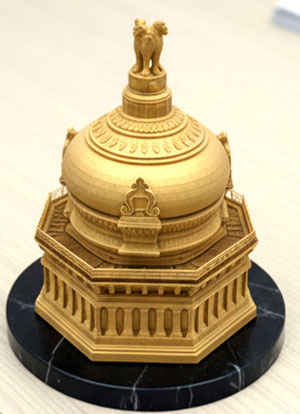 In BOM in a BOX (Mumbai), the team has captured detailed dioramas of the dabbawallas and monuments like Victoria Terminus. BLR in a BOX (Bengaluru) captures landmarks like the Vidhana Soudha and the TV Tower.
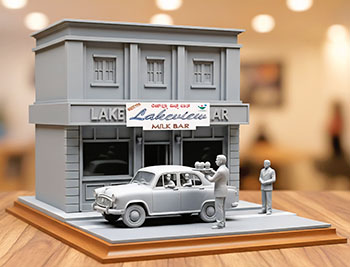
“Beyond specific cities, we also curate what we call ‘Emotive Dioramas’ — capturing places and moments lost in today’s fast-paced world. We have recreated iconic landmarks that exist now only in our memories, like the Chitchat restaurant, Plaza Theatre and Cauvery Theatre in Bengaluru,” says Shilpa.
Attention to detail is paramount in all their creations. So the team captures nuances, whether it is the way a dabbawalla balances a crate or the specific architectural curve of a dome.
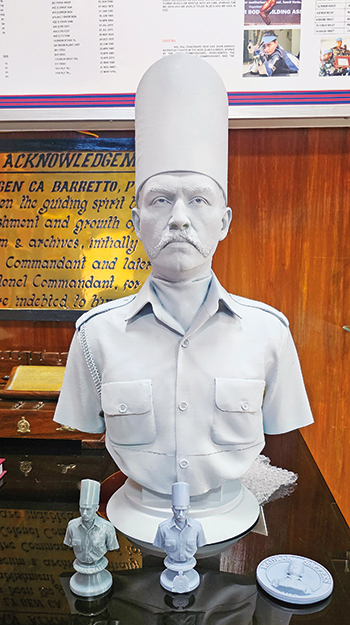
The team recently did a project in association with the Madras Sappers Museum & Archives (MSMA), Bengaluru, by recreating a life-like bust of Mule Operator Munisamy, an iconic hero of the Madras Engineering Group (MEG).
For decades, the memory of Munisamy was preserved only in an archival photograph. Through ethnographic curation the team transformed that two-dimensional memory into a tangible, high-definition 3D exhibit. The bust will be a permanent exhibit at the museum at the College of Military Engineering (CME) in Pune.
“The Madras Sappers project was an emotional milestone and the work we did is perhaps the best example of our mission to give a face to the ‘unsung’. For centuries, Sapper Munisamy — the first Mule Operator — was merely a name and a description in military archives. Our team took those descriptions and sculpted a face for him, giving him a permanent place in visual history. We also took a single, grainy archival photograph of the Decauville (Sapper Train) and reconstructed it as a miniature,” says Shilpa.
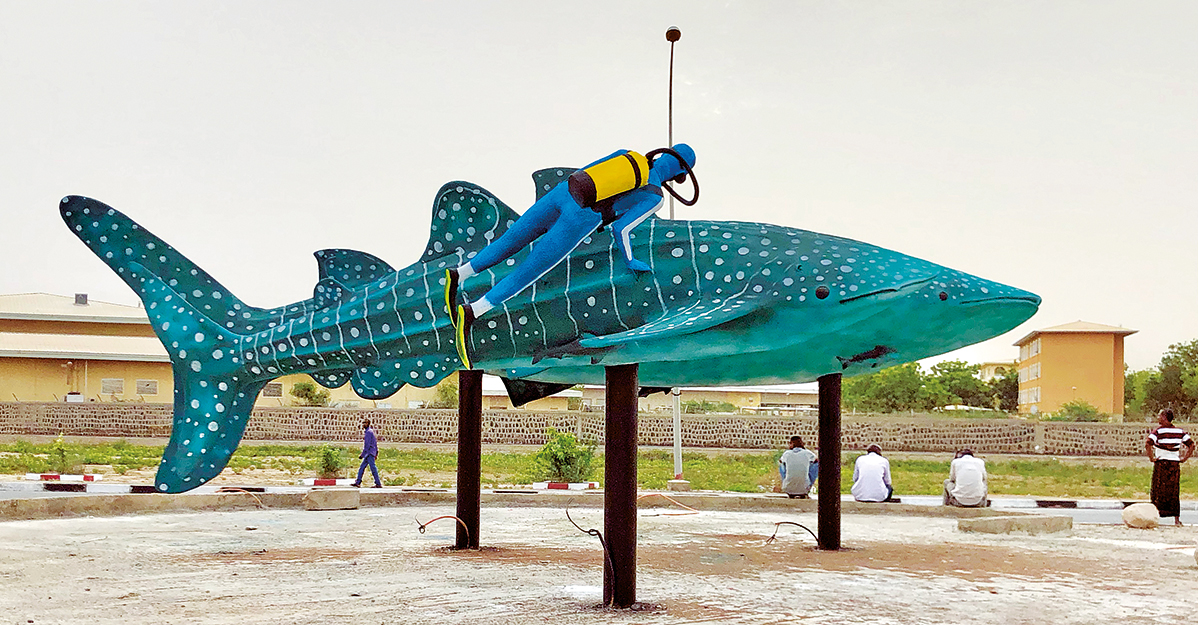 A life-size whale shark created for a roundabout in Djibouti to commemorate 40 years of the country's independence
Another significant work was a wood mural of the Mandalay Gate and the opening of the Zoji La. “Our digital artists and 3D experts worked in tandem to ensure that every bolt on the train and every stone on the gate was historically accurate. We have also created fridge magnets of the opening of the Mandalay Gate and Zoji La,” says N.M. Spoorthy.
 Legacy and memory
Most of their bespoke creations are customized. Their city-specific range celebrates collective heritage. But sometimes they are approached to preserve the most intimate of histories and family legacies.
“We have a growing number of clients who come to us with photos of their beloved parents or grandparents who have passed on. They don’t just want a generic statue, they ask us to capture a ‘characteristic’ moment, a specific body language, a familiar pose, or the way they held a book or wore a shawl,” says N.M. Spoorthy.
IND in a BOX through their 3D sculpting expertise creates personalized busts and full-body models that serve as a physical presence in homes.
“It is indeed special as we are entrusted with a family’s most precious memories and help turn a flat photograph into a form they can touch and hold once more,” adds N.M. Spoorthy.
3D printing
 |
|
Re-creation of nostalgic landmarks |
Souvenirs by IND in a BOX are created using 3D printing, a high-precision technology. “Every piece begins as a high-fidelity 3D digital model. We spend several hours on it to capture intricate textures and geometries that would be impossible with traditional moulds. We use a specialized UV-curable liquid resin. A high-powered light source selectively solidifies the liquid, gradually building the piece. This technology allows for a resolution so fine that it captures even the tiniest details,” says Sriram Seshagiri.
Once the “print” is complete, each piece undergoes a series of refined finishing steps including precision washing to remove excess material and a controlled UV-curing cycle to ensure the structural integrity and durability of the souvenir. After this, the souvenir goes through a multi-stage refinement process where specialized abrasives are used to level the surface and prepare it for the final painting.
“It is during the painting process that the souvenir truly comes to life. We use a combination of airbrushing for smooth gradients and hand-brushing for the finer details. Every piece is finished with a high-grade, UV-resistant clear coat. This protects the paint from oils on the skin and prevents fading over time, ensuring that the souvenir remains a keepsake for years,” explains Sriram.

“Our team has mastered these techniques through years of iterative development, blending industrial engineering with fine arts. While 3D printing technology itself was born from early patents in the 1980s that have since moved into the public domain, our specific value lies in our proprietary workflow and custom material blends,” adds Sriram.
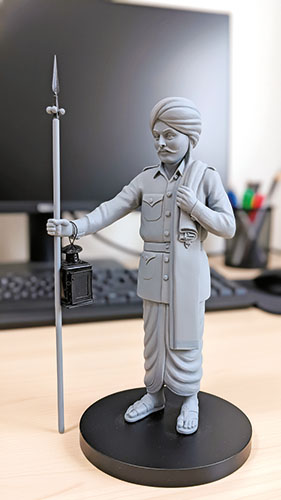 The team also collaborates with other specialized digital artists as they do not believe in a one-size-fits-all approach to art.
“We work with masters of architectural rendering for our buildings, and specialized character sculptors when we need to capture the subtle expression on a human figurine. By bringing together the historian’s curiosity, the sculptor’s touch, and the engineer’s precision, we make sure that every ‘box’ we produce is a masterpiece of collective talent,” explains Shilpa. A single souvenir can take anywhere between one to five days, depending on the size and the amount of work involved.
The team has a dedicated ‘privacy first’ policy. IND in a BOX does not commercialize, publicly announce, or showcase their creative works until they have explicit, written permission from the concerned individual(s) or organizations.
“We believe that heritage is personal before it is public. Our role is to be custodians of these stories and legacies and not just creators,” emphasizes N.M. Spoorthy.
Customers can reach out to IND in a BOX directly through their social media platforms like Instagram.
Comments
Currently there are no Comments. Be first to write a comment!