



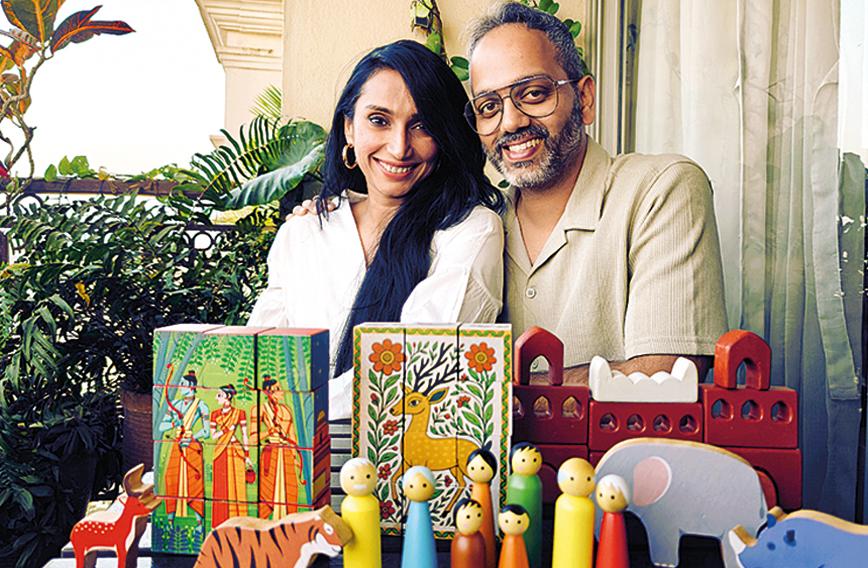
Pallavi and Abhijith Shetty with some of their creations
Taj stacker, play mat of Indian animals
Aiema Tauheed, Kolkata
SIX neat blocks that meld into a beautiful Madhubani, a puzzle that forms a rangoli, stackers of the Taj Mahal, a play mat of Indian animals gleaned from the Panchatantra. Gubbachhi, a new enterprise, has perfectly blended Indian craft with modern sensibilities to create a range of toys from teethers and soft, crocheted figurines to thoughtful puzzles and stackers for babies, toddlers and children.
Eye-catching, educative and artistic, the toys are handmade, non-toxic and created with natural materials like wood, cotton or muslin.
Founded by Abhijith and Pallavi Shetty, and based in Bengaluru, Gubbachhi was inspired by their own experience as parents. With two young sons and a circle of friends who were also parents, discomfort began to surface when they found children more excited about Halloween than Diwali.
“Our kids grow up on Peppa Pig and Octonauts,” says Pallavi. “From the content they watch to the trips families take, everything is international these days.”

They realized India had no shortage of toys that taught numbers, science, or language. What was missing in playrooms were toys that spoke of the country’s rich folk art, its amazing wildlife, literature, architecture, and layered cultural memory.
So in 2025, the Shettys started Gubbachhi to introduce children to the world of India through play. And what does Gubbachhi denote? In Kannada it means sparrow, a bird that’s fun, fearless and curious, just like children. And Gubbi, a little sparrow, is the brand’s mascot.
For Pallavi, the impulse to build something meaningful was shaped early in her career. “My first job was with Titan. I’ve seen the kind of impact the company made through Tanishq and its work with karigars,” she says. “There are skills that will die if nothing is done,” she adds, pointing to the vast cultural knowledge at risk of being lost.
Abhijith says each Gubbachhi product is inspired by India, both in design and philosophy. “If you look at our animals, every toy company has a wild animal set. We have ours too, but they are Indian wild animals,” he explains. Instead of giraffes or hippos, children encounter Bengal tigers, Hanuman langurs, or one-horned rhinos from Assam.
The puzzle sets are drawn from Madhubani, Kalighat, and Warli folk art. There are also Diwali-themed sets that include Ramayana puzzles. Stackers are inspired by iconic landmarks like the Taj Mahal and Red Fort, reflecting a design approach that is Indian in inspiration but international in sensibility, avoiding kitsch or overly loud aesthetics. The range spans ages 0 to 8 and includes gifting sets, soft toys, and educational blocks.
The brand works closely with designers, artists, and artisan clusters across India. The wooden doll sets are fully hand-made, from cutting and shaping the wood to hand-painting by artisans in Channapatna and Jodhpur. Other products, like the Madhubani art blocks, combine handcrafted wooden blocks with UV-printed artwork, allowing Gubbachhi to balance craft with scalability and affordability. Gubbachhi’s soft toys are produced by artisan clusters based in Surat, Ahmedabad, and Rajkot.
Unlike plastic toys, which can be mass produced quickly, hand-skilled pieces take time and care. To balance authenticity with scalability, Gubbachhi sometimes combines artisanal input with machine-assisted processes, as in the Madhubani puzzles, ensuring products remain affordable while meeting growing demand.
The Madhubani puzzles were a breakthrough, quickly becoming a bestseller and inspiring additions like the Ramayana and Mahabharata puzzle sets. The Ramayana set, especially, sold exceptionally well during Diwali, due to its cultural relevance. Puzzles perform well largely because of their usability: each set includes six puzzles and an activity book, allowing children to engage repeatedly while learning about the theme. Parents also value the puzzles as aesthetically pleasing objects which can double as décor.
Another consistent bestseller is the Kutumba pet doll set. Centred on the idea of family, including grandparents, it has become a popular gift, especially among older relatives. Designed for open-ended, imaginative play, the dolls avoid restricting how children interact with them which has worked strongly in their favour.
Animal sets also continue to do well within the pretend-play category. The jungle animal set, which includes an India map, prompts children to locate where the animals are found. It has even sparked family trips to those regions, an outcome parents frequently share, says Pallavi.

On Amazon, crochet toys perform particularly well. As a gifting category, they are easy to sell: visually appealing, intuitive in use, and requiring little explanation. A good image often does the convincing.
Growth for Gubbachhi has been steady. Currently it is an online brand, with most sales driven through its website and a smaller share coming from Amazon. Marketing is mostly through Instagram and Facebook, with storytelling events happening sporadically. Orders are growing month on month, but for the founders, validation has come as much from feedback as from numbers.
“Customers actually call us just to say we’re doing something positive and relevant,” says Abhijith. “That’s been incredibly heartening.”
There has also been early investor interest. A small pre-seed round raised a few months ago marked an important milestone, not so much for its size but for what it signalled. “A stranger backing you is very different from friends and family,” Abhijith notes. The interest is natural. The toys are incredibly neat and safe too, conforming to European and American standards. And response from customers and investors reaffirms that Gubbachhi has found resonance, at an early stage.
Comments
Currently there are no Comments. Be first to write a comment!