



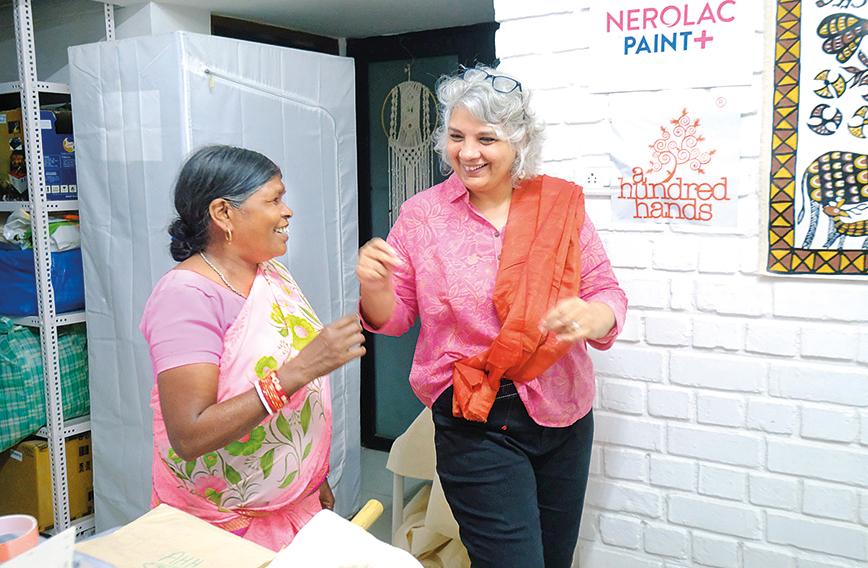
Mala Dhawan interacting with an artisan
Hands up for handmade: How artisans can reach markets
Rashmi Gopal Rao
When Sonia and Mala Dhawan, sisters from a fauji family, decided to help a women’s farmer group sell their products, they inadvertently set off a chain of events culminating in the formation of Bengaluru’s oldest handmade collective, A Hundred Hands (AHH), in August 2010. Started with just 20 artisans, their collective grew and grew and now supports 200 artisan groups every year.
Back in 2000, Sonia and Mala had offered their own garden space so that the women’s farmer group could sell food products to urban consumers living around their home.
“We made handmade posters and placed them in nearby shops, announcing the sale. The response was truly overwhelming and the products were sold out in a day. We then started getting approached by individual artists and groups who were looking for a platform to market and sell their products,” says Mala, 59, who holds a Master’s degree in Business Administration. Incidentally, she has extensive experience in the field of brand strategy. Sonia, who is 62, has a PhD in human genetics and is trained as a naturalist.
“We have been interested in art and craft since childhood. In our family, we were always encouraged to make things by hand whether it was a greeting card, a present or gift wrap. The philosophy to repair, reuse and recycle was ingrained in us,” says Sonia.

“Although our father was a fighter pilot, he cultivated carpentry as his hobby and had a little DIY workshop. Our mum was a nurse but she had an incredible talent for sewing and created the most exquisite pieces of embroidery. So, craft and creation were an intrinsic part of our lives and kept us occupied as we lived in Air Force Stations across India.”
Registered as a charitable trust, the primary mission of AHH is to provide a platform for the artisans where they can interact with the end consumer directly and showcase their skill and products.
While people do appreciate craft, the artistan is often not projected in the forefront. That space is taken up by various middlemen or patronized by big businesses. The middlemen generally control prices, designs, marketing and sales.
“We connect artisans to the right customer bases. They are free to price their work and rightfully retain the whole consideration,” says Mala. AHH acts as a support system which also mentors artisans by guiding them on insights related to design, innovation, pricing, collaboration and so on. Apart from learning to elevate their craft and adapt it to contemporary needs, artisans also acquire a sense of reassurance and confidence through such interactions.
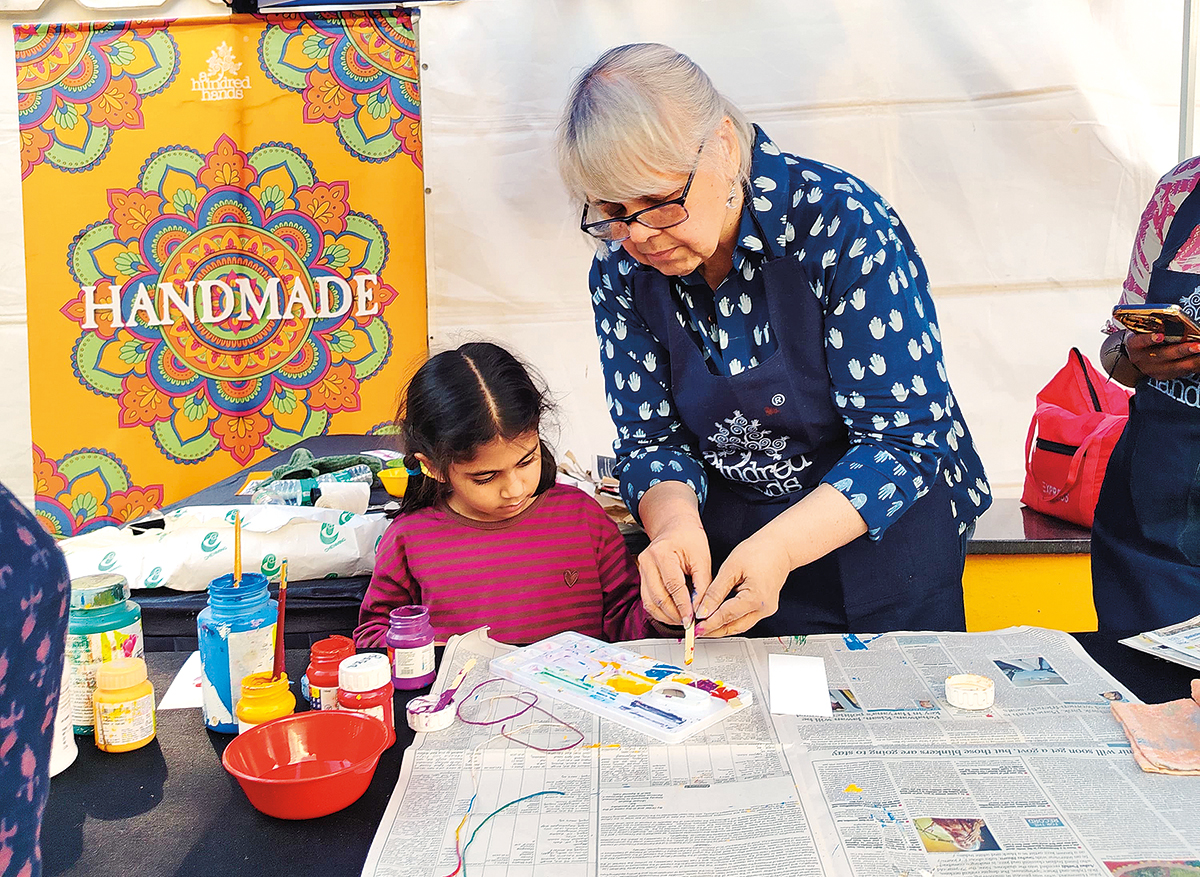 Sonia Dhawan helps a child with artwork
AHH supports a diverse array of crafts from leatherware, puppetry, home décor, pottery and terracotta to textile weaving, metal work, stone carving, ceramics and seashell craft. The collective has given a new lease of life to dying art forms like Sanjhi, a form of papercutting practised in and around Mathura, Rajasthan’s Mughal miniature art, and Bhil tribal painting. AHH has helped make such art forms sustainable through workshops and by sponsoring exhibition stalls.
“I specialize in Sohrai painting from Jharkhand, a form of tribal wall art traditionally created using natural clays (black, red, and yellow soils) without brushes. We use twigs or our fingers. Now we paint on paper and canvas too. A Hundred Hands has enabled me to promote Sohrai art to wider audiences,” said Manikchand Mahato, a Sohrai painter from Jharkhand who has been a member of AHH for the past three years.
“Through this platform, our art has gained recognition, better pricing, and commissioned work opportunities. I have trained about 15 artists who now practise it full-time.”
 |
|
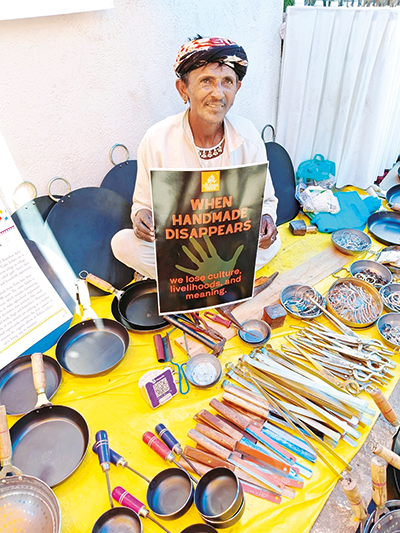
Hanuman Luhar displays his products at the fair |
Mahato felt he had gained access to customers who truly understand and appreciate his craft. Despite cultural and language differences he received a lot of love and respect from customers, he said.
“Being associated with A Hundred Hands felt like a turning point in my life. Our little known craft and community found visibility, dignity, and belonging through this collective,” said Hanuman Luhar who hails from a traditional blacksmith community of Rajasthan.
“While we have been making traditional agricultural tools, cookware, and decorative objects in iron, over time, I began exploring possibilities in metal. I now specialize in handcrafted iron insects, using traditional forging techniques without welding,” said Hanuman, who has been a member of A Hundred Hands for about 11 years.
The collective holds a vibrant bazaar a few times each year in Bengaluru and other cities. It also undertakes corporate and festival gifting. Artisans have secured corporate projects including large format installations and murals for brands such as Flipkart and institutes like the Azim Premji University.
“We also promote artists on social media and connect them to customers directly,” adds Mala.
A Hundred Hands works on an annual membership model and every year about 200 groups are supported. The groups, in turn, include an average of about 50 people and hence about 10,000 livelihoods get supported through AHH initiatives.

“The membership supports the office. We divide the bazaar costs; some are free while other categories pay according to their size. Corporate Social Responsibility (CSR) and sponsorship help to cover some costs. In addition, we do corporate engagements and workshops that help build the team,” explains Sonia.
AHH receives scores of applications each year. Each application is scrutinized before granting membership. The group applying has to fulfil certain criteria like dependency of the craft on the livelihood of the artisans, the craft being practised, the requirement for support, ability to innovate, desire to preserve and help the craft grow, etc. “Based on all these criteria we grant membership to artisans, NGOs, craft entrepreneurs working or reviving niche crafts,” adds Sonia.
AHH also runs a volunteer programme called Blanket of Love, encouraging crocheters and knitters to make blankets for an orphanage every year.
“We are at the crossroads of developing a plan on deeper incubation, mentorship, documentation and collaboration across disciplines,” conclude Sonia and Mala.
Comments
Currently there are no Comments. Be first to write a comment!