



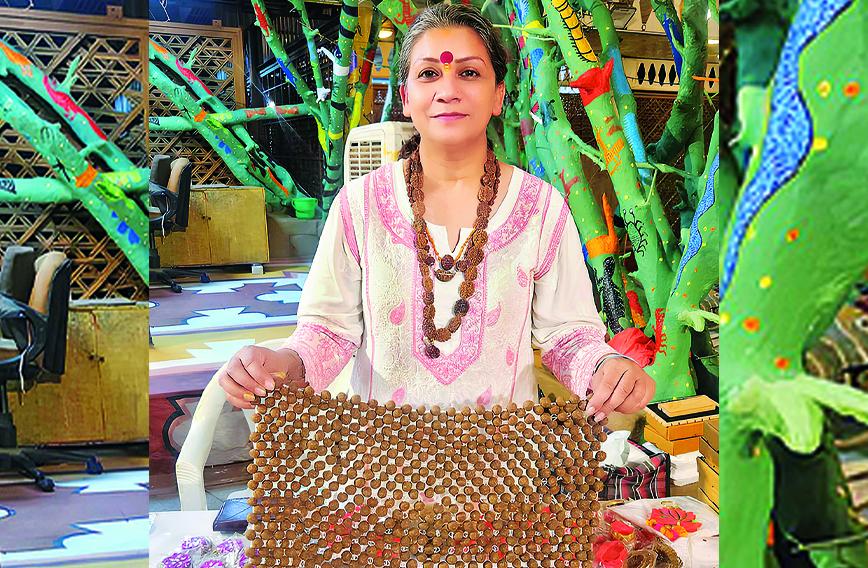
Nita Deep Bajpai with her handwoven cow dung acupressure mat
The dung enterprise
In the ordinary, Nita Deep Bajpai discovered the extraordinary. Cow dung — usually dismissed as waste — becomes in her hands a material of transformation: tangible, purposeful, sacred. It carries the weight of centuries of tradition, the promise of wellness, and the power to uplift entire communities. Through this seemingly humble substance, Bajpai creates acupressure mats that ease tired bodies, therapeutic pillows that encourage rest, wedding jewellery that honours culture, 21-bead Rudraksha sets that strengthen meditation, anti-radiation chips that anchor modern life, and Bhij Ganesha idols that dissolve into soil and sprout medicinal plants. Every creation is alive with intention, connecting people to themselves, their communities, and the natural world.
Yet the brilliance of these products is inseparable from the story that led Bajpai to them. Her life, marked by learning, resilience, and devotion, shapes every creation.
Bajpai’s life was once defined by relentless ambition and balance. A tireless student, she was pursuing her master’s degree and training to become a civil judge, simultaneously nurturing a love for craft and jewellery design while raising her children. This dedication was a reflection of the “old Nita” her husband often encouraged her to be — the one passionate about learning and service.

Then, the ground gave way. Her husband died abruptly following a paralytic attack. “In the span of five seconds, your life can change,” Bajpai reflects on the abrupt shift in her world. She was instantly thrust into managing his CT scan centre in Harda district of Madhya Pradesh, a responsibility that initially felt heavy and isolating.
The centre served a community stretching across 14 villages giving her an unprecedented window into the vulnerability and strength of rural women. It was here, at the crossroads of her personal sorrow and societal reality, that her purpose was revealed.
Ethical source
The choice of cow dung was neither accidental nor arbitrary; it was a stroke of genius rooted in tradition, logistics, and economic viability. For Bajpai, cow dung is inextricably linked to memory and sanctity. She recalls the use of cow dung floors in the villages of her childhood — a sacred, grounding, naturally antiseptic, and cooling surface revered in Sanatan tradition. This material is both spiritually resonant and supremely practical.
 |
|
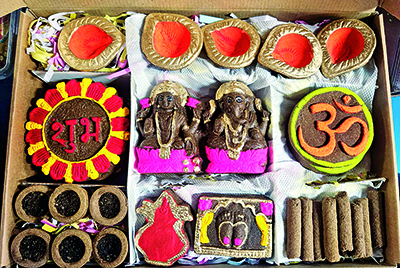
Eco-friendly diyas, idols, and sacred handcrafted pieces |
From an entrepreneurial perspective, the resource is easily available and requires minimal investment to process. The primary energy source needed for hardening is readily accessible sunlight. Furthermore, Bajpai made the strategic decision to establish her production unit immediately adjacent to the gaushala (cow sanctuary). This eliminated the need for complex supply chains, drastically reducing transportation costs and providing a stable, localized source of the core material. This low-investment, high-impact model is a testament to sustainable business practice.
Bajpai’s ethics demanded that her resource be sourced with compassion. Her model is founded on a profound rejection of the practice of abandoning cattle once they stop producing milk. In her gaushala, all cattle — cows, Nandi (bulls), and govansh — live out their full lives with dignity. By valuing the dung, Bajpai ensures the sustained care of the animals, effectively turning a discarded by-product into an economic engine that protects cattle from the dangers of being left on the streets. This ethical sourcing creates a self-sustainable gaushala model where nature is a partner, not a resource to be exploited.
The moment that shattered her isolation and focused her energy involved a woman named Farsana. Battered and bruised after fleeing an abusive marriage, Farsana was left for dead outside the clinic. Bajpai healed her, but in Farsana’s pain, she saw the potential of countless other women: women from tribal groups, marginalized communities, and those who were differently abled — all intelligent, resilient, and skilled, yet trapped by illiteracy and lack of opportunity.
This realization became Bajpai’s mission. Her husband's encouragement to return to her passionate self, merged with a deep, maternal urgency. Her vision crystallized: to use her intellect and emotion not just for her family, but to make women “financially, mentally, and emotionally strong”. She resolved: “To live in the lives of a million people, not in just one home.” The goal was to give love to receive love, and to use her own resilience to foster theirs.
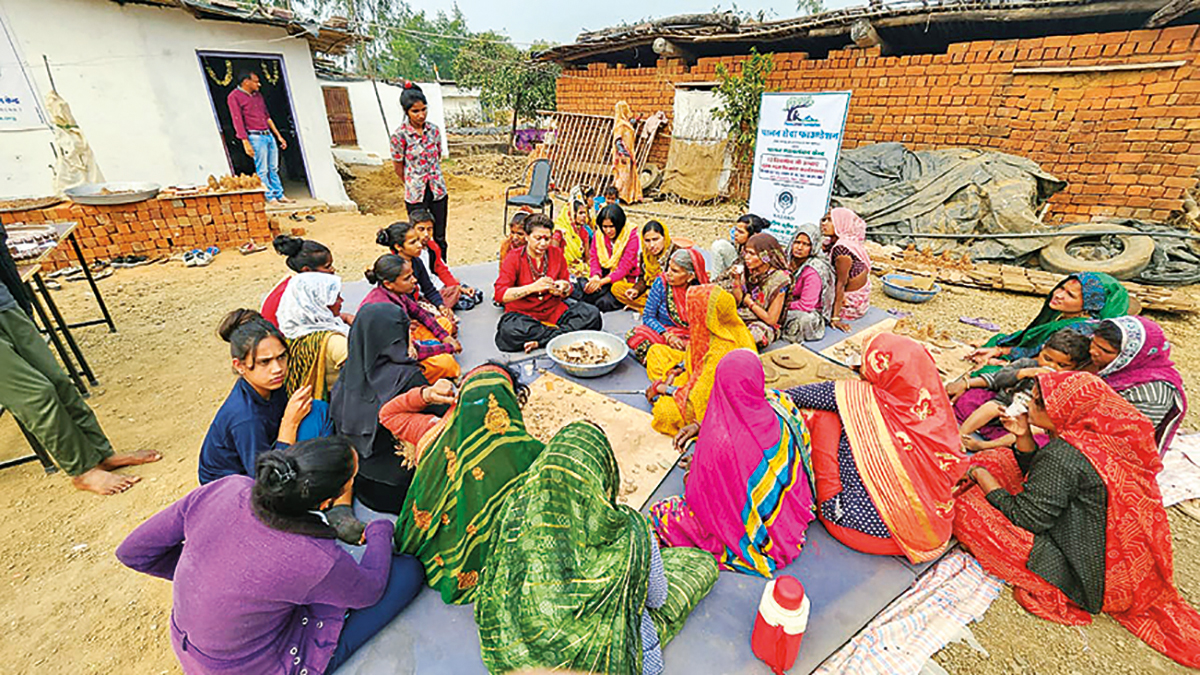 Bajpai teaching women crafts and life skills that transform their future
The true heart of Bajpai’s enterprise is social justice. Her workshop became a sanctuary of opportunity, fulfilling her vision of skill development for marginalized, underprivileged, and physically challenged women who felt they had no purpose due to illiteracy. She specifically works with communities like the Sahariya tribe, who often endure conditions without light or running water.
Bajpai’s model is built on freedom and respect. She offers flexible work hours, allowing women to work as much or as little as they need, balancing income with crucial family duties. In the workshop, they learn sophisticated craft — rolling dung ropes, moulding intricate idols, and executing detailed painting. Each skill mastered is a step towards self-reliance. For these women, the repetitive, careful work of shaping the earth provides immense emotional restoration.
Chips to mats
Among her creations, the anti-radiation chip stands out for its quiet ingenuity. Small enough to sit behind a mobile phone or laptop, it embodies her philosophy of blending ancient knowledge with modern need. Made from finely powdered cow dung mixed with natural binders and sun-cured into firm discs, the chip symbolizes grounding in an age dominated by screens. Whether placed behind a device as a protective charm or kept on a work desk as a reminder of the earth’s stabilizing presence, the chip links technology to tradition.
Wellness takes another tactile form in her acupressure mats and therapeutic pillows, products that translate earth, sunlight, and skill into comfort and restoration. The mats are crafted from ropes of cow dung rolled and woven by hand, then sun-hardened to create gentle pressure points that stimulate circulation and release tension. They offer relief for common ailments like migraines and backaches. Alongside them lie therapeutic pillows, filled with natural materials and shaped to cradle the head and neck in restful alignment. These tools remind users of their bodies’ intelligence, the rhythms of breath, and the quiet power of self-care. In a world increasingly distanced from nature, Bajpai’s wellness products guide people back to a simpler, more embodied state of being.

Spirituality, too, infuses her work in tangible ways. Her 21-bead Rudraksha sets anchor meditation practices with a biodegradable, earth-friendly foundation. The beads are mounted on cow dung bases moulded with precision, ensuring that spiritual objects remain aligned with ecological integrity. Crafting the sets is a soothing, meditative task for the women in Bajpai’s workshop; they speak of finding their own grounding in the repetitive tying, shaping, and threading. The end product carries that sense of intention — each bead offering a moment of pause, each base carrying the energy of the hands that shaped it.
The most powerful fusion of ritual and regeneration is seen in the Bhij Ganesha idols. Crafted from sun-dried cow dung enriched with medicinal seeds, these idols do not pollute. Instead, they dissolve gracefully during visarjan (immersion). As the form disappears, the seeds settle into the soil, sprouting into new medicinal plants and manure. Devotion becomes a profound catalyst for new life, turning an act of faith into a ritual of reforestation — a true guru dakshina to the earth.
Her wedding jewellery carries yet another layer of meaning — culture expressed without compromise. Lightweight, intricately moulded, and hand-painted with natural pigments, each piece tells a story of heritage preserved through sustainable craft. In a world where weddings often generate enormous waste, Bajpai’s jewellery provides a path towards celebration that honours both tradition and the earth. Brides choose them not only for their beauty but for their story: that of artisans who have risen from adversity, making this an exquisite example of alternative sustainable fashion.
What makes Bajpai’s work extraordinary is not only the innovation but the intention behind it. Cow dung, sunlight, and human skill become tools of empowerment. Tradition becomes modern. Ritual becomes sustainable. In the interplay of sunlight, earth, hands, and heart, Nita Deep Bajpai has revealed a profound truth: even the humblest materials hold extraordinary potential. Through cow dung, she has created a world where women rise, animals thrive, communities flourish, and the earth is honoured. Her story flows quietly beneath her creations, giving them soul — but it is the products themselves that speak most powerfully to the future. A future where every act of creation honours life, uplifts communities, and carries intention into the world.
Comments
-

Sumita Ghose - Jan. 25, 2026, 11:20 a.m.
Nita's story and her work is so inspiring! Please send me her email address so I can connect with her and send farmers and artisans from Rajasthan to see her work.