




Narinder Pal Singh in the stock room of their SHG, Nini, with various products
Wonder grinder makes Haryanvi farmer a star in the south
Shree Padre, Kasaragod
A portable food processing machine that can grind, pulverize, extract and distil almost any fruit, crop or seed is becoming a bit of a sensation with Self-Help Groups (SHGs), farmer producer companies and entrepreneurs. Sturdy and inexpensive, it’s a tempting innovation for small agro-processing start-ups.
Invented by a Haryanvi farmer, Dharambir Kanoj, this hardworking machine, called Multipro, is a many-sided wonder. “It does the job of juicer, pulper, cutter, paste-maker. It can mash onion and garlic, make khoya from milk, jam from banana and beetroot and distil lemongrass or rose,” rattles off Prince Kanoj, Dharambir’s son.
So far more than 2,000 machines have been sold by Kanoj’s company, Kisan Dharambir. Multipro has also been exported to 15 countries.
Born into a farming family in Damla village of Haryana, 63-year-old Dharambir dropped out of school in Class 10 due to financial difficulties. He worked as a rickshaw-puller in Delhi to support his family until he met with an accident.

Dharambir then returned to his village, not knowing what to do. He was interested in cultivating exotic vegetables. Aloe vera caught his eye. He decided to cultivate the plant and then process it into gel or juice. For that he needed a processing machine. But a basic machine cost Rs 5 lakh, an unimaginable sum for Dharambir at that time.
He didn’t give up, though. Instead, he turned his home into a workshop, determined to make his own processing machine. After eight months of trial and error he finally invented a multiprocessing machine in 2005. It cost him just Rs 25,000.
 |
|
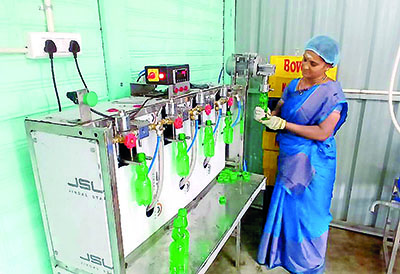
Sai Sakthi Foods produces betel leaf soft drink |
Kisan Dharambir now makes four models of Multipro. The smallest has a capacity of 20 litres and costs Rs 1,13,280. The 60-litre one is priced at Rs 1,51,000. The other two are of 120 and 180 litre capacity.
“Each machine has seven attachments. Five are most important. Three attachments are included in the basic price of the machine. We can also make customized Multipro machines,” explains Prince. The machines run on single-phase electricity and include temperature control as well as an auto cut-off system.
Dr Parthakumar P. Dave, who works in the research section of the National Innovation Foundation (NIF), points out that current mixer-grinders grind and mash everything, including the seeds of the fruit or crop. This makes the pulp bitter.
“Multipro, on the other hand, makes pulp through a beating mechanism. As a result, the seeds remain intact. If you are grinding jamun, you can then use the seeds for value addition too,” he says.
Dharambir and Prince now travel extensively to demonstrate Multipro’s capability to farmers, entrepreneurs, Self-Help Groups and other interested parties across the country. Dharambir inspires farming communities by making a minimum of half a dozen products from local crops in front of their eyes. He invites them to taste whatever he has extracted from their crops, be it juice or paste.
“Multipro is an important invention for the farming community,” says Ramyashivaselvi Manoharan, a home science specialist at Theni Krishi Vijnan Kendra in Tamil Nadu, who has been conducting demos of the machine. “It is ideal for start-ups with limited budget and space. If you buy a drier and pulverizer with it you can make dozens of products.”
In Tamil Nadu the machine is being used to make betel leaf extract and betel juice. Demand for betel leaf has been shrinking, prompting the KVK in Theni district to promote value addition to help struggling betel leaf farmers earn an income.
“We bought two Multipros to demonstrate their utility. We successfully took out betel leaf extract with it. That led us to another promising opportunity,” recalls P. Maheswaran, head of the Theni KVK.
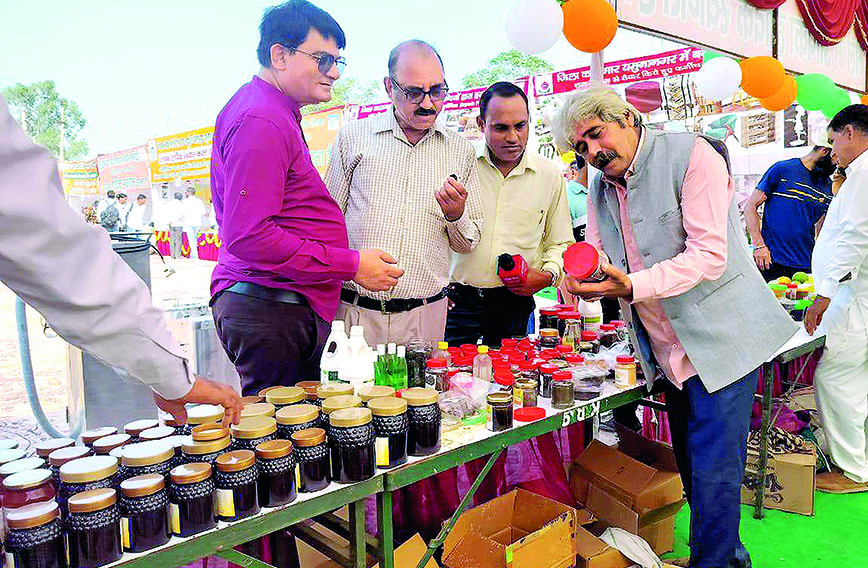 Dharambir Kanoj at an exhibition, showing dozens of products made by his machine for his own business
The KVK drew the attention of S. Renuga Senthilvel, owner of Sai Sakthi Foods, in Chinnamanur. His company makes ready-to-drink (RTD) beverages.
Renuga got interested, bought a Multipro machine and added betel leaf RTD to his range of drinks. For the past year Sai Sakthi is churning out natural betel leaf goli soda in bottles priced at `35. “We are selling 1,000 bottles per month. In summer, sales shoot up to 3,000 to 5,000. This drink has good demand because of its digestive properties,” says Renuga.
A year-old farmer producer company (FPC) called Lavoisier in Theni district’s Vasanthanagar is also hoping to achieve success with this machine. Theni district’s ODOP (One District One Crop) is banana. Members of the FPC have been trained at Central Banana Research Station, Tiruchirappalli, to make RTD beverage from banana pseudostem. The Multipro machine extracts the juice efficiently.
There is demand for banana pseudostem juice because it is believed to contain properties which melt kidney stones. But the FPC is hamstrung by two problems: it doesn’t own a Multipro and has to take all its material to the KVK for juicing. Also, it has yet to create an efficient supply chain since pseudostems of suitable varieties aren’t sufficiently available.
“No one in Theni district is producing banana stem drink. It has very good demand. Already 10 hotels are keen to place orders. If we can set up a fully-fledged production unit we can even sell 500 bottles a day,” says Hema Indrajit, CEO of the FPC.
There is also Narinder Pal Singh, a housewife from Himachal Pradesh, who started Nini SHG with six housewives. They make around 70 products under their brand name, Nini, with a Multipro and earn around `1 lakh a month. Their products range from rose water and herbal hair oil to crushed amla and herbal tea.

The National Innovation Foundation (NIF) has been supporting Dharambir. In 2009, they honoured him with a state award in Haryana. In 2013, he was conferred an award by the President of India for his unique machine.
He has also been supported by Villgro Innovations Foundation and Council on Energy, Environment and Water (CEEW), which works to boost the rural economy. Thanks to financial aid from Villgro, Dharambir was able to expand his enterprise. He now manufactures 15 to 20 machines a month.
“When I developed this machine for the first time, people made fun of me,” recalls Dharambir. “My father believed I was wasting my time. But now the government and ordinary people have recognized our effort. Every month, many teams, some from abroad, come to visit us. I am happy that small farmers are using our machine to earn an income.”
Dharambir runs a value addition unit too. It produces more than 50 products including exotica like black garlic and black lemon. For farmers who come to his factory to see a demo, his range of products, under the brand name Prince, is a source of inspiration.
Contact: Dharambir Food Processing Technologies Pvt Ltd; www.kissandharambir.com, [email protected]; Phone: 98126 46563 / 98960 54925
Comments
-

Vimala Ramachandran - March 18, 2026, 8:06 a.m.
Amazing and congratulations.... such a heart warming experience it must have been for all those involved.