




KIRAN KARNIK
WE need to review our policy if current development models are aggravating these issues. The Himalayas’ situation is a warning bell.” Concerned about environmental degradation, the speaker linked this to “faulty global development models and materialist and consumerist approaches”. These strong words, opposing government policies like broadening roads in the Himalayas to promote development, are not those of a leftist, “urban Naxal”, or an NGO-affiliated environmental activist. Instead, they come from the very powerful head of the RSS!
Meanwhile, a group of respected people, including ecological experts (and a very senior member of the ruling party) have requested the Supreme Court to review its decision permitting broadening of key highways in the Himalayas. This decision had come despite many top experts pointing to the dangers of such broadening (by mountain/rock cutting and deforestation) in the context of the well-established fragility of the Himalayan ecosystem. They had cautioned about this causing landslides and floods, especially with the increasing intensity of extreme weather events, like exceptionally heavy rainfall. All this was overruled on grounds of “security needs”, though the main driver may well have been the promotion of pilgrimages through a vanity project (the Char Dham highway). Now, with roads blocked (or washed away), neither military equipment nor pilgrims are going anywhere.

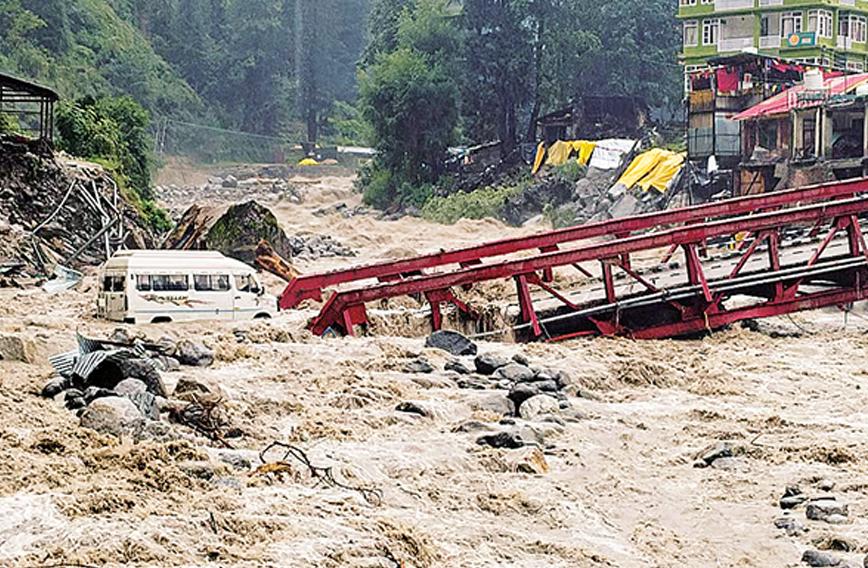
When this broadening of highways was first proposed, one did not have to be an oracle to predict the dangers. Nor does one have to be a soothsayer to look ahead and see that the situation can only worsen. Sensible safeguards — like the creation of the Bhagirathi Eco-Sensitive Zone (BESZ) — have been given the go-by, and there are widespread violations. Following a spate of unprecedented floods and landslides over the past few years, causing much devastation and tragic loss of life, the regulatory bodies have woken up. The Supreme Court took note of logs floating down with flood waters, indicating large-scale deforestation activity. The National Green Tribunal (NGT) took suo moto cognizance of reports on rampant construction near Gangotri Dham posing a threat to the shrine and sought responses from the Central and state governments. Violations such as the construction of homestays and the like in flood plains have suddenly been noticed.
Of course, the floods and consequent damage this year is on a scale that would wake up anyone. Apart from the impact at higher altitudes and rural regions, Dehradun too suffered much damage and, sadly, 29 deaths due to the floods in September. Further east, the intense rainfall in early October washed away roads and bridges in the Darjeeling area, and early reports mention 20 deaths in the region. Punjab too has seen unprecedented floods, leading to a serious impact on crops and the loss of 500,000 trees, depleting its already low (3.7 percent) forest cover. Clearly, the extensive floods will not only affect families, but also the economy of the state.
One more consequence of floods is the inevitable spread of disease — possibly epidemics — with long-term health effects. The immediate economic impact too is substantial, especially in hill stations which have few jobs when tourists don’t come. Loss of jobs and income means a daily-life crisis for many.
Official reaction has followed the standard playbook for such disasters: announcement of compensation for those affected, a committee to assess the damage, aerial surveys by VIPs, pleas by the state for funds from the Centre, and statements about the “unexpected and unprecedented natural events”. There is never even a hint that these tragedies may well be man-made events triggered by thoughtless projects, along with encroachments and illegal construction: local follies that compound the effects of overall climate change.
The future portends a worsening, with global warming triggering even greater climate change and extreme weather events. Reversing this is an uphill task, but what is at stake — in the long run — is our very survival. Possible scenarios include rising sea levels that threaten islands, coastal cities and regions, deep droughts and intense rainfall. As glaciers begin to melt, this too will seriously affect India. These disasters are being amplified by policies and projects that add to our woes.
In cities, hills are being levelled, trees cut, lakes built over: all in the guise of “development”. Public reaction, muted or resigned to fate earlier, has recently become more strident — and no longer limited only to fringe environmentalists. While “security” is yet a largely unquestioned cover for projects, more are protesting against the dilution — often waiving — of environmental regulations to promote “ease of doing business”. Now, media coverage is more extensive, with photographic evidence: of rampant illegal construction in the Aravalis, for example. Shockingly, this includes structures — on notified land — by government agencies; unsurprisingly, these have been recommended for “post-facto approval”.

How this was allowed and why no action was taken is a mystery, especially after the Supreme Court had, in September 2022, directed the Haryana government to remove all illegal construction on notified Aravali land! Ironically, the Haryana government now wants to redefine the Aravalis to release more land for construction. Meanwhile, like the rest of the National Capital Region (NCR), residents in Gurugram and other cities in the state are choking on the air they breathe, when they are not marooned by road-rivers.
The politician-builder-technocrat-bureaucrat nexus and slow-moving, indulgent regulators hold citizens to ransom with on-going deforestation, hill-levelling, and illegal construction. Builders and vanity projects, it seems, matter more than people’s lives. In this seemingly bleak future, growing public awareness and protests are the only sign of hope.
Kiran Karnik is a public policy analyst, author, and columnist. His most recent book is ‘Decisive Decade: India 2030, Gazelle or Hippo’.
Comments
Currently there are no Comments. Be first to write a comment!