




KIRAN KARNIK
No, the year in the title is not a mistake or misprint. We could well be “developed” (viksit) next year, if not this, and we don’t have to wait till 2047.
Recent events, covered in the media, provide the evidence. Take the economy. Most consider this all-important, and leaders have focused on it as the benchmark (for example, a per capita income of $14,000 as the indicator of being a developed country). We are far from that, with the precipitate fall of the rupee in currency markets further widening the distance. Yet, we might be closer.
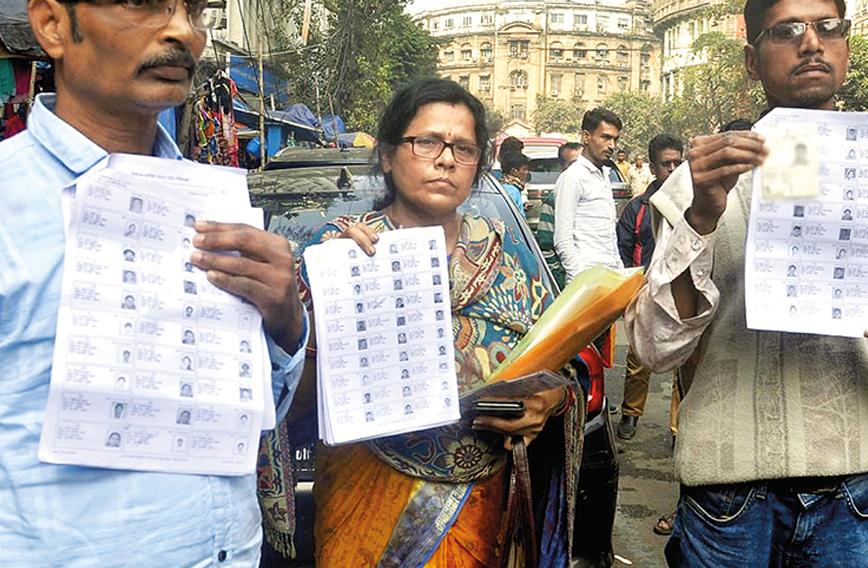
The immediate boost comes from West Bengal: not from its somewhat sluggish economy, but from elsewhere. Credit must go to the Election Commission. It reportedly removed about nine million persons from the electoral rolls. This reduction may be the result of deporting illegal immigrants (every “ghuspetiya” will be deported, promised one top leader).
Though media reports speak only of hundreds being sent across the border, the huge hue and cry of “demographic change” implies millions of illegals. The lack of papers (your 70-year-old father’s birth certificate), resulting deportations, and the “logical inconsistencies” so cleverly detected by the EC’s algorithms indicate that the electorate (therefore, population) is far smaller than the projections or estimates. Since what is measured is gross domestic product (GDP), lower population means that the per capita income (PCI) will become higher.
Similar wonderful exercises by the EC in other states will definitely reduce the electorate — by implication, the population — across the country. This lower population number will boost our PCI, taking our ranking many steps up (of course, we would prefer mentioning our global GDP rank — sixth — and not our 149th rank in PCI).

Not quite viksit yet on the PCI count but — especially if the rupee gains some strength — we may be fifth in global GDP next year. And how can a top five economy not be counted as a “developed” country? On the PCI benchmark too, the strenuous efforts at disenfranchisement launched by the EC, if continued in every election, should substantially reduce the estimated population number and considerably raise our PCI by 2037, 10 years ahead of 2047.
However, some have long argued that development is not fully — nor even substantially — defined by economic yardsticks. GDP and PCI are doubtless important, but so are other measures. Take corruption, a global scourge, perceived as rampant in India. It should be minimal in a developed country.
In India, at least one major institution — a pillar of democracy, the judicial system — is now corruption-free. If you have any doubts, note that the Supreme Court objected to and got deleted a chapter in school textbooks because it mentioned corruption in the judiciary. Reflecting ire at mention of judicial corruption, the persons connected with writing this were, in effect, sentenced to lifelong unemployment (at least, no government jobs) by the court. What more proof does one need of a corruption-free, efficient, and fair justice system? Clearly, a sign of being a developed country.
There was a time when roti, kapda aur makaan were defined as the minimal necessities, the lack of which indicated our under-developed country status. Today, free foodgrains and government schemes for house construction have taken care of two.
As far as kapda is concerned, we seem to have solved that too. Evidence comes, once again, from the judiciary. Very recently, a court pulled up a litigant for wearing a T-shirt and jeans to court rather than something more appropriate. If, instead of worrying about people with no clothes to wear, our learned judges are concerned about better dressing, clearly our clothing problem too has been solved.
Meanwhile, some NGOs were warned against raising funds by talking of malnutrition amongst children. Government programmes have apparently solved this and now there is no malnutrition.
As far as makaan is concerned, there is obviously no problem. Have you read any reports about the suffering of those rendered homeless when their long-standing houses are suddenly discovered to be “illegal” and bulldozed? Clearly, the lack of such stories shows there is enough housing. Taking care of the three key necessities certainly gives us a right to the elevated status of “developed”.
Driving development is our education system. In recent years, it has become more focused with the removal from textbooks of certain historical periods, which were an unnecessary load. Also, academics and writers who espouse contrary views have been barred from lectures to students, since we don’t need critical thinking or diverse perspectives: it may divert students from unified viewpoints that will promote national cohesion.
In keeping with this, student plays, protests, or rallies supporting certain causes are banned, helping the cause of uniformity in education and thought. Unnecessary diversions related to inequity, or to civil, gender, and human rights, are impediments that are best avoided if we want to progress fast. These have been major steps forward, taking us ever-faster to the “developed” status.

Environment being important, some exemplary steps have been taken. For example, while over seven lakh trees will be felled for the Great Nicobar project, the unique ecosystem there will be taken care of by compensatory afforestation in Haryana (only about 2,500 km away).
Social harmony and the rule of law, important signs of development, are being ensured. For the former, there is the Gujarat model — no communal clashes after 2002. For crime abatement, UP provides an example: “encounters” and bulldozers are a good way of rapidly reducing crime, without troubling an overloaded judicial system.
Of course, the courts are playing their part. Accused and trouble-makers are kept in jail for years, bypassing the slow path of evidence, proof, trial, and conviction. Jails are overflowing, with three-quarters of the inmates being undertrials, but that is an inadequate infrastructure problem — for which encounters are one solution.
So, no need to hold your breath till 2047: we will be “viksit” many years earlier.
Kiran Karnik is a public policy analyst, author, and columnist. His most recent book is ‘Decisive Decade: India 2030, Gazelle or Hippo’.
Comments
Currently there are no Comments. Be first to write a comment!