



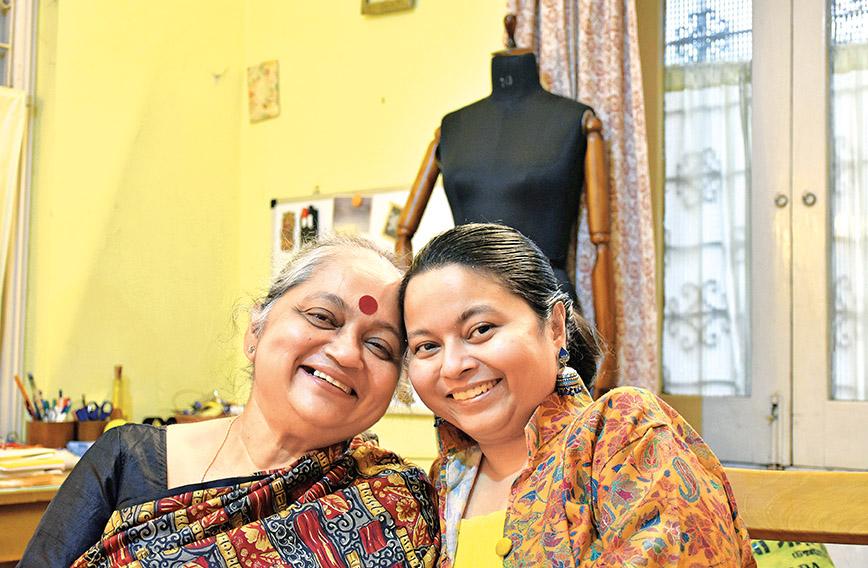
Soumita Basu with her mother, Amita, who is also her business partner | Photos: Civil Society/Ashoke Chakrabarty
Designing clothes people with disability can wear
Aiema Tauheed, Kolkata
It requires a lot of weird calisthenics to get dressed when you have disability. You fumble with buttons and zips, sleeves and pants. It’s time consuming, painful and creates a frustrating dependence. So it was for Soumita Basu. Diagnosed with psoriatic arthritis, she started losing mobility from 2010 and by 2015 she was completely bedridden.
“Even an oversized nighty would cause her acute pain,” remarks her mother, Amita Roychowdhury Basu.
Desperate for solutions, Soumita scoured the internet for clothing options. She even approached designers to create adaptive garments. Most dismissed it as a noble idea that wasn’t viable. Eventually, Soumita and her mother found a local tailor and began developing clothes she could wear with ease.
In 2020, realizing there was a market for such clothes, Soumita and Amita founded Zyenika, an adaptive and inclusive fashion brand that creates clothing for persons with disabilities, the elderly, and those recovering from surgery.
“It was through experience, based on trial and error, that we founded Zyenika,” says Amita.
Soumita graduated in sociology from Calcutta University. She went on to do a master’s in governance and public policy from the International Institute of Social Studies (ISS) at Erasmus University Rotterdam. She completed a PG Diploma in Journalism from the Asian College of Journalism in Chennai.

Soumita then worked in the development sector as a researcher. She also worked as a journalist. Fashion was never part of her career plan, she says.
But, at a small family gathering, something shifted. She was hesitant to attend because she didn’t have attractive clothing to wear that wouldn’t hurt her. In fact, she had normalized missing celebrations, whether weddings or parties, because of her clothing dilemma.
“Oh, you must look better than this,” her sister insisted that day. Soumita replied, “Try your luck.” Her sister styled her in a drawstring skirt pulled up under her arms, paired with a scarf and belt that helped her feel good in what she wore. That tiny moment, of wearing clothes that were comfortable and looked great, motivated her to start Zyenika.
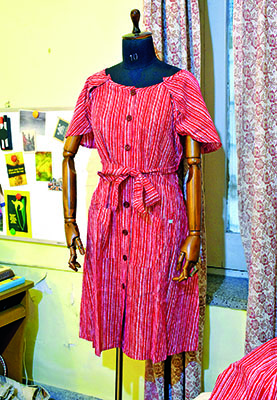 |
|
Natural fabrics like cotton, rayon and bamboo are used |
“So, between my journalism and starting Zyenika, I was also immersed in discussions on public policy as a development researcher,” she says. “One core idea in public policy is, if you have a solution, scale it. Replicate it.” Her research background helped her understand the market and the clients she wanted to serve.
She began connecting with persons with disabilities and later, the elderly, to learn from their daily negotiations with clothing. “They may not have scaled it,” she says. “But they’ve each figured out some kind of solution, even if it comes with struggle.”
With no mentors to guide her, Soumita learnt directly from her customers. “That’s why I say they were like my teachers,” she explains. Customized projects became her live laboratory. Funds were limited, and she would tell customers she was still experimenting.
“I’d say, ‘I’m happy to style for you, but you’ll have to be patient.’ And I was surprised, they were willing to pay for it.” Some even paid extra. “If I quoted `1,500 or `2,000 for a garment, they would say, ‘Here’s another `2,000 for someone else who might need it.’” Their generosity helped sustain the fledgling brand.
But the bespoke model wasn’t scalable. “`2,000 only covered costs. It wouldn’t pay anyone or support a business. Standardization had to follow,” she says. This phase focused on learning largely through all the available resources, YouTube and through trial and error.
Zyenika’s clothes feature large buttons, magnetic closures, Velcro fastenings, concealed openings, and no-bend trousers, enabling users to dress with ease despite limited shoulder, back, or finger movement. Demonstrating her own limited finger flexibility, Amita says “small buttons wouldn’t even make it between her fingers”.
Zyenika’s clothing range is diverse. It includes no-bend trousers for men and women, kurtas with back openings, full front-open dresses, Velcro shirts and slip-on tees. Customers can choose between Velcro or buttons. Undergarments designed to open completely are sold in bulk.
The placement and direction of Velcro fastenings are crucial for security. Strips of Velcro are not aligned in the same direction. Amita displayed an underwear design secured with Velcro strips that could open completely.
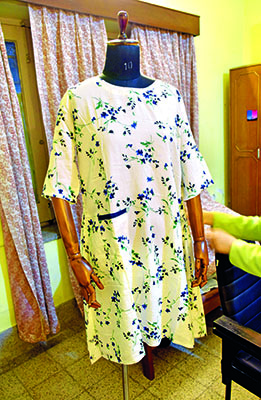 Soumita explains that by orienting the Velcro strips differently, if a pull occurs in a certain direction, only one fastener bears the force while the others remain secure. “Because of the adaptation aspect, I had to use lots of physics,” she adds. For instance, the amount of force required changes depending on the direction of pull or push — a principle that applies universally, regardless of the wearer.
Zyenika offers a special service for persons with disabilities who want to wear a saree. Customers can send their sarees to Zyenika, where they are pre-draped and transformed into a wrap-over, a “one-minute wear”. These aren’t regular pre-draped sarees — they are specifically designed to be disability-friendly. A high-quality petticoat is always included, since tucking can be a challenge for many. Unlike other brands that leave the pallu free, Zyenika offers clients the option of having it stitched in place. Prices for an altered saree are approximately between `950 and `2,200.
The Ananya series is a line of T-shirts illustrated by artist Ananya De, who has ADHD and autism. The thank you note included in every order is designed by Bengaluru-based Glevina D’Sa, diagnosed with autism at the age of two. The note and website carry information about these artists. “I always felt it would be good to feature expressions of artists with disabilities,” Soumita says. “Our clothes could be a medium of conversation. T-shirts felt like a good starting point.”
Natural fabrics are used unless specific adaptation is required. The focus is on durable, easy-wear clothing that won’t need to be discarded quickly. Most garments are made of cotton and rayon while bamboo is used occasionally. All fabric is sourced domestically within India.
The brand also works with factory waste and produces in small batches to minimize environmental impact. “We don’t have the pressure of having the same colour for multiple pieces,” Amita quips with a laugh. Their cutting techniques are planned carefully to reduce fabric waste even further.
She adds that Zyenika also challenges the usual narrative around disability. “Whenever we talk about persons with disabilities, or even senior citizens, there’s always this notion that we must do something for them. By offering products made by us, we’re trying to shift that narrative quietly because you are taking something from us.”
Soumita reaches her target group by partnering with various organizations, including hospitals and rehabilitation centres. Silvergenie, a company dedicated to providing elder care, and Samarth, a non-profit, are some of Zyenika’s partners.
The adaptive wear space is inherently collaborative. “All the people working here are what we today call social impact entrepreneurs,” Amita explains. “And when you talk about social impact, you can’t be boxing others out, you can’t create that impact by yourself.”
The market, they both believe, is huge and largely untapped. Take backache. An Indian Express report mentions a study by Lancet that says India may be having over 87.5 million people living with lower back pain. Products like no-bend trousers aren’t just useful for persons with disabilities but also for anyone who struggles with movement. This positions adaptive wear as a solution with far broader appeal than the niche it is often assumed to serve.
Soumita also realized that while fashion and business have established streams of study, adaptive fashion still has no place in academia. “Today, I teach a course on adaptive fashion because there’s nothing like it available in the market,” she says.
Reaching the market continues to be the biggest challenge Zyenika faces. “I think not being able to access the market because of infrastructural inaccessibility upsets me a lot,” says Soumita.

Zyenika also directly or indirectly employs persons with disabilities or their parents, and outsources stitchwork to marginalized women, generating livelihoods.
Due to Zyenika’s clothes, the caregiver fatigue her mother once faced while dressing her daughter has eased. “I was under a lot of stress. Soumita would cry and struggle while changing. Even remembering it makes me dread that period,” recalls Amita.
Growing up, Soumita was never excited about shopping, often unable to find the right fit due to her body shape. As someone who was always conscious of her body, she wants the brand to cater to a wider range of body types and heights.
“The average height of a woman in India is 5 ft 2 in, but the average height considered when designing a garment is 5 ft 6 in, she chuckles at the absurdity. Alterations, she notes, aren’t always the solution. So there is a lot of scope to enlarge the idea of inclusion.
Comments
Currently there are no Comments. Be first to write a comment!