



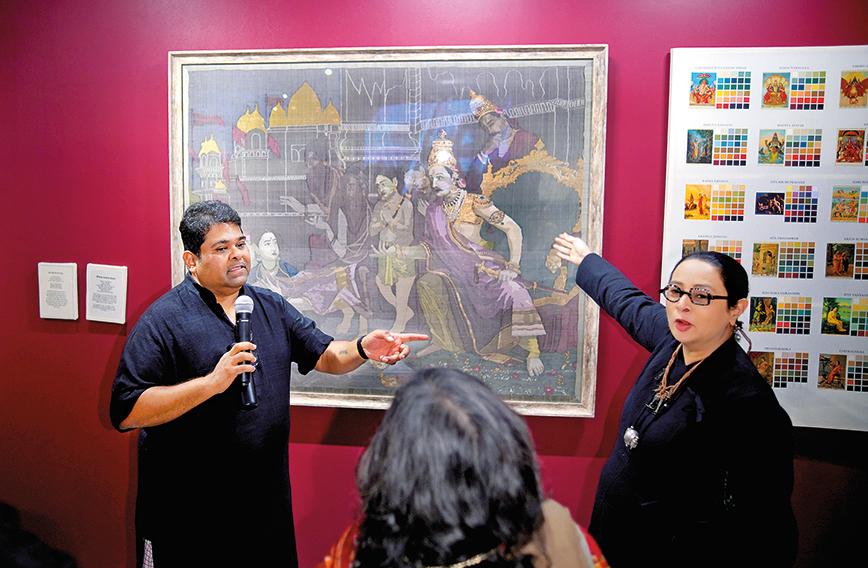
Gaurang Shah and Lavina Baldota explaining their painstaking work. Unlike painting, weaving does not allow for a second chance
Weaving a Raja Ravi Verma painting into a saree
Aiema Tauheed, Kolkata
Merging Mahatma Gandhi’s khadi cloth and Raja Ravi Varma’s iconic paintings sounds impossibly radical. But that’s what two textile revivalists, Gaurang Shah and Lavina Baldota, set out to achieve. It took them all of six years to weave intricate paintings into cloth, using the jamdani technique, and create a collection of remarkable sarees.
Eighteen such sarees were recently displayed in Kolkata at an exhibition titled ‘Khadi, a Canvas’. Curated by Baldota and Shah, the exhibition was presented by TRI Art & Culture, a nonprofit, along with the Abheraj Baldota Foundation.
In 2014, Baldota approached Shah, asking if he could recreate the works of Raja Ravi Varma in weaving. Shah, who has worked with textiles for around 26 years with over 7,000 artisans in 18 states, told her it was near impossible. Pointing to the intricate detailing, facial expressions and folds of clothing on the paintings, he said it was unviable to replicate such detailing with thread.
Yet, he took it on. Conceived as an ode to Mahatma Gandhi on his 150th birth anniversary, the work had to be completed by October 2, 2019 — in khadi, using jamdani and natural dyes — reflecting the shared legacy of Mahatma Gandhi and Raja Ravi Varma.

Often called the father of modern Indian art, Raja Ravi Varma, who was related to the royal family of Travancore, democratized Indian art by creating lithographs of his paintings which were then printed on calendars, postcards and even matchboxes.
“He travelled the length and breadth of our country to capture the nuances and attire of every community in India that was struggling to find its identity under British rule,” explained Muskan Kaur Sukarchakia, co-curator at TRI Art & Culture.
Varma combined Eurocentric realism with an Indian sensibility. The idea of what gods and goddesses from mythological stories, or from the epics, looked like came from Ravi Varma’s style and form, and shaped popular imagination.
At the exhibition, Shah explained the painstaking work that went into replicating Varma’s paintings on khadi. It took months for him just to understand what the project demanded. Then, 54 rare and intricate paintings were selected.
Each painting required its own colour mapping. Elaborate shade cards were created. Recreating natural dyes was a challenge since there were just five basic colours — indigo, yellow, red, black and green. The project demanded far more: skin tones, pinks, peaches, and countless variations of greens, blues and more.
Shades were developed by master craftsman Junaid Khatri from plant and vegetable sources. Dyeing alone took nearly 10 months, a meticulous process of mixing precise shade combinations at controlled temperatures. Yarn dyeing took place in Ajrakhpur, and yielded nearly 600 shades and 200 kg of different types of yarn.
The paintings were woven onto the pallu of each khadi saree. Shah said that about five yarns were used to create a three-dimensional effect on the pallu: cotton khadi for the basic cloth, silk for backgrounds, muga for scenery, tussar for branches.
The weaving demanded extreme precision. A single line of weft could take an entire day to complete. When the project began in 2014 in Srikakulam, the designs were shown to experienced weavers. They declined, calling the detailing impossible.
Shah had been working since 2003 in Ponduru, a village known for its khadi and jamdani. A single weaver asked him for work. Gradually, the entire settlement joined in, taking on the challenge of weaving the sarees. By 2010, nearly 150 looms were running, and the village was thriving on steady employment. Tribal women, who did not know weaving, approached him, asking to be trained after seeing the economic stability weaving had brought to Ponduru.
Shah needed more weavers. Forty women were trained in the art of jamdani. “In fact, the tribal women proved to be so adept that they now do intricate jamdani designs which my traditional weavers had refused to do,” says Shah.
“In 2014, when we began our project, our traditional weavers refused to participate. They said they could not do these designs. The women happily took it on. They had this fire in them to prove a point. People from the weaver community have rejected it, we will get it done, was their attitude,” added Shah.
In three years, they completed 35 of the 54 sarees and the collection was released on October 2, 2019. Unlike painting, where colour can be layered or a line corrected, weaving allows for no such second chance. One misplaced thread cannot be undone. Absolute perfection is required, Shah points out. Pure zari was used. That precision extended to visual fidelity. The saree borders worn by women in Ravi Varma’s paintings were re-created on the pallus that carried their imagery.
Even the mistakes were displayed, documenting the story of the process. Images flipped — an error that became part of the learning curve. Another pallu exposed the absence of a defining black outline. At first, the team relied solely on shading, assuming the forms would emerge on their own. They didn’t. Only later did they begin outlining the figures in black, bringing definition to faces, folds and contours.
Raja Ravi Varma’s Radha Krishna was one of the paintings woven onto a saree. To recreate the translucent cotton saree worn by Radha in the original painting, through which her pearl necklace is faintly visible, the artisans worked with astonishing precision. The thread used for the weave, explained Shah, is only one percent lighter than the saree itself. “We wanted everything in exact measurement,” he said, “but the weavers were a step ahead of us.”
Art and azadi
Sukarchakia asked a rhetorical question: “How does an image find itself in the collective conscience of a nation, and what does it truly mean to democratise the arts?” She pointed to Raja Ravi Varma as a pivotal figure in that process.
He was deeply invested in ensuring that people could access his art and understand the skill behind the art as well.
Ravi Varma was much sought after by royal families. He had more work than he could handle. It was on the advice of Dadabhai Naoroji that he established a chromolithographic printing press with his brother, Raja Raja Varma, who came in as the assistant and manager.
They appointed a German printmaker, Fritz Schleicher, to run its daily operations. The press produced calendars and postcards for clients in India and abroad, circulating Varma’s imagery at scale. His iconography soon permeated popular culture — appearing on postcards, matchboxes, textile labels, and later influencing early Indian cinema, including the work of pioneer Dadasaheb Phalke. “In fact, Amar Chitra Katha was developed by the Raja Ravi Varma printing press,” said Sukarchakia.
Original chromolithograph prints from the Raja Ravi Varma press, alongside rare lithographic stones depicting Shiva and Parvati, Ram and Sita, and Lord Murugan were on display. There were three such mammoth stones, weighing about 100 kg, sourced from a collector.

The exhibition also showcased Raja Ravi Varma’s global cultural influence through early 20th-century objects including Japanese porcelain Ningyo dolls, German Bisque porcelain figures and Art Nouveau Majolica ceramic tiles from Japan. “So what was happening was, because there was such great demand for these symbols of religious iconography, that a lot of manufacturers in Japan and Germany started creating these dolls and selling them in India,” said Sukarchakia.
As we headed to the first floor, the stairway had a charkha against a poem by poet Navkirat Sodhi, despairing the turn his country has taken.
‘What this land has come to
The wheel now churns
Lies after lies…’
The charkha was not just a tool for spinning khadi. It offered space for reciting poetry and for discursive talk during British rule. Next to it hung three pieces of khadi of varying yarn counts. Visitors were invited to touch the white khadi pieces. “It’s 300, 400 and 500 count of khadi, which is the finest possible in India today,” said Baldota. A weaver from Bengal was weaving on a loom, quietly depicting the intense concentration, time and effort that goes into weaving.
Comments
Currently there are no Comments. Be first to write a comment!