



The heritage menu
Aiema Tauheed, Kolkata
In the comfort of your home, you can savour meals from around the globe — picking whatever your heart desires. The options are many: low-calorie, protein-rich, keto, vegan, paleo. And yet it is the home-style meal that is unobtrusively winning the battle for taste buds. Nourishing, nostalgic, slow-cooked and aromatic. Cooked with love. Relished with idle talk and gentle humour.
Alas, time is scarce and scribbled recipes handed down by loving grandmothers often contain all the twists and turns of a detective novel. But what if, once in a while, you could eat a home-style meal out, a throwback to the past — with deep links to the soil, to the place you came from?
In Kolkata there is Amar Khamar Lunch Room in Ballygunge which serves such home-style meals prepared with fresh, seasonal produce sourced directly from farms.
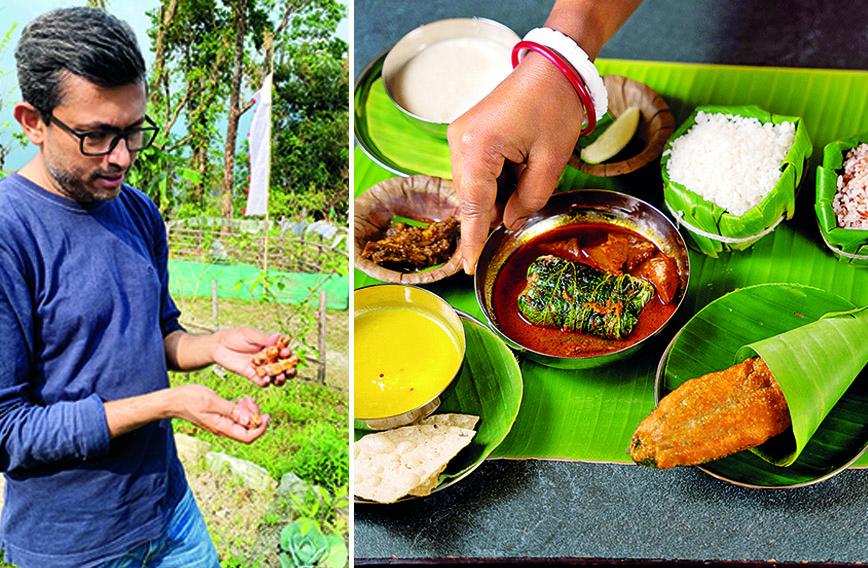
“Amar Khamar began in 2019 as a small, six-seater tasting space for our products, which has now grown into the Lunch Room,” says Sujoy Chatterjee, who co-founded Amar Khamar as a social enterprise.

Chatterjee has also helped develop grassroots entrepreneurship in India. A graduate in management and literature from Kolkata, his interest in Bengal’s history, culture and cuisine often channels into his work.
|
|
|
Sujoy Chatterjee: ‘Amar Khamar links farmers with consumers’ |
Amar Khamar started as an experiment to link farmers with conscious consumers and wider markets, and highlight Bengal’s rich agricultural and culinary traditions. The restaurant emerged as a natural extension to bring farm produce and value-added products directly to the table.
Chatterjee and his team work with small and medium farmers across Bengal and other states to preserve heirloom crops and improve production and quality. The remuneration model is designed to favour the farmers.
“In Amar Khamar’s model of work, the farmers are free to decide on the price of their produce,” he says. “We encourage farmers to add as much value as possible at their end so that they can maximize their revenue. For example, they can make puffed or hand-pounded rice instead of simply selling paddy.” The result is a range of high-quality products that reach consumers across India, who, he noted, appreciate the commitment to quality.
The vegetarian and non-vegetarian menus, designed like postcards with diners’ names, feature climate-sensitive, zero-waste dishes served on banana leaves.
“We decide our menu by first understanding the season and identifying which ingredients will be at their peak within our network of farming communities and city markets,” explains Chatterjee. “Sustainability is the pillar for everything we do. Eating seasonally is one of the simplest ways to bring this about,” says Raina Talukder, Head of Brand. She has a master’s degree in gastronomy from the University of Gastronomic Sciences, Pollenzo, in Italy.
Wholesome lunches are served on weekdays from Tuesday, while the Chutti-r Bhaat (or holiday rice) is reserved for the weekends. Guests can book a table through the number listed on the website, but walk-ins are also welcome.
Portraits of rice grains on the ceiling reflect a focus on rice. The summer menu’s Chutti-r Bhaat alone presents three distinct rice varieties in three spreads: the aromatic Chine Kamini in the first course, followed by Dudhersar, and finally Mohonshal.
“Rice is the heart and soul of Bengali homes. We rarely say, ‘Come over for a meal at my house.’ We say, ‘Bhaat kheye jaben’ — please have rice at my house. Meal and rice are synonymous in Bengal, intertwined with our history. Rice is also the heart and soul of Amar Khamar,” says Talukder.
Amar Khamar currently stocks more than 50 indigenous varieties, with over 200 preserved by farmers associated with the organization. “Farmers across Bengal have been able to preserve about 500 indigenous varieties. When we compare these numbers to the 5,500 that existed in Bengal in the 1960s, we really understand the urgency and importance of conscious consumption and preservation,” Talukder says.
Among the standouts on the menu are dishes that have quickly become favourites. “Many of the dishes we serve are not generally found anywhere else, and some use special ingredients that even many Bengalis from the city are unfamiliar with. One such dish is Chui Jhaal Mangsho,” says Chatterjee.
Chui, he explained, was Bengal’s native pepper before chillies were introduced by the Portuguese in the late 15th century. Particularly abundant in East Bengal (now Bangladesh), the roots and stems of chui (Piper chaba) have for decades been used to spice fish and meat in Bengali households. At Amar Khamar, mutton is prepared with chui jhaal and served with a side of Chui Jhaal Achar.
“Tormuj-er Shukto is another dish that has surprised many of our diners. Shukto is a classic Bengali dish, however, what many don’t know is that it is more like a category than a dish,” says Chatterjee. Varieties of shukto appear across Bengal and embody a culture of resourceful cooking — long before ‘zero-waste’ cooking became a trend. “We are making ours with watermelon rind, which is not commonly found, but again shows the ingenuity and sustainable practices of Bengal’s kitchens.”
For dessert, mishti doi is finished with taler gur. Unlike nolen gur, which dominates Bengal’s winter sweets, taler gur — a jaggery made from palm fruit sap — from North 24-Parganas, is a summer specialty that has been given pride of place on the dessert menu. “Both are delicious and reserve their own space as Bengal’s winter and summer jaggeries. You will rarely find taler gur in any mishti shop in Kolkata and it was about time that changed,” says Talukder.
Our first course was similar to a tasting menu. Served, naturally, on a banana leaf, it consisted of rice, bitters, vegetables, and vegetable paste. The rice, called Lal Kamini, was sourced from coastal Sundarbans. It was served with a generous dollop of Kalimpong ghee. The aroma melted into a warm, toasty flavour.
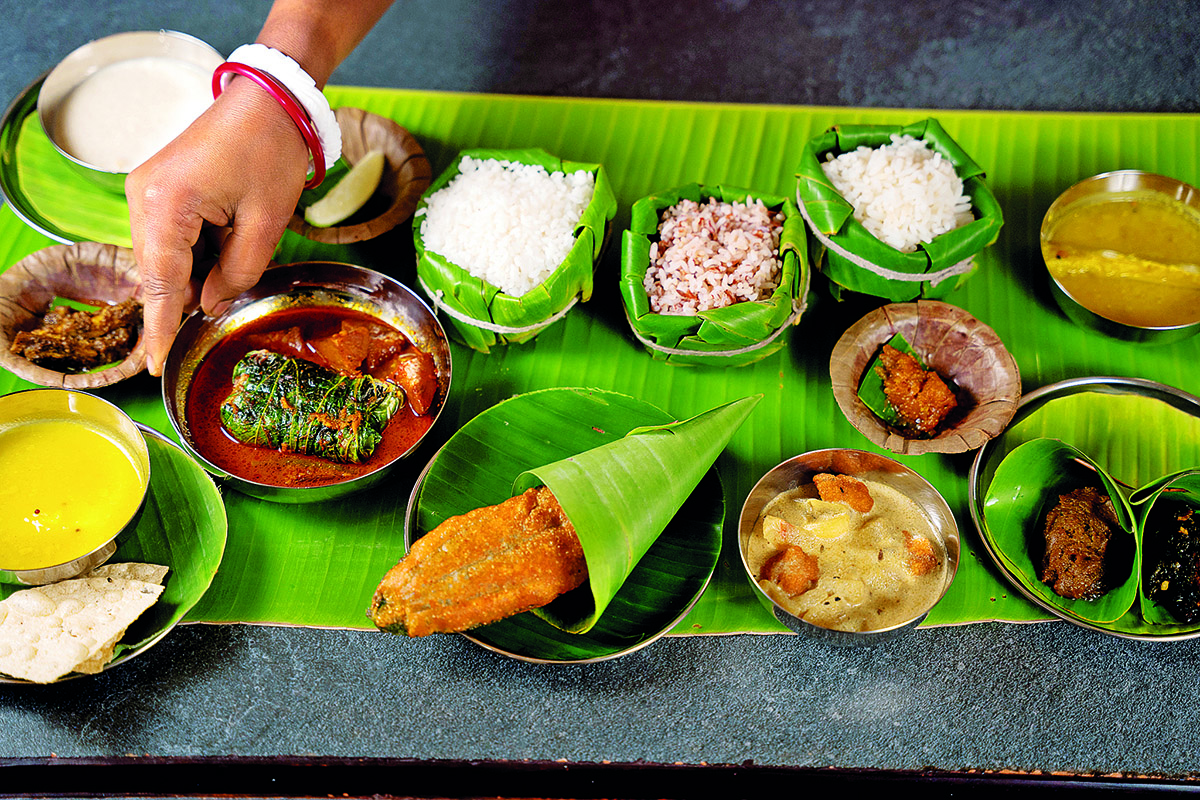 The meal, served on banana leaves, varies according to the season
The rice was accompanied with Tormuj-er Shukto, a stew made from the white rind of watermelon with chunky soft mattar dal boras (lentil fritters), mildly bitter and refreshing, followed by Aam Shorshe — tart mango slivers flecked with ground mustard.
We then relished a mushy Deshi Potol-er Khosa Bata, a mouthwatering paste made from pointed gourd peels. The dish, born in Bengal’s famine years, was a reminder of how resourcefulness and resilience have long shaped the region’s cuisine. Using vegetable peels to make bhaja (fried vegetables) or bata (pastes) has long been common practice here.
The leafy Shak Bhaja that followed had crunchy bits, which I learned were smaller masoor dal boris and served with green chilli pickle.
The second spread consisted of another round of bhaat (rice), bhaja (vegetable fry), dal and torkari (vegetable curry), each in small, precise servings. The rice was red-white Dudhersar, its grains still clinging to brown bran. The ghee, from North-24 Parganas, was delicious. It blended into the rice like a milky-gold ribbon.
It came with a summer favourite, Aam Diye Masur-er Tok Dal — a tangy red lentil soup made with mango. Alongside came Pata-r Bora — light, crisp, golden fritters made from jute leaves. The pointed gourd in mustard gravy was accompanied by two whole potols (pointed gourd) this time. This spread, eaten with a sweet-sour jammy mango pickle, was classic, no-nonsense comfort food.
The non-vegetarian and vegetarian main course were served with an indigenous variety of rice from West Bengal’s Bardhaman district.
My vegetarian spread featured Thor-er Ghonto, a dry but moist dish of banana stem, full of flavour. Alongside was the Lau Pata Diye Chhanar Dolma-r Jhal, crumbled paneer wrapped in a bottle gourd leaf floating in a thin and deliciously spicy gravy.
The non-vegetarian menu comprises four dishes of egg, fish, chicken and mutton. You can pick any two. My friend picked Campbell Hnas-er Dim Posto—duck eggs cooked in a poppy seed gravy, a cult favourite, and Amar Khamar’s special Chui Jhaal Mangsho with Chui Jhaal Achar, a mutton curry infused with the pungent heat of chui jhaal — often likened to fresh pepper or horseradish. The mutton was tender and tasteful.
Accompanying the meal were small triangular pieces of papad with bright yellow tangy mango chutney.
A Bengali meal is, obviously, incomplete without dessert. We savoured the mishti doi and Badshahbhog chal-er payesh — both liberally crowned with jaggery made from palmyra. Sweet, creamy, and a delightful note to end on.

How were such recipes curated? Chatterjee explained that the idea was to create wholesome, comfort meals they themselves grew up eating. “Our recipes are a collaborative effort, drawn from our homes — our kitchen and farm teams, as well as mentors-cum-family friends,” he said. These are dishes from everyday kitchens that rarely find representation in Bengali restaurants. The aim is to serve wholesome food rooted in the wisdom of daily cooking.
In the kitchen, the team is guided by mentors and some of the farmers themselves, who often visit the restaurant to taste the food and advise the chefs. “Our entire team regularly goes through rigorous training from members in the field, who let us know the processes of production, so we understand the core of a dish, be it a grain or a spice,” Talukder emphasizes.
So far, the Lunch Room has been warmly received by a diverse audience. “I think people are inching closer to understanding what they are consuming. There are many more conscious diners today, who crave a deeper connection, and food is no exception,” says Talukder. “Many of our guests at Lunch Room are young diners who want to understand their ingredients better and also look forward to sharing the experience with their parents.”
Chatterjee noted that guests from across India and abroad have embraced the Lunch Room. Vegetarian dishes were especially well-received among non-Bengali audiences. “What Lunch Room offers is more than just cuisine — it’s an experience,” he said. “It’s about conversations and a deeper understanding of consumption, history, culture, and sustainability — at the table and beyond.”
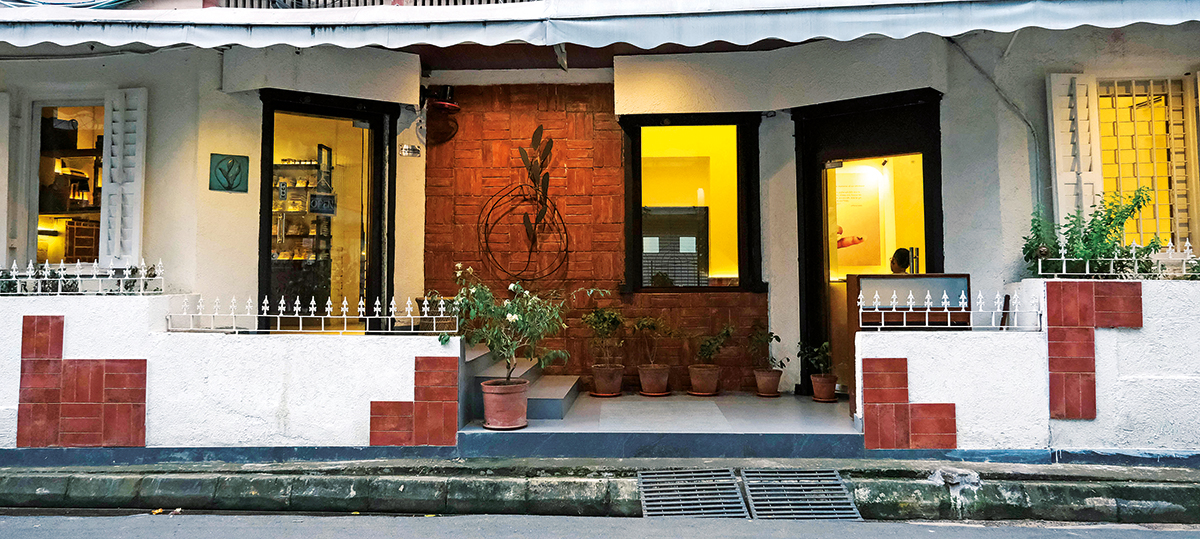 The Amar Khamar restaurant
Comments
-

Hemant raj Lodha - Nov. 16, 2025, 4:08 p.m.
Very enticing , very natural Can we book a table for 6 for lunch on Sunday, November 30,2025. Would like to know the exact address too .