



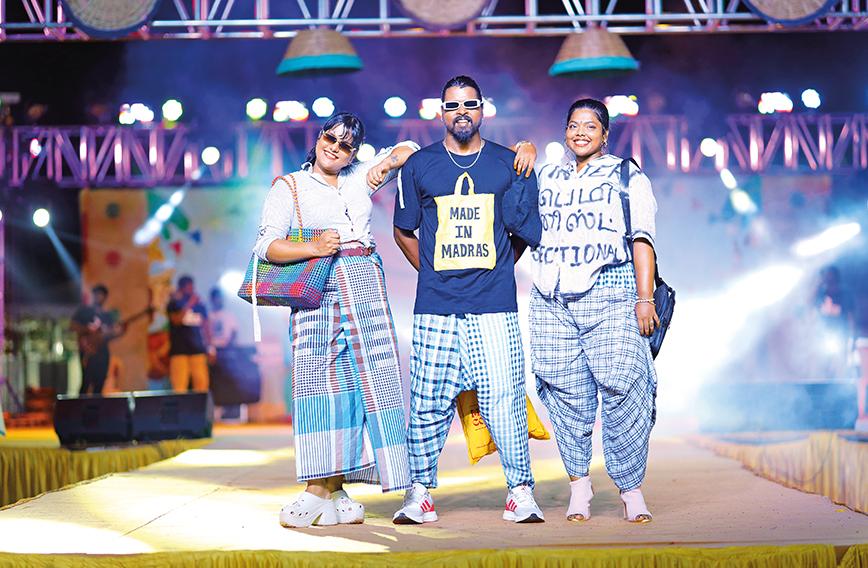
Veshtis, lungis, Madras checks and more have been smartly redesigned to be comfortable, practical and catch the eye of the insouciant young
The lungi is redesigned with inspiration from the street
Aiema Tauheed, Kolkata
Purushu Arie was working as a menswear designer for Lee Cooper in Mumbai when he happened to visit a factory in Tirupur. At a four-star hotel, frequented by international buyers, a signboard caught his eye. It read: “Do not wear a lungi in the hotel premises to avoid indecency to guests.”
Arie was shocked. After all, the lungi is an everyday garment worn across class lines. Yet, in wealthy settings its association with ordinary people seemed to override its practicality.
As a student at the National Institute of Fashion Technology (NIFT) in Delhi, Arie had noted the casual use of the word behenji to mock women who wore Indian clothes.
Like so many young designers, Arie had joined the fashion industry aspiring to be the next Galliano or Alexander McQueen.
But what he saw didn’t align with his personal values. He watched show after show at India Fashion Week, noting the catwalk’s display of endless regal fashion. “You’d see nawabi inspiration, colonial-era zamindari styles. Ultimately, it was a celebration of royalty, a spectacle of elitist and upper-caste culture,” he says.
He found the colonial afterlife of Indian fashion with its hierarchies rather jarring. The world he came from was far removed from the glitz of fashion shows.
“I grew up on the streets of Chennai, living in the lower economic pin codes of the city,” he says. Among the snatches of egalitarianism the city retains is a culture of shared spaces. Like cinema. Ticket prices are capped at `150 so rich and poor watch the same film together.

He translated that same equality and fraternity into his own label. Its slogan, ‘Wear your freedom,’ reflects B.R. Ambedkar’s abiding stand for liberty. His objective is to create a fashion label free of caste, class and gender.
Clothing should offer personal and social freedom by being practical, adaptable, and accessible, he believes. Every garment he designs includes pockets. “If there is no pocket, I am not designing,” says Arie.
He also incorporates size fluidity. Garments are designed to be adjustable rather than strait-jacketed to fit a single body type.
Handlooms from across Tamil Nadu, like Vanavasi cotton, Madurai organic cotton, Kanchi cotton and kora silk are used as well as Kanchivaram silks and Madras checks.
There are veshtis with Kalamkari borders, lungis with buffalo checks, saree-dresses made from veshtis, and oversized shirts — one with golden zari accents, another with coconut shell buttons.
There are also lungi drape-inspired shorts in Madras checks and crop tops, including one with a pleated mundhanai (pallu) inspired by Mauryan sculptures. Others are emblazoned with hand-painted slogans of Ungender, Uncaste, Unclass.
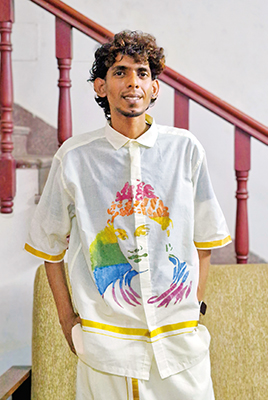
Purushu Arie, the fashion rebel |
Arie’s clothes sell exclusively on his website. Since 2024, the brand has been associated with StartupTN, the Government of Tamil Nadu platform which supports startups with mentorship, funding, and business guidance. The association has helped him overcome the limits of working independently by providing clarity on scaling, connecting him to resources like artisan clusters, and strengthening his business model without compromising his core values.
Although the label took shape in 2017, its roots go back to 2009, when Arie, then a student at NIFT, used to write a fashion blog, one of the earliest, predating the social media boom. His work caught the attention of the Fashion Design Council of India (FDCI), which invited him to cover shows at India Fashion Week. At the time, his blog was recognized as one of the most influential in Delhi.
“We have a lot of trickle-down trends, where power structures decide what is supposed to be trending,” he says. Fashion, he explains, is dictated from the top — by designers, celebrities, and institutions — and filtered down, creating a kind of “manufactured consent”.
Arie pushes against this model. He is trying to redefine streetwear by anchoring it in the culture and identity of Tamil Nadu. He describes himself as anti-fashion, interested in trickle-up trends that emerge from the grassroots.
Denim, for instance, began as a worker’s garment; the T-shirt as a sailor’s essential. Utility came first, fashion later. In India, he found such movements largely absent from mainstream fashion.
This, combined with his knowledge of Tamil clothing history, shaped his design language. In early Tamil society, clothing was not inherently gendered. People wore similar garments like the meiladai (upper cloth) and keeladai (lower cloth), with adornments shared across genders.
The lungi is a garment in which ancient Tamil history meets the contemporary reality of Chennai’s streets. He approaches it as a living garment that keeps pace with changing generations.
 |
|
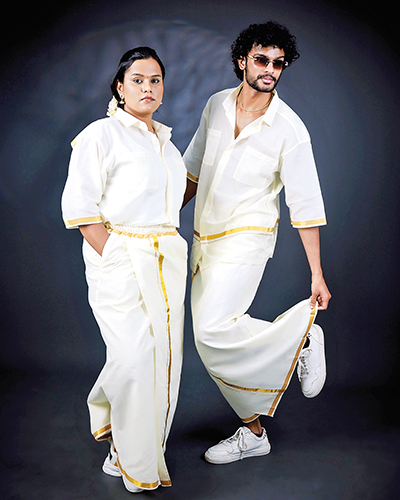
The veshti with waistband and side pockets |
When he began wearing veshtis and lungis, he found them impractical. They were constantly slipping, had no pockets and required frequent adjustment.
He made the garment functional and hands-free without altering its visual identity. He added elastic waistbands and introduced side pockets.
“I didn’t want to change how it looked,” he says. “I only worked on the functionality.”
Inspired by the everyday, he recalls scenes of water shortages in Chennai, where women would tuck their sarees at the waist while carrying water from tankers. That gesture inspired his designs. He created draped lungis that mimic the same tuck and fall.
Among his most popular pieces are reimagined veshtis, including a waisband version that simplifies the traditional drape. Madras check lungi shorts are another bestseller, while shirts remain a staple. Tailored sarees, often customized, add a personal dimension. There’s a hand-painted one with a portrait of Savitribai Phule for Preeti Ramprasad, a dancer based in the US.
“When I say veshtis are the highest selling, it’s not just men buying them. It’s also women, people from all genders,” he says. The brand’s website has no gender categories either.
Neither are his collections seasonal. He launches his newest creations when inspiration strikes.
His 2025 collection, Mozhi Mann Maatram, reflects his philosophy of design. It explores Tamil linguistic identity through three strands — Aadhi Mozhi (the primal tongue), Semmozhi (classical language), and Theru Mozhi (the language of the streets).
Naturally dyed handloom fabrics in shades of burnt ochre, turmeric yellow, terracotta red, kora white, neem green, and iron black rendered in coarse, grainy, and crumpled textures form the first chapter of Aadhi Mozhi.
It’s inspired by Sangam and pre-Sangam landscapes, mountains, forests, farmlands. The Tamil language of the period is shaped by land, labour, and ritual, with clothing emerging as a marker of survival and community.
Graffiti from one of the earliest forms of the Tamil language, called Keeladi, is reimagined as print motifs. “I made a garment fully hand-painted with a script in Keeladi. It was really well received,” he says.

While classical Tamil is often framed through the arts of royal courts and temple walls, the second chapter, Semmozhi, turns to folk traditions that have long thrived in the streets like the kummi dance, fisherfolk hymns and the songs of women planting paddy.
“Classical Tamil society had weavers from Andhra Pradesh and other regions, and a lot of regional knowledge was shared,” he says. “So we focused on handlooms from that period, along with silks and silk-cotton blends in the drapes.”
 |
|
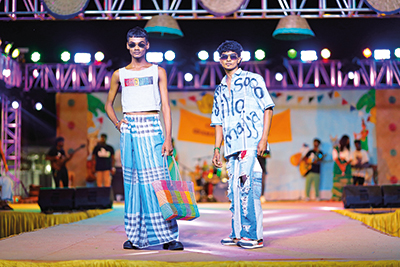
Clothes with hand-painted slogans |
Theru Mozhi, the final chapter of his collection and his favourite, reflects the language of the streets. Born of bus stands, the gaana songs of north Madras, a genre of music often associated with poverty and marginalized castes, memes, and global dreams, the collection pairs Madras checks with upcycled, tattered denim.
Colloquial phrases like chikkom pannadha which means ‘don’t complicate things’ and jillo, slang for run, appear as hand-painted slogans on oversized T-shirts and shirts.
“These words don’t usually enter the vocabulary of the sophisticated,” he says. “So I used them as typographic motifs.” He also finds inspiration in Chennai’s everyday visual landscape, with prints inspired by local trains and city buses. This is infrastructure shared by people from all walks of life.
Clothes are priced roughly between Rs 1,500 to Rs 8,000. Youngsters with pocket money can afford to buy from him.
Arie also outsources work to weavers across villages in Tamil Nadu, producing in small batches. True to his philosophy, Arie is committed to providing fair wages and good quality. “I pay my tailors anywhere between `600 to `900 per shirt,” he says. This is significantly higher than typical factory rates.
Recently, Arie — original name R.V. Purusothaman — walked into a five-star hotel in Chennai in a veshti, wearing his freedom. And no one stopped him.
Comments
-

Rajkumar Ramasamy - Aug. 10, 2026, 10:39 a.m.
Radically beautiful real fashion. Well done Purushu Arie!