



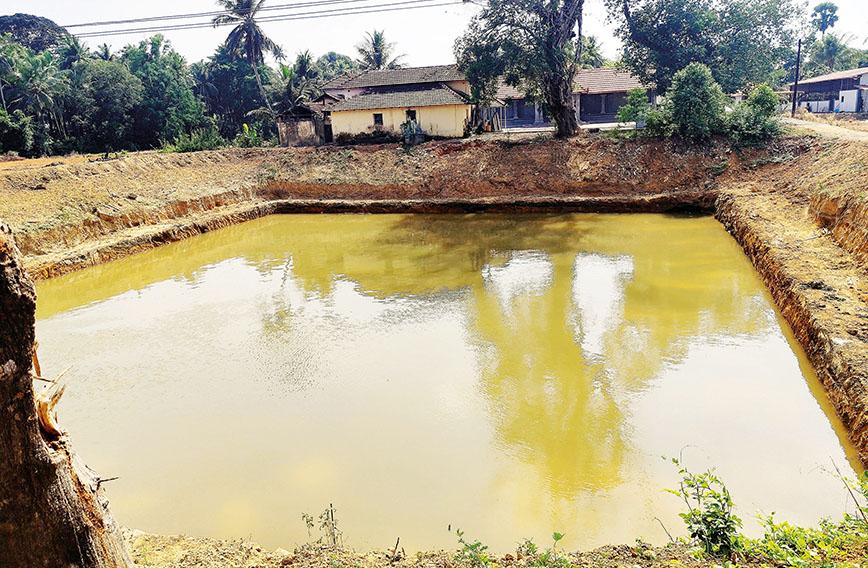
The Handadi kere, which has been revived, is more than five centuries old
Breathing life back into tanks
Shree Padre, Kasaragod
Driving through the placid countryside of Kundapura, a coastal taluk in Udupi district, Dr Satish Kamath says he feels deeply fulfilled on seeing a restored kere brimming with water. “It prompts me to revive another,” he remarks. A kere is a manmade earthen tank.
For the past seven years, Dr Kamath, a reputed gynaecologist in Udupi, has been on a water mission — restoring one kere every year. Villages have witnessed derelict tanks turning into lakes and dried-up wells filling with water after a long time. The doctor’s diligent self-effacing work has turned his solo mission into a community effort with citizens joining in.
Three years ago, a retired engineer, Krishna Hebsur, joined him. Hebsur is from Vijayapura, and has now settled in Udupi. Dr Kamath funds the work while Hebsur provides technical expertise. Together they search for neglected keres. They visit villages, consult local communities, and finally select a kere for restoration. And this year, for the first time, they restored two instead of one.
It wasn’t Dr Kamath’s dream to repair keres though he is also a keen environmentalist. His kere revival journey began in 2020 during the Covid-19 pandemic. He chanced upon a newspaper report that said desilting of a kere in Kumbhashi, a village in Udupi district, had stalled because the village panchayat had run out of funds. The very next day, Dr Kamath drove to the village, met panchayat members and assured them money would not be a constraint.
“Gather all your workers and don’t worry about money. I’ll bear the entire cost,” he said. Many workers were idling due to the lockdown. Thirty people joined at once. Dr Kamath supervised the project almost daily. Within a week the lake was desilted. The total cost came to `75,000 and he paid for it.
 |
|
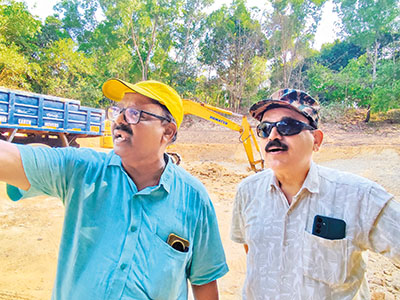
Krishna Hebsur, a retired engineer, with Dr Satish Kamath |
But that was just the beginning. Dr Kamath resolved to restore one kere every year, and he sought neither government assistance nor publicity. He continued reviving neglected water bodies very quietly. For years, even local newspapers were unaware of his work.
The late Gandhian, Anupam Mishra, who dedicated his life to reviving rainwater harvesting systems would often speak of a meaningful tradition that still survives in Rajasthan: Swamitva Visarjan or renunciation of ownership.
“Water is seen as sacred. And offering water to a thirsty person is considered the greatest act of humanity. Since the era of kings and even today, those who build a pond or a tanka never erect a board claiming credit. This is the spirit of Swamitva Visarjan,” Mishra would explain. Dr Kamath’s work embodies the same philosophy.
Hebsur too has experience in restoring keres. Between 2019 and 2020 he helped restore 10 to 12 keres around Udupi. “After retirement, I was looking for something useful to do for society. Dr Kamath’s kere restoration mission unfolded before my eyes, so I joined him,” he recalls. Apart from technical expertise, Hebsur contributes a little from his pocket too.
Colleagues describe Dr Kamath as a shy man who simply does his job. It took some time for his mission to become known even in his hometowns, Udupi and Manipal.
“Every summer, we start by deciding which kere to restore. News reports are our main source. Since desilting is possible only after keres dry up, we work mainly during the peak of summer,” he says.
By April, excavation machines are put in place: two JCBs, two tipper trucks, and, if required, pumps to drain residual water. Most keres lie far from villages and lack electricity, so generators are also essential.The daily cost of excavators, trucks, fuel, food, pumps, and generators is around `40,000. Restoration takes about three to eight days.
Dr Kamath and Hebsur’s sixth project was a 3.25-acre pond called Shedikere in Salikeri village, next to the Brahmalinga Veerabhadra Durgaparameshwari temple. “Weeds had completely engulfed the lake right from the bottom,” recalls the temple’s trustee, Suresh Shettigar. “A local newspaper carried a report on our kere’s neglected condition. This attracted Dr Kamath’s attention.”
The work was anything but easy. “The rains arrived even as desilting forged ahead. The JCB excavator sank into the mud. It couldn’t be pulled out. We had to finally bring in a crane. Since there was no access road, a next-door family allowed us to demolish part of their compound wall. After rescuing the machine, we rebuilt the wall,” recalls Hebsur.
Shedikere is now brimming with clear water. “Its revival has recharged at least 50 wells nearby,” says Shettigar.
The Santhan Gopalakrishna temple at Handadi has a kere dating back more than five centuries. It was choked with silt after agriculture around it declined. Eighty-one-year-old Ramadas Udupa recalls that nearly a century ago, the kere irrigated 30 to 40 acres with a Persian wheel.
“I still remember watching bullocks turn the wheel when I was a teenager,” he says. Around `2.5 lakh was spent by Dr Kamath on desilting.
“We usually choose sites near Udupi for ease of travel. This is the first kere so far away,” say Dr Kamath and Hebsur en route to Nancharu Kamadhenu Goshala near Mandarthi in Brahmavar taluk. This project was suggested by one of Dr Kamath’s medical representatives.
Unlike earlier works, here they have
revived not a kere but a traditional madaga, jointly owned by two families in the Udupi region. This is the first madaga Dr Kamat
has restored in seven years. A madaga is akin to a percolation pond that collects run-off from its suroundings which then permeates the soil.
One part of the madaga belongs to N. Rajendra Chakkera, who runs a goshala with around 350 cattle. Despite the presence of a bore well, water scarcity worsened towards the end of last summer, he says.
During desilting, excavation went nearly eight feet below the original bed, where natural springs emerged. “If springs are flowing even during this severe summer, next year water availability should be much better,” muses Chakkera.
Dr Kamath’s work gradually gained support across the twin cities of Udupi and Manipal. Last year, a turning point was reached when several citizens approached him saying they too would like to join in. Thirty people are now part of his mission. Dr Kamath created a WhatsApp group called Nature Care Group, largely comprising doctors.
“Instead of people who make speeches we need people who do small, meaningful work,” says Dr P.V. Bhandari, a psychiatrist. “Dr Kamath is one such person. We have already lost many water bodies silently. I joined because I felt an inner urge to contribute.”
Download PDFComments
Currently there are no Comments. Be first to write a comment!