



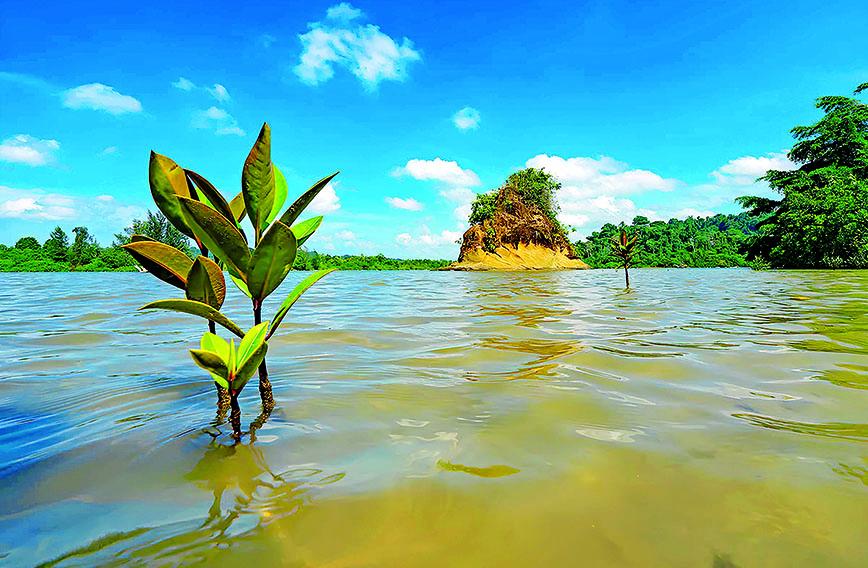
India’s last old-growth forest with a million rainforest trees is on the Great Nicobar Island | Photo: Dhritiman Mukherjee
Great Nicobar: Experts take on minister in joint letter
Civil Society News, New Delhi
THE Union government’s plans to convert the Great Nicobar Island into a bustling economic hub has caused deep disquiet among environmentalists, scientists and sociologists. The island, a green jewel in the midst of the blue waters of the Indian Ocean, is part of UNESCO’s Man and Biosphere programme because of its ecological wealth and ancient indigenous people.
In a bid to alleviate the concerns, Union Minister for Environment Bhupinder Yadav wrote an article in The Hindu on September 12, stating that the project is needed for defence and in strategic terms is of national importance. It would also transform the island into a major hub of maritime and air connectivity in the Indian Ocean.
He reassured opponents of the project that it had undergone detailed and multiple layers of scrutiny before getting clearances. These include an environmental impact assessment and an environmental management plan. Mitigation plans had been drawn up by eminent research institutions. He said indigenous communities, the Shompen and Nicobarese, would not be displaced, tribal experts had been consulted and a dedicated budget set aside for tribal welfare. The minister said 136.75 sq. km of forest area is proposed to be diverted which is only 1.82 percent of the total forest area of the Andaman and Nicobar Islands.

However, around 70 concerned environmentalists, scientists and sociologists, some of whom have worked in the Andaman and Nicobar Islands, have questioned the need for the project. They are unconvinced by the minister’s arguments and have written to him saying so.
They have said that the Great Nicobar Infrastructure Project is essentially for commercial purposes. The only component that is defence-related is a military-civilian airport which will cover just five percent of the total project area. Out of the remaining 160 sq. km, 130.75 sq. km is a rainforest which will be diverted and 2.98 sq. km will be reclaimed from the sea.
This entire land will be used to build an international container transshipment terminal (ICTT), a greenfield international airport, a solar-based power plant and a township for 3.5 lakh people — which will require shopping areas, hospitals, academic institutions and so on. The township will cover 80 percent of the project area whereas the defence township will cover just 12.6 sq. km. Currently, only around 8,000 people live on the island.
The proposed defence expansion is on land which was allotted to the military in the 1970s. Some land will now actually be taken from the Navy and given for building the ICTT.
Second, 15 percent of forest area will be taken, not 1.82 percent, and the second phase will require even more forest land. This figure of 1.82 percent has been calculated by dividing the forest area to be diverted with the total forest cover in the entire Andaman and Nicobar archipelago. Instead, the forest area to be diverted should be calculated based on Great Nicobar Island alone.
Also, it is not scientifically correct to club the Andaman Islands with the Nicobar Islands. The biodiversity of both is very different. The Andamans are an Indo-Burma Biodiversity Hotspot whereas the Nicobar Islands are a Sunda biodiversity hotspot. Their species and geology are quite different. The Great Nicobar Island is the biggest in the Nicobar group. It has a contiguous forest area with immense ecological wealth.
Also to be considered is that the forest area to be cut down has a million rainforest trees and is India’s last old growth forest. It is irreplaceable; 24 percent of rare species is found here. For the Shompen and Nicobarese, the two indigenous communities who’ve lived here for centuries, it is their only home.
 |
|
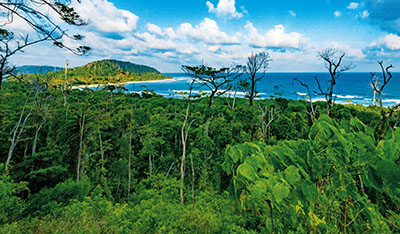
Clearing thick forests and undergrowth will have an adverse environmental fallout | Photo: Dhritiman Mukherjee |
Third, the economic rationale. The proposed commercial port will face stiff competition from other existing ports including an upcoming one being built by Indonesia in partnership with India in Sabang, just 190 km from Great Nicobar. It will require considerable capital and logistics. Have viability and profitability been seriously examined?
Besides, post-construction, there is the environmental fallout. Setting up the project will require clearing forests, dredging, landfills, hill slope cutting, change in water courses. This, in turn, will result in erosion, environment degradation, pollution and adverse socio-cultural fallouts. A lot of services to build and sustain such construction work will be required.
Fourth, there is concern about the people living on the island, who are Scheduled Caste and PVTGs (Particularly Vulnerable Tribal Groups). The development they want differs vastly from what is being currently created.
The indigenous islanders have been relocated twice. In the 1960s they were relocated to make way for settlers. Then they were relocated during the tsunami of 2004, rendering them internally displaced people on their own island. They want to return to their old location in the southeast and southwest part of the coast which is now part of the project area.
Even their basic needs are not being fulfilled. The North-South road, a key artery, is in disrepair, there are no proper health services, and schools lack teachers. For higher secondary education, young students have to relocate from the island. Transport is a problem. Helicopter services are not accessible to all, ships are insufficient. There is a shortage of petrol and LPG cylinders as well.
Fifth, the signatories dispute that policies for indigenous communities have been respected and implemented. The rights of indigenous communities under the Forest Rights Act have been violated. The Andaman and Nicobar Islands (Protection of Aboriginal Tribes) Regulation, 1956, and the Shompen Policy have been ignored to give clearances.
They point out there’s been no engagement with the Shompen or Great Nicobarese to understand their perspectives on the project. Not a single person in the administration or the Adim Janjati Vikas Samiti (AJVS) can understand the Shompen language. Both the AJVS and the directorate of tribal welfare have not engaged with the communities.
As mandated by the Environment Clearance, a committee for monitoring tribal issues has been set up. It does not have a single anthropologist familiar with the two indigenous communities, they write. This committee has not met the Nicobarese Tribal Council which of its own volition has been writing to the Andaman and Nicobar Administration even before the environmental clearance was granted, expressing their disagreement with their lands being designated as project area and their traditional resource management practices not being recognized for conservation. The council was even omitted from a social impact assessment for a trunk road infrastructure project, allege the signatories.
After a recognition of forest rights (RoFR) certificate was issued, certifying that rights under the FRA have been recognized, the Galathea Wildlife Sanctuary was denotified and three new sanctuaries were notified without any consultation with the islanders who are the traditional owners and guardians of the island.

No ecological survey or biodiversity assessment was carried out to establish the significance of the area being notified before declaring the three wildlife sanctuaries though this is mandated under the Wild Life Protection Act, 1972.
Last, the letter questions the studies being carried out and the mitigation measures being put in place by various government-run institutions. For example, the Zoological Survey of India (ZSI) and the Wildlife Institute of India (WII) were given the task of drawing up 10-year conservation and management plans for megapodes, corals, leatherback turtles, crocodiles, and mangroves.
These include proposals to translocate coral colonies and crocodiles from Galathea Bay, build artificial enclosures for megapodes, reduce the approach way from 3 km to 300 m for the leatherback turtles who come to nest at the bay and much more. The plans proposed by the research institutes have been deemed unscientific, illogical and baseless mitigation strategies by experts, states the letter.
The ZSI, WII, Salim Ali Centre for Ornithology and Natural History (SACON) and Botanical Survey of India, all government-run bodies, have been appointed members of the biodiversity monitoring committee, creating a conflict of interest.
Instead, the signatories recommend independent institutes be made members of the committee and that all mitigation and management plans be subjected to scientific scrutiny and uploaded on the government’s PARIVESH portal. ν
Comments
Currently there are no Comments. Be first to write a comment!