



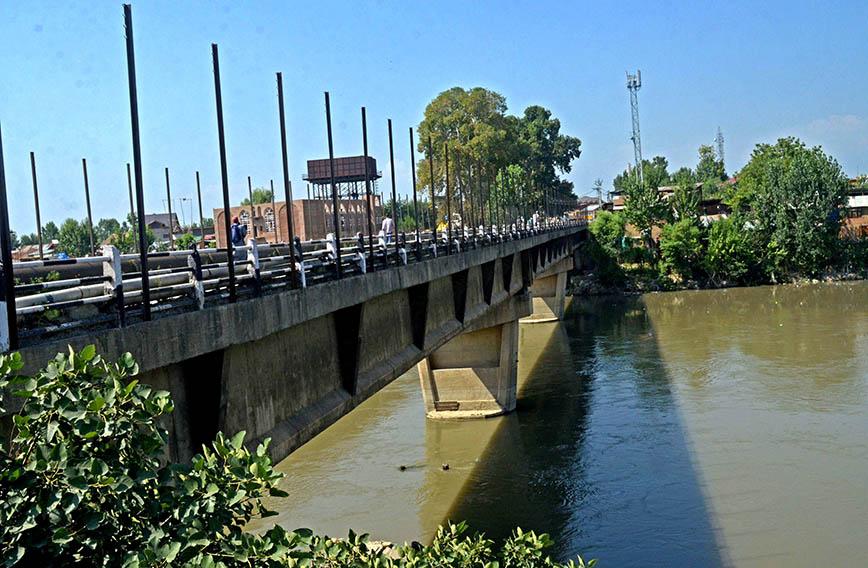
Bridges over the Jhelum are being fenced to prevent distressed young people from plunging to death | Civil Society picture/Bilal Bahadur
Youth suicides worry Srinagar
Jehangir Rashid, Srinagar
Mahi (name changed), a resident of Srinagar, was devastated when she scored low marks in her Class 10 exams. Unable to come to terms with her results, and fearful of her family’s disapproval, she took the extreme step of ending her life by jumping into the Jhelum river from a bridge.
Junaid (name changed), also a resident of Srinagar, reached the Rajbagh area to die by suicide. He too planned to jump off a bridge into the Jhelum. But a relative spotted him just in time. When asked why he was killing himself, he replied that his family was harassing him since he had failed to find a job after graduating with a professional degree.
To prevent youngsters from jumping off bridges, the district administration of Srinagar has decided to fence the bridges as quickly as possible. The modus operandi of distressed people is to stand on top of a bridge and then plunge to their deaths in the Jhelum. Fencing is expected to be completed soon.
But it may not stem what appears to be a rising trend of suicide. No data has as yet been collected. The reasons for suicide are generally failure in exams, financial instability, or the break-up of a love affair. Generally, the age group most prone to suicide is 18 to 25 years.

Since this is a subject that’s taboo in Kashmiri society, not many are willing to talk openly about it. So the conversation surfaces in social media and then becomes a hot topic. Different social media channels resort to non-stop reporting of suicide cases. This is worrying psychiatrists and mental health counsellors.
Prof. Arshad Hussain, a reputed psychiatrist, says that the factors contributing to suicide and its prevention are complex and have not been fully understood. But the media can play a significant role in either enhancing or weakening suicide prevention efforts.
“The complexity of factors contributing to suicides calls for nuanced reporting, steering clear of oversimplification. Celebrity suicides warrant particularly cautious handling due to the phenomenon of copycat suicides. In these instances, the focus should be on celebrating the positive contributions and achievements of the celebrity, featuring images from happier times,” says Dr Hussain, who is part of the faculty at the Government Medical College, Srinagar. He also works at the Institute of Mental Health and Neuro Sciences (IMHANS), Srinagar.
“Media reports on persons who were in adverse life circumstances but managed to cope constructively with their suicidal thoughts have been associated with a decrease in suicidal behaviour. Further studies suggest that educative media portrayals featuring how to cope with suicidal thoughts may help reduce suicidal behaviour,” said Dr Hussain.
Information about support resources, like suicide prevention centres, crisis helplines, and health and welfare professionals should be provided at the end of every programme, he suggests. Information about where to seek help should include services that are recognized in the community as being of high quality and accessible 24/7.
“Apparent changes in suicide statistics should be verified, as they may signal temporary fluctuations. The phrase ‘committed suicide’ implies criminality and unnecessarily increases the stigma experienced by those who have lost a person to suicide. Particular care should be taken by the media not to promote certain locations as suicide sites,” said Dr Hussain.
“Research has indicated that sensationalist portrayal of suicide on-screen and in the theatre can lead to subsequent imitation suicides and suicidal attempts. Those involved in the development or production of content for cinema, stage and screen should exercise caution in depicting suicide in order to reduce the risk of causing harm,” he said.
Mental health professionals also say Kashmiri society should overcome its hesitation and start talking about suicide and mental health issues more openly.
Wasim Kakroo, consultant clinical psychologist, Centre for Mental Health Services, Rambagh, Srinagar, says that the reverse happens. Instead of speaking with compassion and understanding, a vilification campaign is carried out against the person who takes this extreme step. People should understand that taking such a step is not easy. The person who tries to die by suicide does so because they feel helpless and is pushed to the wall. There could also be biological factors or adverse childhood experiences like bullying in school or domestic violence, he points out.

Kakroo is emphatic that the taboo attached to mental health issues needs to be overcome. Parenting has to be in tune with contemporary life situations. Parents should be friendly and not strict with their children.
“The parents have to maintain a fine balance. They need to be friendly with children and at the same time the activities of children have to be monitored. Moral education needs to be given to children and they should be asked to follow religious obligations on a regular basis,” says the psychologist.
Kakroo suggests that mental health awareness should be made part of the curriculum from primary school onwards. This, he says, will encourage children to speak about mental health issues and teachers will be able to come up with specific solutions according to the emerging situation.
“Schools have to be more accommodative towards children and they should look into complaints against a child in a broader form. Since the National Education Policy (NEP) 2020 has asked schools to appoint a full-time counsellor, it should be done in letter and spirit. The time has come for more focus on emotional quotient (EQ) rather than intelligence quotient (IQ),” says Kakroo.
Since a stigma is attached to this social problem in Kashmir, most religious preachers and scholars are unwilling to talk about mental health issues. A campaign and the participation of religious leaders is important.
Comments
Currently there are no Comments. Be first to write a comment!