



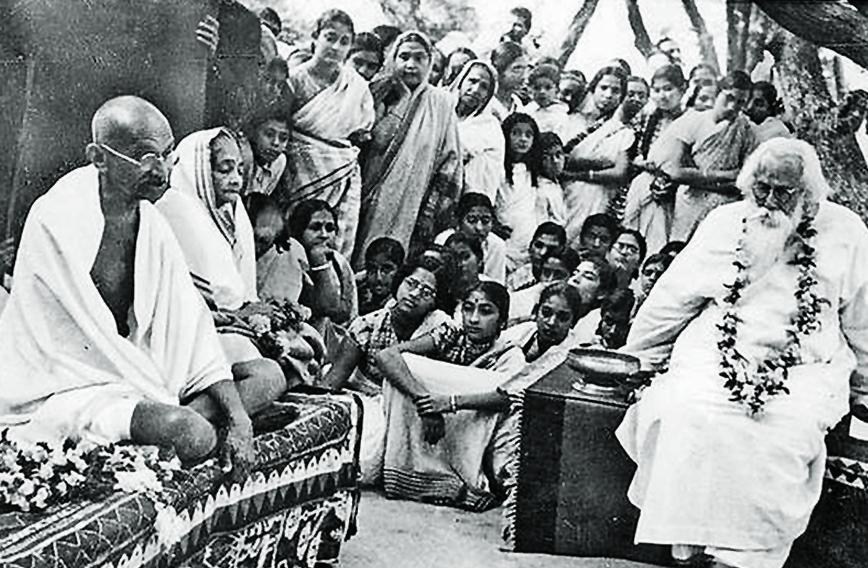
Gandhi tried to convey ethical and spiritual values through music
Gandhi’s bhajans are melodies of nonviolence
Rajdeep Pathak
Mahatma Gandhi’s life was deeply intertwined with music particularly devotional songs known as bhajans. These simple yet powerful melodies served as a source of solace, strength, and inspiration, fuelling his unwavering commitment to nonviolent resistance and social justice.
The focus of songs on divine love, humility, and selfless service, resonated deeply with Mahatma Gandhi’s philosophy of satyagraha (the quest for truth). He once stated, “My life is an experiment in living.” Music, for Gandhi, was an integral part of this experiment, a tool for self-discovery and spiritual growth.
Gandhi’s deep connection to music stemmed from his upbringing. In his autobiography, The Story of My Experiments with Truth, he recounts how his mother, Putlibai, often sang devotional songs, instilling in him a love for religious music. This early exposure laid the foundation for his lifelong appreciation of bhajans by saints and seers.
During his formative years in South Africa, Gandhi found solace and strength in music. John Henry Newman’s hymn, “Lead, Kindly Light”, inspired him and guided his path in dark times. He regarded music as a spiritual companion and a catalyst for self-purification, resilience, and moral awakening. His use of bhajans as part of his daily routine and political movements highlights the importance of music both in his personal life and the collective consciousness of India’s freedom struggle.

One of the songs that had a lasting impact on him was “Vaishnava Jana To,” composed by the 15th-century Gujarati poet, Narsinh Mehta. The song’s central themes of selflessness, compassion, and empathy resonated deeply with Gandhi’s moral and ethical beliefs. As historian Judith Brown observes, “Gandhi’s engagement with music was not about aesthetics but about its power to convey ethical and spiritual truths.”
For Gandhi, bhajans were more than just melodies; they were a form of prayer and a tool for spiritual discipline. He began every day with a prayer meeting where bhajans were sung, setting a tone of peace and reflection for the day ahead. These meetings were inclusive, inviting people from diverse backgrounds and faiths, thus embodying Gandhi’s vision of communal harmony. Scholar Raghavan Iyer writes in his 1973 book, The Moral and Political Thought of Mahatma Gandhi: “Through music, Gandhi sought to dissolve barriers of caste, creed, and religion, fostering a sense of unity and shared purpose.”
Mahatma Gandhi recognized the unifying power of music and leveraged it to inspire mass participation in the independence movement. Bhajans sung during marches and protests provided participants with moral strength and a sense of collective identity.
In his book, Gandhi: The Years That Changed the World, 1914-1948, historian Ramachandra Guha mentions that “Gandhi’s understanding of music as a communal activity allowed him to harness its power to mobilize and sustain resistance against colonial rule.”
With the belief that music could transcend linguistic and cultural barriers, fostering a sense of national unity, Gandhi encouraged the singing of folk songs and traditional music from different regions of India, promoting cultural diversity and celebrating the rich tapestry of Indian culture.
The simplicity of bhajans — their repetitive structures and profound messages — made them accessible to people from all walks of life. Singing together, regardless of one’s caste or creed, embodied the principles of equality and shared humanity central to Gandhi’s vision.
During the Dandi March in 1930, bhajans played a pivotal role in maintaining the participants’ morale and focus. Songs like “Vaishnava Jana To” and “Raghupati Raghav Raja Ram” echoed through the journey, reinforcing the principles of nonviolence and self-discipline.
Gandhi believed that the repetitive singing of such songs cultivated an inner strength that was essential for enduring the hardships of civil disobedience. This perspective is echoed by psychologist and Gandhian scholar Arun Kumar, who states, “For Gandhi, music was a form of therapy, a way to connect with the divine and find solace amid chaos.”
Mahatma Gandhi often combined spinning on the charkha (spinning wheel) with the singing of bhajans. The charkha, a symbol of self-reliance and nonviolence, became a focal point of Gandhi’s Swadeshi movement. He encouraged people to spin while chanting bhajans, creating a meditative practice that combined physical labour with spiritual introspection. The connection between the charkha and bhajans also highlighted Gandhi’s philosophy of integrating the spiritual and the material. By emphasizing self-reliance through spinning and spiritual growth through music, Gandhi sought to create a holistic approach to personal and national liberation.
“In his communication with musicians and artists, he often referred to the importance of the music of life and extolled the gentle hum of the wheel, the powerful music of the march and the melody of prayer and immersion,” writes author Lakshmi Subramaniam in Singing Gandhi’s India – Music and Sonic Nationalism.

Subramaniam further observes: “It was through music that rich and emancipating religious ideas had been communicated and rendered intelligible to the vast population, such as the work of poets and singers like Ramdas and Narasinh Mehta who conveyed the message of the Gita. It was thus essential for such music to permeate the souls of the devotees, who would then be ready to embark on the moral and political struggle.”
Pandit Narayan Moreshwar Khare, a musician and freedom fighter, worked with Gandhi at the Sabarmati Ashram in Ahmedabad as his ashram musician. Gandhi found in him both a practitioner and a satyagrahi who did not make a distinction between art and life and, to that extent, embodied the principles that Gandhi adhered to.
Mahatma Gandhi’s relationship with music, particularly bhajans, reflects his belief in the transformative power of art to inspire personal and collective growth. Through devotional songs, Gandhi sought to instil a sense of moral responsibility, spiritual resilience, and communal unity among his followers. Bhajans became not only the soundtrack of his life but also a cornerstone of India’s freedom struggle, harmonizing the quest for independence with the pursuit of inner peace.
Rajdeep Pathak is programme executive, Gandhi Smriti and Darshan Samiti
Comments
Currently there are no Comments. Be first to write a comment!