



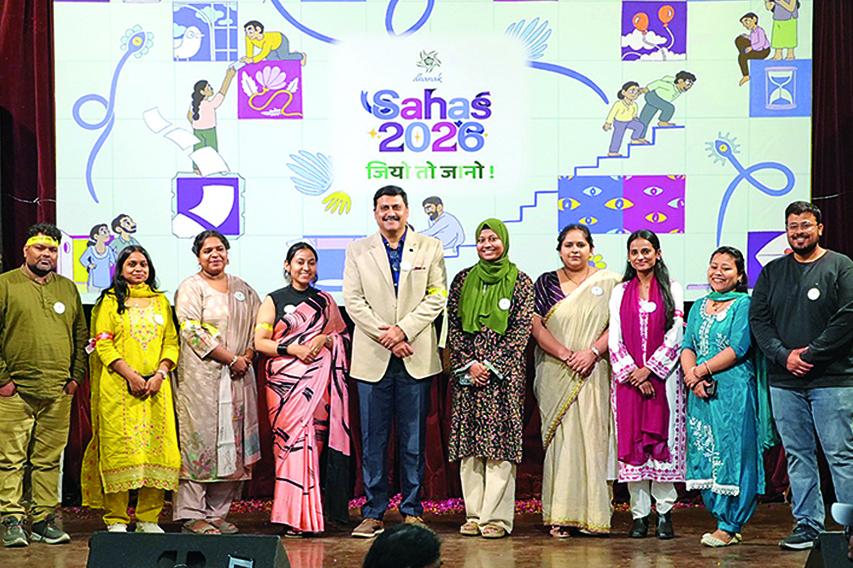
Asif Iqbal (centre) with the Dhanak of Humanity team
Concern over Gujarat law on parental consent
Aiema Tauheed, Kolkata
When two adults wish to marry, should the consent of their parents become legally compulsory? Most couples whose choice of partner wasn’t approved by their parents say no, it is not at all necessary.
“I wouldn’t have been as happy as I am today if I sought my parents’ approval. They would have got me married to someone else, and I would have been miserable,” says Anushree Dhaoriya, reflecting on her inter-caste marriage with Rajiv Samanto.
Both work as house painters on a daily wage basis. Anushree, from a Scheduled Caste, first met Rajiv, who is an upper caste, in Medinipur, West Bengal.
She was cycling down the road when his cycle crashed into hers. He apologized with chocolates and slipped his phone number into the packet. For the next six months they spoke over the phone.
When her parents discovered her friendship they beat her so badly her glass bangles broke and the shards pierced the skin of her wrists. The scars are still visible. Soon after, she eloped with Rajiv. When she called her parents, they said, “We are dead to you.” Rajiv’s family also rejected the marriage. The couple is happy with the life they’ve built away from their disapproving parents.
Yet, the government wants to weaponize parental consent for inter-caste and inter-faith marriages.

On February 20, 2026, Gujarat’s Deputy Chief Minister, Harsh Sanghavi, proposed an amendment to the Gujarat Registration of Marriages Act, 2006, seeking to formally involve parents in the marriage registration process.
According to the amendment, adults who wish to marry a person of their choice must declare that their parents have been informed, submit their identity proof, phone numbers and residential addresses. The Assistant Registrar would then notify the parents within ten days of receiving the application, and only after that would the marriage be registered.
 |
|
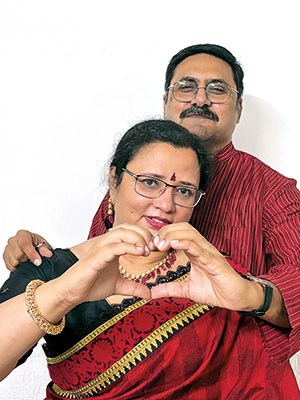
Asif Iqbal and Ranu Kulshrestha had an inter-faith marriage |
Asif Iqbal, co-founder of Dhanak of Humanity, an organization that helps couples trying to marry on their own, says, “Across states, we are seeing efforts to curb what they call ‘love marriages’. It began with Uttar Pradesh, then Uttarakhand, and now other states are following suit.”
“UP’s law initially focused on preventing the marriage itself. Uttarakhand extended it to live-in relationships. And now the trend is to legalize parental consent,” he says. It bolsters the overweening importance placed on familial consent.
“If two consenting adults can’t legally marry unless their parents approve then I’m afraid our generation will lose the courage to even pick such battles,” says Sagar Garg, who married Varsha Maurya in 2024 without parental approval. They chose to cement their relationship through a religious ceremony.
Maurya is an OBC from the Koeri community of Uttar Pradesh. Garg is a general category Baniya. But caste never mattered to them. Until their families asked. Maurya was warned she’d face discrimination post-marriage. They held firm, their shared love for music, books and social justice anchoring them.
Battle to marry
Why do adults who decide to marry a person not of their religion or caste face such a mountain of disapproval — family, society, vigilante groups? Why this obsession around endogamy?
Iqbal points to control over women’s sexuality and reproduction. “Women are considered the repositories of honour, values, social status, everything, by the family,” he says.
 |
|
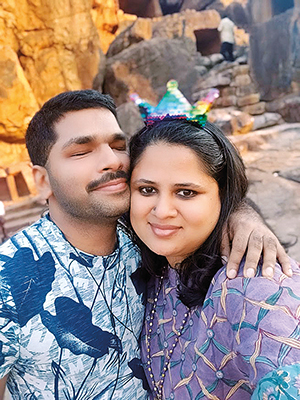
Vinaya Kurtkoti married Tony Kurian, a Syrian Christian |
Power and property also matter. “If the boy is from a marginalized family, a Dalit, an Adivasi or a Muslim, then they fear losing their property and of them becoming equal to you,” says Iqbal.
Since 2004, Dhanak of Humanity has been working with couples facing family wrath for choosing their partners. Dhanak was started by a small group of inter-faith couples who wanted to help others like them who opted for a civil marriage.
Despite parental disapproval, Iqbal married Ranu Kulshrestha, a Hindu, in January 2000. They met as students studying social work at Jamia Milia Islamia in New Delhi.
Their main hurdle came at the marriage registrar’s office in Noida. The sub-divisional magistrate (SDM) refused to register their marriage citing concerns over ‘law and order’. The couple sought the help of an advocate and got married in Delhi.
“But Dhanak is not a marriage bureau. Marriage is only the first stop of the journey of troubled couples,” says Iqbal. Dhanak offers support. It provides legal and financial help, if required, shelter and counselling for mental health and relationships.
Laws which make parental consent compulsory will certainly impact people.
“Couples from Gujarat who are facing a crisis, being forced into an arranged marriage or facing a threat to their lives, will run away to different states and get married. They will find their way,” he says.
The immediate consequence is that the couple becomes displaced, uprooted from their families and the threat of violence shadows them. Many couples from across the country come to Delhi, seeking help.
“In a crisis situation, a lot of couples decide to have a religious marriage because that’s instant,” he says. “When you are in a crisis, you cannot wait for a civil marriage under the Special Marriage Act, because it takes a lot of time and your entire identity, location, everything gets disclosed,” explains Iqbal.
The Special Marriage Act remains one of the few legal options for such couples, but it is not widely used. “Very few people can use it,” he says, noting that couples, especially from less privileged backgrounds, often resort to religious ceremonies because they are quick and easy.
It is inter-faith couples who become the softest targets. Asmita Konwar, an Ahom from Assam, met Hussain Ahmed from Varanasi on a work trip. They fell in love and by 2017 they were in a live-in relationship. They waited for six years for their families to agree. Konwar’s family feared she would be forced into a burqa and polygamy.
 |
|
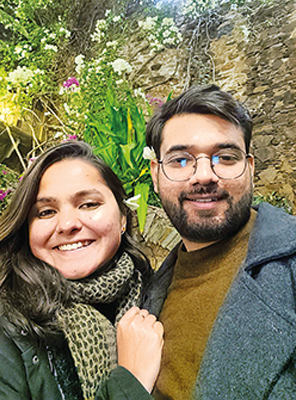
Varsha Maurya and Sagar Garg belong to different castes |
Ahmed’s family, on the other hand, thought Assam was primitive and feared violence against their community. Tensions eased only when the families met in 2022.
In 2023 they married through an Ahom ceremony as well as a nikah ceremony. They also registered their marriage, finally overcoming years of resistance from both families.
Today, the two families have cordial relations. “I’ve not changed. I don’t wear the burqa and I’m not expected to read the Quran,” says Konwar. “In fact, Hussain fasts during Ramzan and Shivratri. This Shivratri, he influenced me to fast too,” she says, fondly.
Konwar values parental consent, which is why they waited six years. Yet, she believes making it a legal requirement would take away choice. “Parental consent already exists socially and culturally. Making it legal would just fortify it,” she says.
Vinaya Kurtkoti from Pune married Tony Kurian, a Syrian Christian from Kerala who is three years younger to her and lives with a disability. She counts herself lucky to have faced little resistance. The couple registered their marriage in 2022. “There is value for parental consent but it shouldn’t be the sole deciding factor,” she says.
Facing family hostility
Actually, the state is expected to provide protection mechanisms to threatened couples such as safe houses. Gujarat, for instance, has established a safe house in Gandhinagar.
“But forget about inter-faith couples, they are not even using it for inter-caste couples or couples who are facing threats,” says Iqbal. “I think the intention is very clear. The state does not consider itself responsible for those couples. It becomes the parents’ responsibility. If parents are ready to accept it, fine. Else, we are going to separate them.”
Social conditioning shapes how couples deal with such conflicts. The emphasis on reconciliation and parental approval, before and after marriage, runs deep.
“We ask girls and boys who are trying to convince their parents: don’t you think your marriage can sustain without their presence or absence?” he says. For many, the question itself is difficult. “They have not been brought up with the thought that you are independent, you can choose, you can decide.”
It is this mindset that makes it a challenge to frame a separate law against honour crimes. Even when women flee violence after their relationship is discovered, many hesitate to file complaints against their parents.
“She’s not ready to name her parents. She’s not ready to write anything against them. The belief that parents are always right runs deep, that whatever they do is correct, and ultimately we want to be under their patronage.”
But a separate law to prevent killings that are largely underreported is needed. Formal recognition of honour crimes would make it harder for families to pass off such killings as suicides or ordinary murders, he says.
Despite occasional bias, Iqbal remains hopeful about the judiciary, which often becomes the last resort for couples. “By and large, the judiciary has been supportive of a couple’s right to choose,” he says, noting that courts have upheld this right under Article 21 of the Constitution and generally favour love marriages.
“Recently, the Allahabad High Court in a judgment allowed live-in relationships. So, it all depends on the judge, but more or less the judiciary does not disapprove.” But access to legal remedies often depends on whether couples can afford a lawyer.
In Shakti Vahini v. Union of India (2018), the Supreme Court held that consent of family, community or clan is not necessary when two adults decide to marry and that any interference with such a choice violates constitutional liberty.
The apex court also issued preventive, remedial and punitive directions to states to protect couples from honour crimes and community interference, including setting up special cells in every district to receive complaints and provide protection.
However, there are gaps in implementation. “All the states and Union Territories complied in writing,” Iqbal says. “But take Delhi. The city has 15 police districts. Each district is supposed to have one special cell for couples. Out of 15 districts, only one special cell is working. We know because we are in that district. The remaining 14 districts are either oblivious to this direction or, if they are aware, they are not practising it.

"Instead, they follow the conventional route. The boy and girl are separated. The girl is kept in Nari Niketan, the women’s shelter home, and the boy is set free. So the idea becomes to separate them.”
The contradiction runs deep. “Unfortunately, the government, on the one hand, is giving in writing that it is complying with the Supreme Court directions. On the other hand, they are practising the same old conventional method of separating the couple,” he says.
If a couple seeks help, the police often fall back on conventional procedure. They ask for the marriage certificate and then inform the families. And once the families step in, chances of the couple being allowed to stay together become almost negligible.
“In most cases the families are informed because when a girl or a boy leaves home, a missing complaint is usually filed so the role of the police becomes very important,” explains Iqbal. However, it is very rare for a couple to approach the police, seeking protection.
Comments
-

Sampreeti Purohit - May 11, 2026, 2:43 p.m.
The very inception of an idea as "parental consent to marriage", defeats the sense of individuality, ownership over life and the concept of adulthood. All of which deeply assault one's democratic fundamental right to life and liberty. It aggravates and saddens me that even in the 21st Century we are debating the reinforcement of an idea so regressive. Anyone who isn't as agitated certainly prioritizes control over love; in parenthood and in relationships. Adulthood is tied not just with freedom to make choices but an inherent empowerment, responsibility and confidence to make a right choice. It is disappointing that one would go to the extent of killing and violence instead of merely accepting an idea of love different from their own.